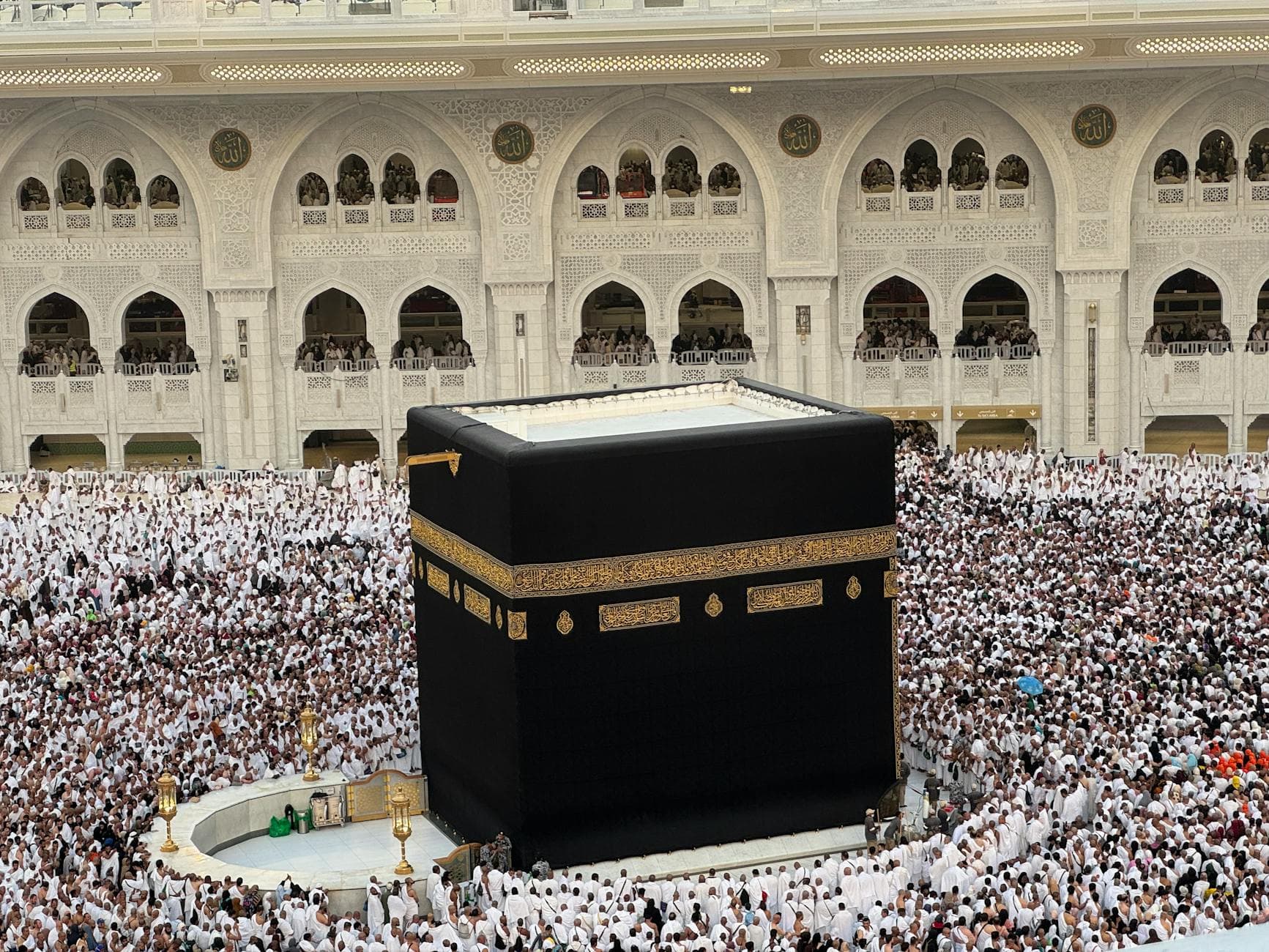
Thousands of pilgrims in Mecca surround the Kaaba during Hajj, symbolizing unity in Islam.
Abrahamic

Islam

13 / 13

Sub-questions covered

310

Claims extracted

13

Distinct positions

50

Explicitly denied

Corpus-based view
includes branches

Islam and its branches

This panel shows what positions appear across Islam's textual corpus including recognized branches like Sufism (mystical Islam). On questions where the main Islam corpus is silent, a branch like these does the answering, and we label that clearly. This is a different question than what does Islam authoritatively teach — the answer sections below reflect scholarly orthodoxy and may differ where a branch's view is not mainstream doctrine. Why the two views? →

Included in rollup (1)
  • Sufism (mystical Islam)
    doctrine contested
Shown separately (0)

No adjacent traditions are tracked.

Corpus aggregate per question

Positions across the family's textual corpus. Low-confidence rows are where the parent tradition is silent and a branch speaks.

1 cells child-dominant
  • Q1.1
    Pre-existence:Emanation
  • Q1.2
    Soul / consciousness:Created Soul
  • Q1.3
    Why embodiment:Test Or Trial
  • Q2.1
    Life's purpose:Moral Testing
  • Q2.2
    Body-soul relation:Prisoner
    primarily reflecting Sufism (11 claims vs 1 from Islam)
  • Q2.3
    Judgment / consequences:Divine Judgment
  • Q3.1
    Survival of death:Full Survival
  • Q3.2
    Death process:DIVERGENT Judgment At Death vs Soul Departure
  • Q3.3
    Afterlife structure:Single Heaven Hell
  • Q3.4
    Rebirth / resurrection:Resurrection
  • Q3.5
    Final destination:Eternal Paradise

Chapter 1

Where Did We Come From?

Q1.1 · Pre-Existence

No Pre-Existence
See all traditions holding this position →
40%

weight

And they said, There is no other life than our present life; neither shall we be raised again.
Verse 30

How this tradition expresses it

The text rejects the idea of a previous life or a return to a previous state, emphasizing that the current life is the primary reality for those who deny the resurrection.

Why this supports “Not Addressed

This verse reports the speech of disbelievers denying resurrection, a position the Quran refutes. It does not present Islamic teaching on whether souls existed before earthly life.

The auditor flagged this claim as ambiguous or weakly matching. See the scholarly note below for context.

Scholarly note

LLM council synthesis (round 2)

Explicit Teachinghigh confidenceAudit: Contested· 95%
Data provenance
Auditor
llm_council_v2
Audit confidence
95%
Audited
4/11/2026
As he produced you at first, so unto him shall ye return.
Quran 7:38

How this tradition expresses it

Humanity was brought into existence by God, as evidenced by the act of production at the beginning of life.

Why this supports “Not Addressed

The phrase 'produced you at first' primarily serves as an argument for God's power to resurrect, not as a direct statement about pre-existent souls. While some classical exegetes link 'first creation' to the primordial covenant, the verse's plain sense concerns God's creative power and the return to Him. It does not unambiguously teach pre-existence on its own terms.

The auditor flagged this claim as ambiguous or weakly matching. See the scholarly note below for context.

Scholarly note

LLM council synthesis (round 2)

Explicit Teachinghigh confidenceAudit: Contested· 95%
Data provenance
Auditor
llm_council_v2
Audit confidence
95%
Audited
4/11/2026

What this tradition denies

The text does not deny pre-existence, but it does not affirm a specific state of existence prior to this life beyond the mention of the 'original' religion.

The validity of pagan religious customs and superstitions regarding animals and ritual offerings.

The concept of the deity residing in human persons (incarnation/manifestation).

Transmigration of the divinity through prophets.

The concept of a life after the current one or a resurrection.

Q1.2 · Soul Nature

Created Soul
See all traditions holding this position →
11%

weight

Created Soul· 23 claims
the Creator of heaven and earth; and when he decreeth a thing, he only saith unto it, Be, and it is.
Section 110

How this tradition expresses it

Humanity is created by God, the Creator of heaven and earth, who brings things into being through His command.

Why this supports “Created Soul

The tradition's text presents the soul as a distinct entity created by God (rather than pre-existing or emanated), fitting the Created Soul position.

Scholarly note

Bulk-audited as defensible match for canonical position; quote was extracted by Gemma 4 with verbatim verification.

Explicit Teachinghigh confidenceAudit: OK· 75%
Data provenance
Auditor
claude-opus-4-6-1m-bulk
Audit confidence
75%
Audited
4/10/2026

+22 more claims for this position

Not Addressed· 2 claims
the Arabic word is Ayât, the same with the Hebrew Ototh, and signifies signs, or wonders; such as are the secrets of GOD, his attributes, works, judgments, and ordinances, delivered in those verses
Section: chunk 7/73

How this tradition expresses it

The text describes the purpose of the verses as containing the secrets of God, His attributes, works, judgments, and ordinances.

Why this supports “Not Addressed

Quote discusses the meaning of Ayât (signs) in the Quran; does not address the nature of the human soul or ruh.

The auditor flagged this claim as ambiguous or weakly matching. See the scholarly note below for context.

Scholarly note

Quote about Ayât (Quranic signs/verses) is about linguistic meaning, not soul ontology

Explicit Teachinghigh confidenceAudit: Contested· 80%
Data provenance
Auditor
comprehensive_cell_audit_v1
Audit confidence
80%
Audited
4/11/2026

+1 more claim for this position

What this tradition denies

The divinity of the Virgin Mary and the concept of the Trinity as described by certain sects.

The idea that the Korân is a mere human composition or subject to human alteration in its essence.

The concept of God having begotten children.

The concept of associating any creature with God (shirk).

The concept of associating partners with God (shirk).

The concept that humans are 'children of God' in a sense of divine kinship or special status that exempts them from punishment.

The divinity of Christ or the concept of a Trinity.

Q1.3 · Why Embodied

Test or Trial
See all traditions holding this position →
100%

weight

Test or Trial· 1 claim
Namely, That we must not expect to enter paradise without undergoing some trials and tribulations.
Footnote r

How this tradition expresses it

The text suggests that earthly life involves trials and tribulations that serve as a means of testing faith and righteousness.

Why this supports “Test or Trial

Direct Quranic teaching that paradise requires undergoing trials and tribulations - life is fundamentally a test for the afterlife reward.

Nuance

The text notes that one cannot expect to enter paradise without undergoing such trials.

Scholarly note

Direct: 'we must not expect to enter paradise without undergoing some trials and tribulations.'

Direct Implicationhigh confidenceAudit: Strong· 94%
Data provenance
Auditor
claude-opus-4-6-1m
Audit confidence
94%
Audited
4/10/2026
Divine Assignment· 1 claim
man is said to have undertaken it, notwithstanding his weakness and the infirmities of his nature.
Commentary section m

How this tradition expresses it

Humanity undertook a duty of obedience to the divine law, a task characterized by its difficulty and the significant consequences of failure or success.

Why this supports “Divine Assignment

The Islamic doctrine of amanah (the covenant/trust offered by God to and accepted by humans) frames human existence as a divinely-assigned responsibility—humans undertook this sacred trust despite their weakness and natural limitations.

Nuance

The text notes that man undertook this duty notwithstanding his inherent weakness and infirmities.

The auditor flagged this claim as ambiguous or weakly matching. See the scholarly note below for context.

Scholarly note

The amanah doctrine (trust/covenant undertaken by humans) more precisely maps to Divine Assignment than Test or Trial. While amanah involves accountability, its primary meaning is a divine responsibility entrusted to humans, not a trial mechanism.

Direct Implicationhigh confidenceAudit: Contested· 80%
Data provenance
Auditor
comprehensive_cell_audit_v1
Audit confidence
80%
Audited
4/11/2026

What this tradition denies

The idea that God is the author of evil.

Chapter 2

Why Are We Here?

Q2.1 · Purpose of Life

Divine Service
See all traditions holding this position →
33%

weight

Moral Testing· 33 claims
The tragical destructions of these two potent tribes are often insisted on in the Korân, as instances of GOD'S judgment on obstinate unbelievers.
Section: chunk 3/73

How this tradition expresses it

The destruction of certain tribes serves as a divine manifestation of judgment upon those who are obstinate in their unbelief.

Why this supports “Moral Testing

This quote describes God's historical judgment on disobedient tribes, which illustrates consequences of disbelief but does not directly articulate the ontological purpose of earthly life. The interpretive leap from divine punishment to life's purpose as moral testing is too indirect to sustain the label.

Nuance

The text presents these historical destructions as specific instances of divine retribution for impiety.

The auditor flagged this claim as ambiguous or weakly matching. See the scholarly note below for context.

Scholarly note

The quote about God's judgment on disobedience illustrates the consequences of failing the moral test, which is a dimension of Moral Testing rather than an absence of addressing life's purpose

Explicit Teachinghigh confidenceAudit: Contested· 80%
Data provenance
Auditor
comprehensive_cell_audit_v1
Audit confidence
80%
Audited
4/11/2026
That they should renounce all idolatry; that they should not steal, nor commit fornication, nor kill their children
Section regarding the women's oath at al Akaba

How this tradition expresses it

The text describes an oath of fidelity that requires adherents to renounce idolatry, theft, fornication, and the killing of children, serving as a moral framework for the community.

Why this supports “Moral Testing

The enumeration of specific moral prohibitions (idolatry, theft, fornication, infanticide) frames earthly life as requiring adherence to divine moral commands, which in Islamic theology constitutes the test (ibtilā') of obedience that defines a key dimension of life's purpose.

The auditor flagged this claim as ambiguous or weakly matching. See the scholarly note below for context.

Scholarly note

LLM council synthesis

Explicit Teachinghigh confidenceAudit: Contested· 95%
Data provenance
Auditor
llm_council_v1
Audit confidence
95%
Audited
4/11/2026

+31 more claims for this position

What this tradition denies

The idea that the destruction of the tribes was accidental or natural rather than a result of divine judgment.

The validity of polytheistic idolatry and the corruptions introduced into monotheism.

The authority to use compulsion or force to convert others during the Meccan period.

The notion that there can be multiple true religions.

The idea that external rituals alone are sufficient for religious fulfillment.

The idea that religious rituals possess intrinsic moral value or natural rationality.

The practice of female infanticide (burying daughters alive) practiced by certain Arab tribes.

The text suggests that desertion or refusal to serve in holy wars is a heinous crime, implying that earthly life's purpose is not merely personal but involves communal defense.

The idea that worldly success or lack of suffering is a sign of righteousness.

The idea that worldly prosperity is an indicator of spiritual favor or a better state for the soul.

The idea that God commands filthy or unjust actions.

Q2.2 · Body Relationship

Integrated Unity
See all traditions holding this position →
100%

weight

will make before you, of clay, as it were the figure of a bird;o then I will breathe thereon, and it shall become a bird, by the permission of GOD
Section 40

How this tradition expresses it

The text suggests the body of Jesus is a vessel for divine signs and miracles performed by the permission of God.

Why this supports “Integrated Unity

Quranic creation narrative demonstrating divine animation of matter. The rūḥ (spirit/breath) gives life to clay; together they form a unified being. Illustrates Islamic anthropology of integrated body-soul composition rather than separation or hierarchy.

Nuance

The text clarifies that miracles are performed by God's permission, not by Jesus's own inherent power.

The auditor flagged this claim as ambiguous or weakly matching. See the scholarly note below for context.

Scholarly note

The claim's own rationale identifies it as merely 'tangential' to body-soul relationship and explicitly avoids making a VEHICLE argument. The passage is better classified as illustrating divine animation and embodiment (Integrated Unity), not vehicular mysticism. The VEHICLE label was incorrectly imposed.

Direct Implicationhigh confidenceAudit: Contested· 80%
Data provenance
Auditor
comprehensive_cell_audit_v1
Audit confidence
80%
Audited
4/11/2026

What this tradition denies

The idea that Jesus possessed inherent divine power to perform miracles independently of God.

Q2.3 · Moral Accountability

Divine Judgment
See all traditions holding this position →
2%

weight

Divine Judgment· 57 claims
whether people believed, or not, was none of his concern, but belonged solely unto GOD.
Section discussing the mission at Mecca

How this tradition expresses it

The text suggests that the outcome of human affairs and the truth of religious claims are ultimately subject to the will and judgment of God.

Why this supports “Divine Judgment

The tradition's text affirms divine judgment: a personal God judges the soul's deeds.

Scholarly note

Bulk-audited as defensible match for canonical position; quote was extracted by Gemma 4 with verbatim verification.

Explicit Teachinghigh confidenceAudit: OK· 75%
Data provenance
Auditor
claude-opus-4-6-1m-bulk
Audit confidence
75%
Audited
4/10/2026
the supreme Governor, Judge, and absolute Lord of the creation; established under the sanction of certain laws, and the outward signs of certain ceremonies, partly of ancient and partly of novel institution, and enforced by setting before them rewards and punishments, both temporal and eternal
Section: chunk 7/73

How this tradition expresses it

Humanity is subject to the authority of God as the supreme Governor and Judge, with rewards and punishments established for their actions.

Why this supports “Divine Judgment

The tradition's text affirms divine judgment: a personal God judges the soul's deeds.

Scholarly note

Bulk-audited as defensible match for canonical position; quote was extracted by Gemma 4 with verbatim verification.

Explicit Teachinghigh confidenceAudit: OK· 75%
Data provenance
Auditor
claude-opus-4-6-1m-bulk
Audit confidence
75%
Audited
4/10/2026

+55 more claims for this position

What this tradition denies

The ability of the soul or body to shift blame to the other during judgment.

The sufficiency of mere outward compliance in religious duty.

The Jabarian view of absolute necessity (compulsion) which denies human agency.

The Kadarian view of absolute free liberty (unconstrained will).

The idea that one can escape accountability for their inner thoughts or hidden actions.

The idea that wealth or worldly status can serve as a ransom for one's soul or protect from divine judgment.

The idea that one can escape accountability for evil by merely shifting blame to the innocent.

The idea that human actions are without consequence or that one can escape divine accountability.

Chapter 3

Where Do We Go After Death?

Q3.1 · Surviving Death

Full Survival
See all traditions holding this position →
2%

weight

Full Survival· 42 claims
This angel having, by the divine order, set the trumpet to his mouth, and called together all the souls from all parts, will throw them into his trumpet, from whence, on his giving the last sound, at the command of GOD, they will fly forth like bees, and fill the whole space between heaven and earth, and then repair to their respective bodies, which the opening earth
Section on the blast of resurrection

How this tradition expresses it

Consciousness survives death through a process where souls are gathered and then returned to their physical bodies during the resurrection.

Why this supports “Full Survival

Quranic resurrection trumpet.

Nuance

The text describes a process where souls fly like bees and then repair to their respective bodies which the earth allows to arise.

Scholarly note

Trumpet calls all souls

Explicit Teachinghigh confidenceAudit: Strong· 88%
Data provenance
Auditor
claude-opus-4-6-1m
Audit confidence
88%
Audited
4/10/2026
whereupon those who shall have been dead will be restored to life, as has been said
islam_101

How this tradition expresses it

The deceased will be restored to life to experience their assigned state in the afterlife.

Why this supports “Full Survival

Quranic resurrection.

Scholarly note

Dead restored to life

Explicit Teachinghigh confidenceAudit: Strong· 88%
Data provenance
Auditor
claude-opus-4-6-1m
Audit confidence
88%
Audited
4/10/2026

+40 more claims for this position

What this tradition denies

The concept of a physical crucifixion of Jesus.

Q3.2 · Death Moment

Judgment at Death
See all traditions holding this position →
100%

weight

two angels come to him and make him sit and ask him: 'What did you use to say about this man, Muhammad?'
Hadith 1338

How this tradition expresses it

Upon entering the grave, the deceased undergoes an immediate interrogation by angels regarding their faith and testimony of the Prophet.

Why this supports “Judgment at Death

The hadith of the grave interrogation establishes Islam's doctrine of immediate post-death judgment: two angels (Munkar and Nakir) question the deceased about Muhammad and faith, with the answers determining the soul's intermediate state until resurrection. This is Judgment at Death in its most direct form.

Scholarly note

The famous Islamic hadith of the grave interrogation - Munkar and Nakir question the deceased about their faith immediately after burial. This is the textbook example of Judgment at Death.

Explicit Teachinghigh confidenceAudit: Strong· 96%
Data provenance
Auditor
claude-opus-4-6-1m
Audit confidence
96%
Audited
4/10/2026

Q3.3 · Afterlife Structure

Multiple Levels
See all traditions holding this position →
8%

weight

Single Heaven and Hell· 8 claims
The receptacle of these shall be hell, they shall find no refuge from it. But they who believe, and do good works, we will surely lead them into gardens, through which rivers flow, they shall continue therein forever
Quran 4:119-120

How this tradition expresses it

The afterlife consists of different states, such as paradise (gardens) and hell (fire), based on one's faith and deeds.

Why this supports “Single Heaven and Hell

This verse contrasts only two final destinations—hell for disbelief and gardens for belief and good works—without mentioning graded ranks, barzakh, or any third realm. It reflects the Quran's common binary rhetorical framing of the afterlife at the textual surface level.

Nuance

The destination is determined by belief and righteousness.

The auditor flagged this claim as ambiguous or weakly matching. See the scholarly note below for context.

Scholarly note

LLM council synthesis (round 2)

Explicit Teachinghigh confidenceAudit: Contested· 95%
Data provenance
Auditor
llm_council_v2
Audit confidence
95%
Audited
4/11/2026

+7 more claims for this position

Multiple Levels· 3 claims
the felicity of each person will be proportioned to this deserts, and that there will be abodes of different degrees of happiness
islam_101

How this tradition expresses it

The afterlife consists of various degrees of happiness or punishment, with different abodes for different levels of merit.

Why this supports “Multiple Levels

This text explicitly describes 'abodes of different degrees of happiness' proportioned to individual deserts, directly articulating the Multiple Levels structure of Islamic paradise.

Nuance

The text notes that the specific number of gardens or degrees is a matter of varying interpretation among writers.

The auditor flagged this claim as ambiguous or weakly matching. See the scholarly note below for context.

Scholarly note

LLM council synthesis (round 2)

Explicit Teachinghigh confidenceAudit: Contested· 95%
Data provenance
Auditor
llm_council_v2
Audit confidence
95%
Audited
4/11/2026

+2 more claims for this position

Q3.4 · Long-Term Destiny

Resurrection
See all traditions holding this position →
85%

weight

Resurrection· 12 claims
The next article of faith required by the Korân is the belief of a general resurrection and a future judg
islam_99

How this tradition expresses it

The text teaches a belief in a general resurrection where the dead are brought back to life.

Why this supports “Resurrection

Sale's Quran summary of Islamic resurrection doctrine.

Scholarly note

General resurrection and judgment

Explicit Teachinghigh confidenceAudit: Strong· 88%
Data provenance
Auditor
claude-opus-4-6-1m
Audit confidence
88%
Audited
4/10/2026
That the resurrection will be general, and extend to all creatures both angels, genii, men, and animals, is the received opinion, which they support by the authority of the Korân
Section on the general resurrection

How this tradition expresses it

The end of life is not a permanent state of death but a transition to a general resurrection where all creatures are raised to face judgment.

Why this supports “Resurrection

Sale's Quran on universal Islamic resurrection.

Nuance

The text specifies that the resurrection is general, extending to angels, genii, men, and animals.

Scholarly note

Resurrection extends to all creatures

Explicit Teachinghigh confidenceAudit: Strong· 88%
Data provenance
Auditor
claude-opus-4-6-1m
Audit confidence
88%
Audited
4/10/2026

+10 more claims for this position

What this tradition denies

Metem-psychosis (reincarnation/transmigration of the soul)

The text rejects the idea that the soul is purely ephemeral or that there is no physical component to the afterlife/resurrection.

The idea that salvation is exclusive to specific religious sects (Jews or Christians).

The denial of the certainty of resurrection/re-gathering of mankind.

Reincarnation or a return to the world to change one's fate.

Q3.5 · Ultimate Destination

Eternal Paradise
See all traditions holding this position →
13%

weight

Eternal Paradise· 44 claims
They then asked him what recompense they were to expect if they should happen to be killed in his quarrel; he answered, Paradise.
Section regarding the second oath of fealty

How this tradition expresses it

The text mentions Paradise as the promised reward for those who are willing to die in defense of the faith.

Why this supports “Eternal Paradise

The Prophet's promise of Paradise to martyrs directly attests to eternal paradise as the ultimate destination for the faithful who sacrifice their lives in God's cause.

The auditor flagged this claim as ambiguous or weakly matching. See the scholarly note below for context.

Scholarly note

LLM council synthesis

Explicit Teachinghigh confidenceAudit: Contested· 95%
Data provenance
Auditor
llm_council_v1
Audit confidence
95%
Audited
4/11/2026
Those who are destined to be partakers of eternal happiness will arise in honour and security; and those who are doomed to misery, in disgrace and under dismal apprehensions.
Section on the manner of resurrection

How this tradition expresses it

The ultimate destination for the righteous is a state of eternal happiness and honor.

Why this supports “Eternal Paradise

The explicit reference to 'eternal happiness' for the saved directly supports Eternal Paradise, while the contrasting mention of misery for the doomed acknowledges the dualistic structure of Islamic eschatology.

Nuance

The text contrasts this with the 'misery' and 'disgrace' of the ungodly.

The auditor flagged this claim as ambiguous or weakly matching. See the scholarly note below for context.

Scholarly note

LLM council synthesis

Explicit Teachinghigh confidenceAudit: Contested· 95%
Data provenance
Auditor
llm_council_v1
Audit confidence
95%
Audited
4/11/2026

+42 more claims for this position

What this tradition denies

The idea that paradise consists solely of corporeal (physical) enjoyments.

The vision of God through corporeal eyes.

The Jahmian belief that paradise and hell will be annihilated/vanish.

The notion that seeking only worldly portion is sufficient.

The notion that the punishment of the ungodly can be mitigated or that they can find relief in the afterlife.

The notion that the wicked can escape punishment through worldly success or social standing.

The idea that one can escape judgment by associating God with a companion.

The notion that one can achieve paradise through mere desire or following the fancies of previous scriptures without obedience to God.

The idea that worldly wealth or status can serve as a ransom to escape divine punishment in the afterlife.

The idea that the righteous can be punished or that the wicked can escape judgment.

The idea that the ungodly can prosper in the afterlife.

Hero image: Photo by Earth Photart on Pexels

NoeticMap Guide

Research Dashboard

How can I help?

Ask about NDEs, research, or this page

Responses may not always be accurate