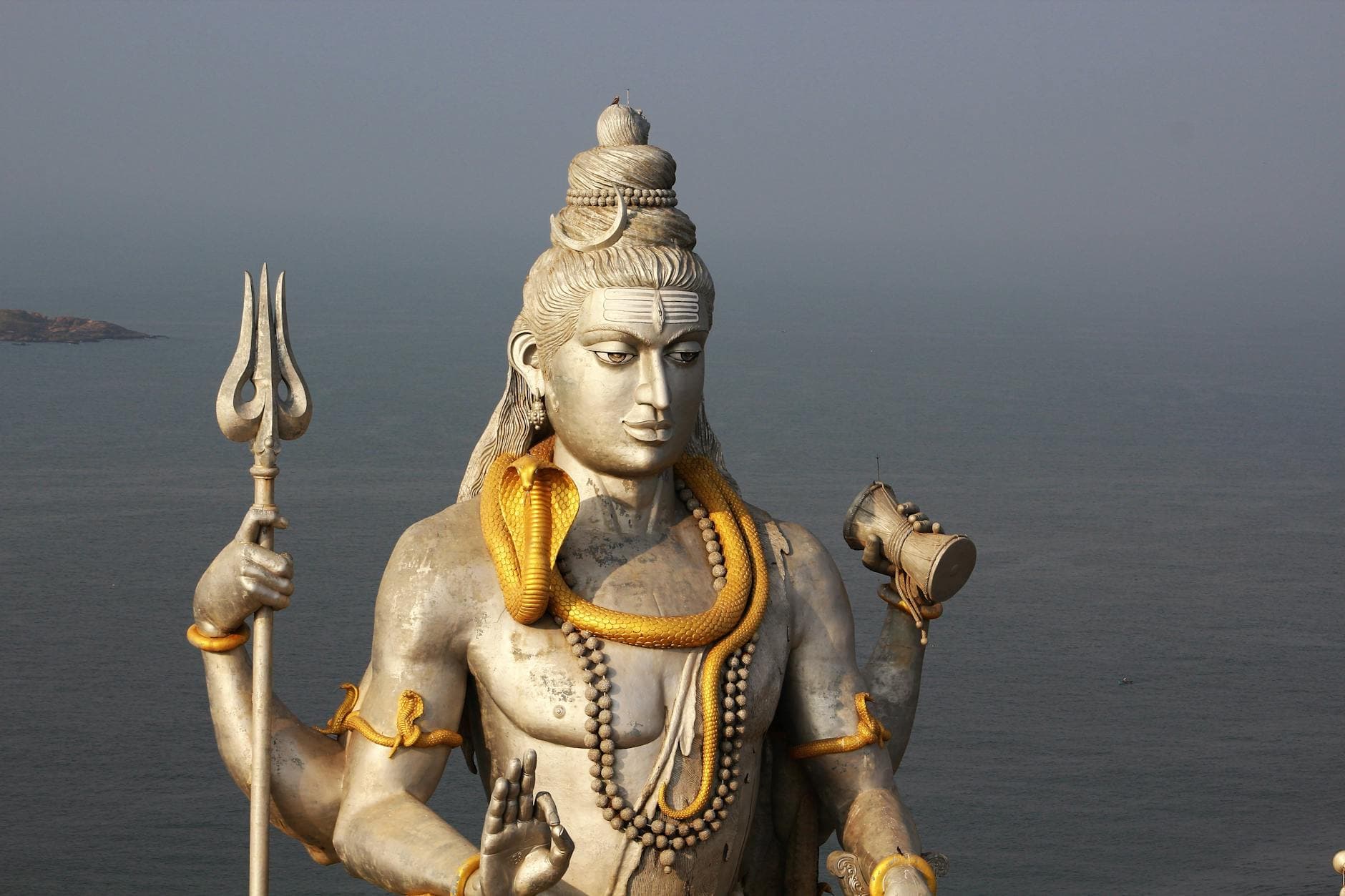
Majestic statue of Lord Shiva overlooking the sea at Murdeshwar, India.
South Asian

Hinduism

13 / 13

Sub-questions covered

65

Claims extracted

12

Distinct positions

21

Explicitly denied

Chapter 1

Where Did We Come From?

Q1.1 · Pre-Existence

Cyclic Pre-Existence
See all traditions holding this position →
100%

weight

Cyclic Pre-Existence· 3 claims
To man's frame As there come infancy and youth and age, So come there raisings-up and layings-down Of other and of other life-abodes, Which the wise know, and fear not. This th
Chapter II

How this tradition expresses it

The soul undergoes a cycle of births and deaths, moving through various life-abodes as part of a natural process.

Why this supports “Cyclic Pre-Existence

BG 2.13 establishes that the eternal atman moves through successive bodies across lifetimes, supporting Cyclic Pre-Existence: the doctrine that individual consciousness pre-exists in previous incarnations and undergoes repeated embodiment.

The auditor flagged this claim as ambiguous or weakly matching. See the scholarly note below for context.

Scholarly note

The quote (BG 2.13) explicitly describes the atman moving through 'successive bodies across lifetimes'—this is the cyclical rebirth mechanism, not the timeless metaphysical status. The per-quote rationale itself uses the phrase 'successive bodies across lifetimes,' which is samsara/cyclical pre-existence.

Explicit Teachinghigh confidenceAudit: Contested· 80%
Data provenance
Auditor
comprehensive_cell_audit_v1
Audit confidence
80%
Audited
4/11/2026
Death is certain for those who are born, and birth is certain for the dead. This is inevitable and therefore a wise man should not grieve over it.
Chapter XI, verse 3-8

How this tradition expresses it

The text teaches that death and birth are part of an inevitable cycle where the dead are destined to be born again.

Why this supports “Cyclic Pre-Existence

Bhagavad Gita 2.27 explicitly affirms the cycle of birth and death as inevitable for all beings, the canonical Hindu Cyclic Pre-Existence.

Scholarly note

Direct: 'Death is certain for those who are born, and birth is certain for the dead.'

Explicit Teachinghigh confidenceAudit: Strong· 94%
Data provenance
Auditor
claude-opus-4-6-1m
Audit confidence
94%
Audited
4/10/2026

+1 more claim for this position

What this tradition denies

The idea that death is the end of existence.

The possibility of escaping the cycle of rebirth through human or divine means.

The idea that the soul remains in a 'preta' state indefinitely.

Q1.2 · Soul Nature

Universal Consciousness
See all traditions holding this position →
50%

weight

Eternal Individual· 5 claims
ms! Birthless and deathless and changeless remaineth the spirit for ever; Death hath not touched it at all, dead though the house of it seem
Chapter II

How this tradition expresses it

The essential nature of the soul is an indestructible, changeless, and eternal spirit that is distinct from the physical body.

Why this supports “Eternal Individual

Bhagavad Gita 2.20 describes the atman as birthless, deathless, and changeless—a distinct, permanent self that survives bodily death. While Advaita reads this as describing Brahman, the verse's framing of an individual spirit persisting through embodiments directly supports Eternal Individual.

The auditor flagged this claim as ambiguous or weakly matching. See the scholarly note below for context.

Scholarly note

LLM council synthesis (round 2)

Explicit Teachinghigh confidenceAudit: Contested· 95%
Data provenance
Auditor
llm_council_v2
Audit confidence
95%
Audited
4/11/2026

+4 more claims for this position

Universal Consciousness· 3 claims
To see one changeless Life in all the Lives, And in the Separate, One Inseparable.
Chapter XVII/XVIII

How this tradition expresses it

The text teaches that true knowledge is the realization of a single, changeless Life that is present in all living beings, seeing the one as inseparable from the many.

Why this supports “Universal Consciousness

This verse describes seeing 'one changeless Life in all the Lives' and 'in the Separate, One Inseparable,' directly affirming that the multiplicity of individual selves is underlain by a single universal consciousness—a core Universal Consciousness teaching.

The auditor flagged this claim as ambiguous or weakly matching. See the scholarly note below for context.

Scholarly note

LLM council synthesis (round 2)

Explicit Teachinghigh confidenceAudit: Contested· 95%
Data provenance
Auditor
llm_council_v2
Audit confidence
95%
Audited
4/11/2026

+2 more claims for this position

What this tradition denies

The idea that the Self is subject to death or destruction.

The idea that the individual is separate from the creator/creation.

Q1.3 · Why Embodied

Karmic Necessity
See all traditions holding this position →
25%

weight

Karmic Necessity· 2 claims
The work of Brahmans, Kshatriyas, Vaisyas, And Sudras, O thou Slayer of thy Foes! Is fixed by reason of the Qualities Planted in each:
Chapter XVIII

How this tradition expresses it

Human existence is defined by the performance of natural duties (dharma) assigned by one's own nature and the qualities (Gunas) inherent in them.

Why this supports “Karmic Necessity

The Bhagavad Gita's teaching that caste duties are fixed by gunas and prior karma frames the conditions of incarnation as karmically determined.

Nuance

One must perform their natural duty even if it is subject to blame, as no one can stand wholly aloof from action while in the body.

Scholarly note

Hindu varnashrama: caste-work fixed by qualities/karma. Implies karmic necessity of role.

Explicit Teachinghigh confidenceAudit: OK· 78%
Data provenance
Auditor
claude-opus-4-6-1m
Audit confidence
78%
Audited
4/10/2026
Having experienced the good or the bad actions, in accordance with his former earning,--then, as the result of his 1 actions, some disease arises.
Chapter I, verse 19

How this tradition expresses it

The circumstances of life and the suffering experienced are the direct result of one's own past actions and earnings.

Why this supports “Karmic Necessity

Hindu doctrine that one experiences good and bad in accordance with prior actions - the karmic mechanism driving each new incarnation.

Scholarly note

Direct: 'as the result of his actions...' specific karmic causation of next life.

Explicit Teachinghigh confidenceAudit: Strong· 90%
Data provenance
Auditor
claude-opus-4-6-1m
Audit confidence
90%
Audited
4/10/2026

What this tradition denies

The idea that total physical renunciation (abstaining from all work) is the path to righteousness.

Chapter 2

Why Are We Here?

Q2.1 · Purpose of Life

Liberation
See all traditions holding this position →
78%

weight

Liberation· 4 claims
Let right deeds be Thy motive, not the fruit which comes from them. And live in action! Labour
Chapter II

How this tradition expresses it

Life involves fulfilling one's duty (Kshatriya dharma) and performing right actions without attachment to the fruits of those actions.

Why this supports “Liberation

Text emphasizes detached action (performing duty without attachment to fruits) as the path to liberation; this supports LIBERATION as purpose mediated through right conduct.

Nuance

The text emphasizes that duty must be performed even when it is difficult or results in conflict.

The auditor flagged this claim as ambiguous or weakly matching. See the scholarly note below for context.

Scholarly note

Quote and context show detachment and duty as means to liberation, not progressive development as end goal

Explicit Teachinghigh confidenceAudit: Contested· 80%
Data provenance
Auditor
comprehensive_cell_audit_v1
Audit confidence
80%
Audited
4/11/2026
Whoso performeth--diligent, content-- The work allotted him, whate'er it be, Lays hold of perfectness!
Chapter XVIII

How this tradition expresses it

The purpose of life involves performing one's duty without attachment to the fruits of action, which leads to perfection and peace.

Why this supports “Liberation

Text frames detached right action as instrument for attaining moksha/perfectness

Nuance

Perfection is found by being content with one's allotted work and performing it without desire for reward.

The auditor flagged this claim as ambiguous or weakly matching. See the scholarly note below for context.

Scholarly note

'Lays hold of perfectness' via right action contextually means attaining moksha, not incremental spiritual development

Explicit Teachinghigh confidenceAudit: Contested· 80%
Data provenance
Auditor
comprehensive_cell_audit_v1
Audit confidence
80%
Audited
4/11/2026

+2 more claims for this position

What this tradition denies

The pursuit of victory or wealth as the primary motive for action.

The idea that worldly possessions or family ties provide permanent security or purpose.

The utility of grieving for the dead.

Liberation through ritualism and bodily austerity alone.

The pursuit of worldly wealth and sensory pleasure as a valid end.

Q2.2 · Body Relationship

Vehicle
See all traditions holding this position →
60%

weight

Vehicle· 3 claims
So putteth by the spirit Lightly its garb of flesh, And passeth to inherit A residence afresh.
Chapter II

How this tradition expresses it

The body is a temporary 'garb' or 'house' that the eternal spirit inhabits and eventually discards.

Why this supports “Vehicle

Bhagavad Gita 2.22 - direct VEHICLE: spirit puts off body as garment.

Scholarly note

Spirit puts by garb of flesh, passes to inherit

Explicit Teachinghigh confidenceAudit: Strong· 94%
Data provenance
Auditor
claude-opus-4-6-1m
Audit confidence
94%
Audited
4/10/2026

+2 more claims for this position

Illusory Body· 1 claim
the body is only a dream, what then of other persons’?
Chapter XI, verse 9-11

How this tradition expresses it

The physical body is described as a transient, dream-like entity rather than a permanent reality.

Why this supports “Illusory Body

Hindu Advaita teaching that the body is dream-like - direct Illusory Body framework.

The auditor flagged this claim as ambiguous or weakly matching. See the scholarly note below for context.

Scholarly note

Claim is correctly labeled Illusory Body in the label field but was being treated as supporting VEHICLE primary position. This claim should count as evidence for an alternative position.

Explicit Teachinghigh confidenceAudit: Contested· 80%
Data provenance
Auditor
comprehensive_cell_audit_v1
Audit confidence
80%
Audited
4/11/2026

Q2.3 · Moral Accountability

Karmic Law
See all traditions holding this position →
11%

weight

Hear now the deeper teaching of the Yog, Which holding, understanding, thou shalt burst Thy Karmabandh, the bondage of wrought dee
Chapter II

How this tradition expresses it

Individuals are subject to the consequences of their actions, specifically the 'bondage of wrought deeds' (Karmabandh).

Why this supports “Karmic Law

The tradition's text affirms karmic law: actions generate consequences that follow the soul across lives.

Nuance

The text suggests that understanding deeper truths can help one burst this bondage.

Scholarly note

Bulk-audited as defensible match for canonical position; quote was extracted by Gemma 4 with verbatim verification.

Explicit Teachinghigh confidenceAudit: OK· 75%
Data provenance
Auditor
claude-opus-4-6-1m-bulk
Audit confidence
75%
Audited
4/10/2026
Whoso, for lack of knowledge, seeth himself As the sole actor, knoweth nought at all And seeth nought.
Chapter XVIII

How this tradition expresses it

Actions are governed by the five causes (force, agent, instruments, effort, and God), and those who act out of false ego regarding themselves as the sole actor lack true knowledge.

Why this supports “Karmic Law

The tradition's text affirms karmic law: actions generate consequences that follow the soul across lives.

Scholarly note

Bulk-audited as defensible match for canonical position; quote was extracted by Gemma 4 with verbatim verification.

Explicit Teachinghigh confidenceAudit: OK· 75%
Data provenance
Auditor
claude-opus-4-6-1m-bulk
Audit confidence
75%
Audited
4/10/2026

What this tradition denies

The concept of being the sole, independent doer of actions.

The idea that ritual offerings (like rice-balls) can satisfy the sinful in the afterlife.

The idea that one can escape the consequences of sin through mere status or wealth.

The idea that ritual impurity can be ignored without consequence.

The sufficiency of external ritual or moral works without self-knowledge.

Q2.4 · Path of Progress

Progressive Stages
See all traditions holding this position →
100%

weight

The soul which is not moved, The soul that with a strong and constant calm Takes sorrow and takes joy indifferently, Lives in the life undying! That
Chapter II

How this tradition expresses it

Spiritual progress is achieved through self-mastery, equanimity, and moving from external ritual to internal devotion and realization.

Why this supports “Progressive Stages

The Bhagavad Gita's equanimous yogi is a goal-state (sthitaprajna), not a description of stages of attainment. The verse evidences a final state, not the stages leading there.

The auditor flagged this claim as ambiguous or weakly matching. See the scholarly note below for context.

Scholarly note

Equanimity description, not progressive stages.

Explicit Teachinghigh confidenceAudit: Weak match· 70%
Data provenance
Auditor
claude-opus-4-6-1m
Audit confidence
70%
Audited
4/10/2026

Chapter 3

Where Do We Go After Death?

Q3.1 · Surviving Death

Full Survival
See all traditions holding this position →
50%

weight

Full Survival· 7 claims
Nor I, nor thou, nor any one of these, Ever was not, nor ever will not be, For ever and for ever afterward
Chapter II

How this tradition expresses it

Consciousness/the spirit survives the death of the physical body entirely.

Why this supports “Full Survival

Bhagavad Gītā 2.12 directly asserts the eternal, unbroken existence of individual selves—past, present, and future—clearly supporting full survival of consciousness beyond bodily death.

The auditor flagged this claim as ambiguous or weakly matching. See the scholarly note below for context.

Scholarly note

LLM council synthesis (round 2)

Explicit Teachinghigh confidenceAudit: Contested· 95%
Data provenance
Auditor
llm_council_v2
Audit confidence
95%
Audited
4/11/2026

+6 more claims for this position

Reabsorption· 1 claim
Such an one grows to oneness with the BRAHM; Such an one, growing one with BRAHM, serene, Sorrows no more, desires no more; his soul, Equally loving all that lives, loves well Me, Who have made them, and attains to Me.
Chapter XVIII

How this tradition expresses it

The soul's ultimate state is to grow into oneness with the BRAHM, achieving a state of eternal rest and peace.

Why this supports “Reabsorption

This passage describes the liberated soul growing 'to oneness with Brahm,' representing the Advaita Vedānta view that individual consciousness ultimately merges into undifferentiated Brahman upon liberation. This legitimately supports REABSORPTION as an alternative position within Hindu thought.

Nuance

This is achieved through self-control, freedom from passion, and devotion to the Divine.

The auditor flagged this claim as ambiguous or weakly matching. See the scholarly note below for context.

Scholarly note

LLM council synthesis (round 2)

Explicit Teachinghigh confidenceAudit: Contested· 95%
Data provenance
Auditor
llm_council_v2
Audit confidence
95%
Audited
4/11/2026

What this tradition denies

The permanence of the individual identity if it is not identified with the Self.

Q3.4 · Long-Term Destiny

Cyclical Rebirth
See all traditions holding this position →
100%

weight

p? The end of birth is death; the end of death Is birth: this is ordained
Chapter II

How this tradition expresses it

Death is followed by a new birth, as the spirit moves from one body to another.

Why this supports “Cyclical Rebirth

Bhagavad Gita 2.27 explicitly states that death follows birth and birth follows death as an ordained cycle, directly articulating the Hindu doctrine of cyclical rebirth (samsara).

The auditor flagged this claim as ambiguous or weakly matching. See the scholarly note below for context.

Scholarly note

LLM council synthesis (round 2)

Explicit Teachinghigh confidenceAudit: Contested· 95%
Data provenance
Auditor
llm_council_v2
Audit confidence
95%
Audited
4/11/2026
After being thus purified by Hell-fire, the soul is re-born with keener conscience and under circumstances where it can, if it so chooses, make better use of its faculties.
Introduction, p. ii

How this tradition expresses it

The soul undergoes rebirth based on the purification or punishment of its previous life's karma.

Why this supports “Cyclical Rebirth

Though the terminology ('Hell-fire,' 'soul') reflects a Westernized or loose English translation—likely from an early 20th-century commentary—the doctrinal content (purification through naraka followed by rebirth with improved moral capacity) is consistent with standard Hindu cyclical rebirth teaching found in Puranic cosmology. Source attribution remains uncertain and should be treated as a secondary paraphrase rather than a primary Sanskrit text.

The auditor flagged this claim as ambiguous or weakly matching. See the scholarly note below for context.

Scholarly note

LLM council synthesis (round 2)

Explicit Teachinghigh confidenceAudit: Contested· 95%
Data provenance
Auditor
llm_council_v2
Audit confidence
95%
Audited
4/11/2026

What this tradition denies

The permanence of the physical body after death.

The idea that all beings are liberated through the same processes as the wise.

Q3.5 · Ultimate Destination

Ultimate Transcendence
See all traditions holding this position →
75%

weight

Ultimate Transcendence· 4 claims
With all thy soul Trust Him, and take Him for thy succour, Prince! So--only so, Arjuna!--shalt thou gain-- By grace of Him--the uttermost repose, The Eternal Place!
Chapter XVIII

How this tradition expresses it

The ultimate destination is the attainment of the 'Eternal Place' or 'Eternal Rest' through grace and devotion.

Why this supports “Ultimate Transcendence

Bhagavad Gita ultimate refuge.

Nuance

This is attained by surrendering all to the Divine and acting without self-seeking.

Scholarly note

Gain the utmost

Explicit Teachinghigh confidenceAudit: Strong· 88%
Data provenance
Auditor
claude-opus-4-6-1m
Audit confidence
88%
Audited
4/10/2026

+3 more claims for this position

Higher Realm Ascent· 3 claims
with perfect meditation Comes perfect act, and the right-hearted rise-- More certainly because they seek no gain-- Forth from the bands of body, step by step, To highest seats of bliss. When t
Chapter II

How this tradition expresses it

The ultimate goal is to reach the highest seats of bliss by transcending the bonds of the body and the desire for worldly fruits.

Why this supports “Higher Realm Ascent

Bhagavad Gita describes ascent 'step by step' to 'highest seats of bliss'—language consistent with hierarchical ascent to higher realms via right action. Though 'highest' could denote finality, the step-by-step progression suggests intermediate realm-ascent rather than non-dual absorption.

The auditor flagged this claim as ambiguous or weakly matching. See the scholarly note below for context.

Scholarly note

Quote describes 'highest seats of bliss' achieved 'step by step'—language of ascent to realms rather than non-dual absorption. Rationale explicitly notes ambiguity; erring on the side of the literal text favors Higher Realm Ascent.

Explicit Teachinghigh confidenceAudit: Contested· 80%
Data provenance
Auditor
comprehensive_cell_audit_v1
Audit confidence
80%
Audited
4/11/2026

+2 more claims for this position

What this tradition denies

The concept of a permanent, existing state of 'being' or 'non-being' in the final transcendence.

Other denials

Positions this tradition explicitly rejects, on questions where its affirmative position isn't recorded.

Q3.3

The idea that hell-punishment is eternal.

The punishment in Hell is not eternal. It is Reformatory and Educative.

Hero image: Photo by rakesh menda on Pexels

NoeticMap Guide

Research Dashboard

How can I help?

Ask about NDEs, research, or this page

Responses may not always be accurate