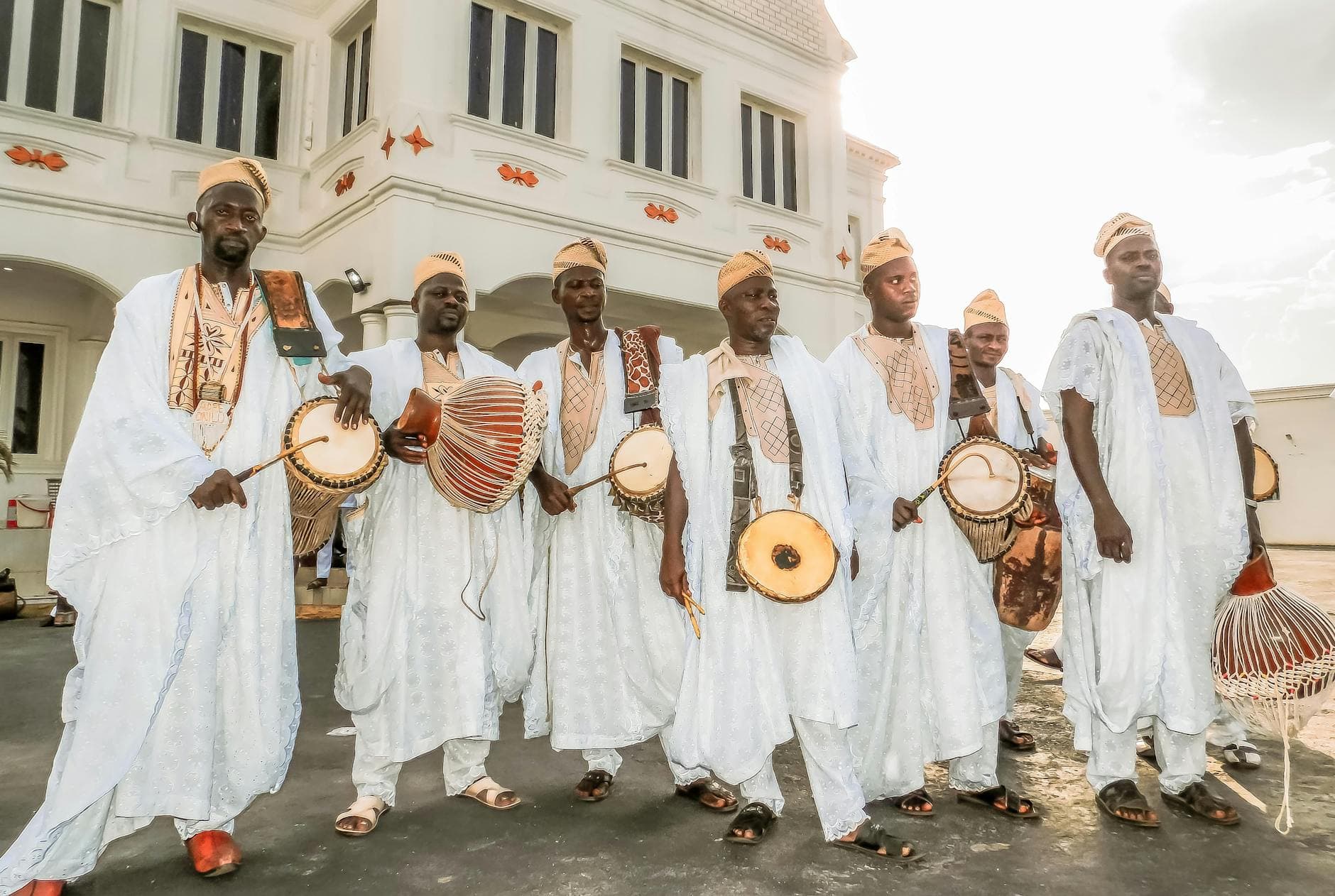
Group of African men in traditional attire with drums in front of a building in Nigeria.
African/Egyptian/Mesoamerican

Yoruba/Ifa

13 / 13

Sub-questions covered

24

Claims extracted

8

Distinct positions

9

Explicitly denied

Chapter 1

Where Did We Come From?

Q1.1 · Pre-Existence

Cyclic Pre-Existence
See all traditions holding this position →
100%

weight

The dead often return to earth, and are born again in the families to which they belonged in their former life.
Section: chunk 7/19

How this tradition expresses it

The dead return to the earth and are reborn into the families to which they previously belonged.

Why this supports “Cyclic Pre-Existence

Yoruba teaching of atunwa (rebirth into the same family) - direct cyclic pre-existence with familial continuity.

Scholarly note

Direct: 'The dead often return to earth, and are born again in the families to which they belonged in their former life.'

Explicit Teachinghigh confidenceAudit: Strong· 94%
Data provenance
Auditor
claude-opus-4-6-1m
Audit confidence
94%
Audited
4/10/2026
soon after the child is born, a babalawo appears on the scene to ascertain what ancestral soul has been re-born in the infant.
Chapter IX, I. At Birth

How this tradition expresses it

The text suggests that an ancestral soul is reborn into the infant at the time of birth.

Why this supports “Cyclic Pre-Existence

Yoruba diviner's task of identifying which ancestor has been reborn in a new infant presupposes the cyclic pre-existence framework.

Scholarly note

Direct: 'babalawo... ascertain what ancestral soul has been re-born in the infant.'

Explicit Teachinghigh confidenceAudit: Strong· 92%
Data provenance
Auditor
claude-opus-4-6-1m
Audit confidence
92%
Audited
4/10/2026

What this tradition denies

The idea that a child is a completely new entity without ancestral connection.

Q1.2 · Soul Nature

Composite Soul
See all traditions holding this position →
100%

weight

Not Addressed· 4 claims
he streams from Yemaja's breasts joined and formed a lagoon, and from her gaping body came the following: — (1) Dada (god of vegetables), (2
Section: CHIEF GODS, page 45

How this tradition expresses it

The text describes the origin of various deities as emerging from the physical body of a goddess, specifically through the bursting of Yemaja's abdomen.

Why this supports “Not Addressed

This quote describes a Fon/Dahomean cosmogonic narrative involving Yemaja and does not address the Yoruba/Ifa understanding of human essential nature or soul composition. It is not relevant to this sub-question and contaminates the cell.

The auditor flagged this claim as ambiguous or weakly matching. See the scholarly note below for context.

Scholarly note

LLM council synthesis (round 2)

Explicit Teachinghigh confidenceAudit: Contested· 95%
Data provenance
Auditor
llm_council_v2
Audit confidence
95%
Audited
4/11/2026

+3 more claims for this position

Composite Soul· 1 claim
According to some, Obatala made the first man and woman out of clay or mud, whence he has obtained his titles of Alamorere and Orisha Kpokpo
Section: Remarks on the Foregoing

How this tradition expresses it

One mythological account suggests humans were fashioned from physical elements like clay or mud by a deity.

Why this supports “Composite Soul

This Yoruba creation narrative establishes that Obatala fashioned the human body (ara) from clay/mud, specifying the material component of the multi-part person. Combined with the well-attested doctrines of orí (destiny-bearing inner head chosen in heaven from Ajala's workshop) and èmí (divine breath/life-force from Olodumare), this passage supports the Composite Soul model by identifying the physical component as distinct from spiritual elements.

Nuance

This is presented as one of several conflicting traditions.

The auditor flagged this claim as ambiguous or weakly matching. See the scholarly note below for context.

Scholarly note

LLM council synthesis (round 2)

Explicit Teachinghigh confidenceAudit: Contested· 95%
Data provenance
Auditor
llm_council_v2
Audit confidence
95%
Audited
4/11/2026

What this tradition denies

The idea that humans were created from clay/mud as the sole origin.

The idea that Egungun is a supernatural entity rather than a human in disguise.

Q1.3 · Why Embodied

Not Addressed
See all traditions holding this position →
100%

weight

ULS OF MEN. 1 20 what ancestral ghost has animated her new-born child, and the bahalawo always tells her which it is
Section: chunk 7/19

How this tradition expresses it

Rebirth is a process where ancestral ghosts animate newborn children within their own families.

Why this supports “Not Addressed

The babalawo's ability to identify which specific ancestor has animated a newborn demonstrates that reincarnation occurs in patterned, identifiable ways within Yoruba kinship systems. However, identification of *who* returns does not establish *why* or whether return is chosen by the ancestor or divinely orchestrated. This quote evidences the reincarnation mechanism but remains neutral on ancestral agency versus divine assignment.

The auditor flagged this claim as ambiguous or weakly matching. See the scholarly note below for context.

Scholarly note

The claim's own rationale explicitly states it 'remains neutral on ancestral agency versus divine assignment' and 'evidences the reincarnation mechanism but' does not address causation. The label should match the rationale.

Explicit Teachinghigh confidenceAudit: Contested· 80%
Data provenance
Auditor
comprehensive_cell_audit_v1
Audit confidence
80%
Audited
4/11/2026
the parents are informed that the child must conform in all respects to the manner of life of the ancestor who now animates it
Chapter IX, I. At Birth

How this tradition expresses it

The purpose of the current life is to live according to the identity and manner of the ancestor who has been reborn into the body.

Why this supports “Not Addressed

The expectation that a child embody an ancestor's manner of life indicates that ancestral personhood, identity, and characteristics persist across embodiments. This supports the conclusion that ancestors reincarnate with their identity intact, but does not distinguish whether this occurs through ancestral choice, divine assignment, or collaborative determination. The quote supports ancestral continuity, not the cause of reincarnation.

The auditor flagged this claim as ambiguous or weakly matching. See the scholarly note below for context.

Scholarly note

The claim's own rationale states it 'does not distinguish whether this occurs through ancestral choice, divine assignment, or collaborative determination' and 'supports ancestral continuity, not the cause of reincarnation.' The label should match the rationale.

Explicit Teachinghigh confidenceAudit: Contested· 80%
Data provenance
Auditor
comprehensive_cell_audit_v1
Audit confidence
80%
Audited
4/11/2026

Q1.4 · Pre-Birth State

Not Addressed
See all traditions holding this position →
100%

weight

it seems probable that originally he was regarded as the incarnation of the dead, and that the whole custom is connected with manes-worship.
Section: Egungun, Oro, and Abiku

How this tradition expresses it

The Egungun is understood to be an incarnation of the deceased, representing those who have risen from the dead.

Why this supports “Not Addressed

This quote addresses post-mortem ancestral veneration (Egungun and manes-worship) rather than pre-life cosmology. While it demonstrates Yoruba belief in ancestral transcendence and continued agency, it does not speak to the state or realm of existence before birth.

Nuance

The text notes that while it is popularly believed to be an incarnation, it is also recognized as a disguised man.

The auditor flagged this claim as ambiguous or weakly matching. See the scholarly note below for context.

Scholarly note

The quote discusses Egungun ancestral masquerade and post-mortem veneration, not pre-birth state. It provides no evidence about what the Yoruba understood the pre-life condition to be. The claim's rationale overstates the quote's relevance.

Direct Implicationhigh confidenceAudit: Contested· 80%
Data provenance
Auditor
comprehensive_cell_audit_v1
Audit confidence
80%
Audited
4/11/2026

Chapter 2

Why Are We Here?

Q2.3 · Moral Accountability

Divine Judgment
See all traditions holding this position →
100%

weight

When a man wishes to revenge himself upon another he offers a sacrifice to Shigidi, who thereupon proceeds at night to the house of the person indicated and kills him.
Section: MINOR GODS

How this tradition expresses it

The text suggests that certain deities can act as agents of retribution or punishment based on human actions or social standing.

Why this supports “Not Addressed

This quote describes a transactional magical practice—offering a sacrifice to Shigidi to trigger the spirit to kill a targeted person—which constitutes an act of sorcery or personal revenge rather than a teaching on moral accountability or divine judgment for how one lives. It does not address the sub-question of whether humans are accountable for how they live before Olodumare or any other moral arbiter, so it does not directly support any accountability position.

Nuance

The text describes these as mythological or ritualistic functions of specific gods.

The auditor flagged this claim as ambiguous or weakly matching. See the scholarly note below for context.

Scholarly note

LLM council synthesis (round 2)

Explicit Teachinghigh confidenceAudit: Contested· 95%
Data provenance
Auditor
llm_council_v2
Audit confidence
95%
Audited
4/11/2026

What this tradition denies

The idea that death is always a finality without potential for rebirth in specific ritual contexts.

The connection between religious observance and moral accountability.

The idea that moral righteousness ensures divine favor.

Chapter 3

Where Do We Go After Death?

Q3.1 · Surviving Death

Full Survival
See all traditions holding this position →
100%

weight

Shango is not dead. He has become an orisha. He has descended into the earth, and lives among the dead people, with whom we have heard him conversing.
Section: CHIEF GODS, page 51

How this tradition expresses it

The text suggests that certain beings (specifically the deified King Shango) transition from earthly life to a state of being an orisha, living among the dead.

Why this supports “Full Survival

Yoruba: deceased becomes deity.

Nuance

The text notes this is a myth that may represent a transition from an earthly king to a god.

Scholarly note

Shango became orisha

Explicit Teachinghigh confidenceAudit: Strong· 88%
Data provenance
Auditor
claude-opus-4-6-1m
Audit confidence
88%
Audited
4/10/2026
brings to the relatives news of the deceased, usually that he has arrived in Deadland safely, and is quite well.
Section: Egungun, Oro, and Abiku

How this tradition expresses it

The deceased are believed to arrive in 'Deadland' and can communicate messages to the living through Egungun.

Why this supports “Full Survival

Yoruba: communications from deceased.

Nuance

The text describes this as a way to bring news to relatives that the deceased has arrived safely.

Scholarly note

News from Deadland

Explicit Teachinghigh confidenceAudit: Strong· 85%
Data provenance
Auditor
claude-opus-4-6-1m
Audit confidence
85%
Audited
4/10/2026

What this tradition denies

The finality of death for certain beings.

The idea that the soul is a single, unchanging entity that does not involve a division between life-phantom and death-phantom.

Q3.2 · Death Moment

Not Addressed
See all traditions holding this position →
100%

weight

releasing their ghosts, or souls, from their bodies to enable them to continue their ministrations to their lord
section 283

How this tradition expresses it

Death involves the release of the ghost or soul from the physical body.

Why this supports “Soul Departure

Yoruba royal funerary practice (the killing of attendants) is justified by the doctrine that soul-release frees them to continue serving their lord in the afterlife. The text directly describes the death-moment as the soul being released from the body, fitting Soul Departure.

Scholarly note

The quote describes 'releasing their ghosts, or souls, from their bodies' - direct language of soul departure at death. Used in the context of Yoruba royal funerary practices where servants follow the king.

Direct Implicationhigh confidenceAudit: Strong· 85%
Data provenance
Auditor
claude-opus-4-6-1m
Audit confidence
85%
Audited
4/10/2026

Q3.3 · Afterlife Structure

Spirit World
See all traditions holding this position →
50%

weight

Not Addressed· 1 claim
He dwells in the clouds in an immense brazen palace, where he maintains a large retinue and keeps a great number of horses
Section: CHIEF GODS, page 47

How this tradition expresses it

The afterlife or the realm of the gods involves different locations, including the sky (clouds) and the earth (underground/the dead).

Why this supports “Not Addressed

Describes a palace in the spirit realm, but attributes it to a deity's residence rather than the human soul's afterlife destination. Does not provide evidence for the structure of the afterlife as experienced by human souls.

The auditor flagged this claim as ambiguous or weakly matching. See the scholarly note below for context.

Scholarly note

Describes a deity's (likely Olorun or Shango's) palace in the spirit realm, not the structure of the human afterlife or soul destinations

Explicit Teachinghigh confidenceAudit: Contested· 80%
Data provenance
Auditor
comprehensive_cell_audit_v1
Audit confidence
80%
Audited
4/11/2026
Spirit World· 1 claim
Then they walked on again, a long, long way; and at last they arrived at the land of dead people.
Folk-lore Tales, Section II

How this tradition expresses it

The afterlife is described as a specific realm or 'land of dead people' where individuals reside after death.

Why this supports “Spirit World

Narrative evidence confirming the existence of a discrete, non-physical realm ('the land of dead people') as the destination for souls. Directly supports Spirit World; does not address internal stratification or multiple levels.

The auditor flagged this claim as ambiguous or weakly matching. See the scholarly note below for context.

Scholarly note

Retain label but clarify: this claim correctly supports Spirit World (existence of a discrete spirit realm), not Multiple Levels. The narrative describes arrival at 'the land of dead people' as a singular destination.

Explicit Teachinghigh confidenceAudit: Contested· 80%
Data provenance
Auditor
comprehensive_cell_audit_v1
Audit confidence
80%
Audited
4/11/2026

Q3.4 · Long-Term Destiny

Cyclical Rebirth
See all traditions holding this position →
50%

weight

The reason of his being thus honoured for the twenty-four hours before being sacrificed, is that it is believed he will be born again and become a king
Section: CHIEF GODS

How this tradition expresses it

The text mentions a belief that a sacrificed individual may be born again into a position of power.

Why this supports “Cyclical Rebirth

Yoruba ritual context: the sacrificed individual is believed to return in a future birth—an instance of cyclical rebirth tied to ritual transition, though not necessarily lineal family rebirth.

Nuance

This is presented as a belief held during specific ritual contexts regarding human sacrifice.

The auditor flagged this claim as ambiguous or weakly matching. See the scholarly note below for context.

Scholarly note

Quote describes a specific ritual context where an individual is believed to 'be born again and become a king'—this is rebirth, but the rationale mistakenly reads 'ritual death' as establishing conditionality. This is better classified as a particular instance of cyclical rebirth (return to high status) rather than conditional rebirth doctrine.

Explicit Teachinghigh confidenceAudit: Contested· 80%
Data provenance
Auditor
comprehensive_cell_audit_v1
Audit confidence
80%
Audited
4/11/2026
The souls of the dead are sometimes reborn in animals, and occasionally, though but rarely, in plants.
Section: chunk 7/19

How this tradition expresses it

Human souls may be reborn into animals, such as hyenas or monkeys, due to shared characteristics.

Why this supports “Cyclical Rebirth

Yoruba: souls reborn in various forms - direct cyclical rebirth.

Nuance

The text notes that rebirth into plants is much rarer and often explained through specific folk-tales.

Scholarly note

Souls reborn in animals (rarely plants)

Explicit Teachinghigh confidenceAudit: Strong· 88%
Data provenance
Auditor
claude-opus-4-6-1m
Audit confidence
88%
Audited
4/10/2026

Q3.5 · Ultimate Destination

Unknown or Ineffable
See all traditions holding this position →
100%

weight

He has descended into the earth, and lives among the dead people, with whom we have heard him conversing.
Section: CHIEF GODS, page 51

How this tradition expresses it

The text describes a state where a deity descends into the earth to live among the dead.

Why this supports “Not Addressed

Yoruba: describes the intermediate ancestral state ('Deadland') where the soul resides after death and communicates. Does not address what happens to the soul after the ancestral phase or upon reunion with Olodumare. This quote illustrates cosmological stages but is not engaged with the ultimate destination question.

The auditor flagged this claim as ambiguous or weakly matching. See the scholarly note below for context.

Scholarly note

The quote describes the intermediate ancestral state ('Deadland') and the soul's presence there. It does not address the ultimate destination. The rationale correctly identifies this as 'multi-stage cosmology, not ineffability.' This claim should be reclassified as Not Addressed, indicating the quote simply does not engage the ultimate destination question.

Explicit Teachinghigh confidenceAudit: Contested· 80%
Data provenance
Auditor
comprehensive_cell_audit_v1
Audit confidence
80%
Audited
4/11/2026
brings to the relatives news of the deceased, usually that he has arrived in Deadland safely, and is quite well.
Section: Egungun, Oro, and Abiku

How this tradition expresses it

The destination of the deceased is referred to as 'Deadland'.

Why this supports “Not Addressed

Yoruba: describes communication from the ancestral intermediate realm conveying safe arrival in Deadland. Establishes the intermediate stage as a real, experienced realm but provides no information about the soul's ultimate destination or the nature of reunion with Olodumare.

The auditor flagged this claim as ambiguous or weakly matching. See the scholarly note below for context.

Scholarly note

The quote describes communication from the ancestral intermediate realm. The rationale explicitly states it 'provides context for Yoruba cosmology but does not clarify what ultimate destination means.' This is Not Addressed, not Unknown or Ineffable.

Direct Implicationhigh confidenceAudit: Contested· 80%
Data provenance
Auditor
comprehensive_cell_audit_v1
Audit confidence
80%
Audited
4/11/2026

What this tradition denies

The text denies that the physical images of gods are the objects of worship themselves.

Hero image: Photo by Babajide Olusanya on Pexels

NoeticMap Guide

Research Dashboard

How can I help?

Ask about NDEs, research, or this page

Responses may not always be accurate