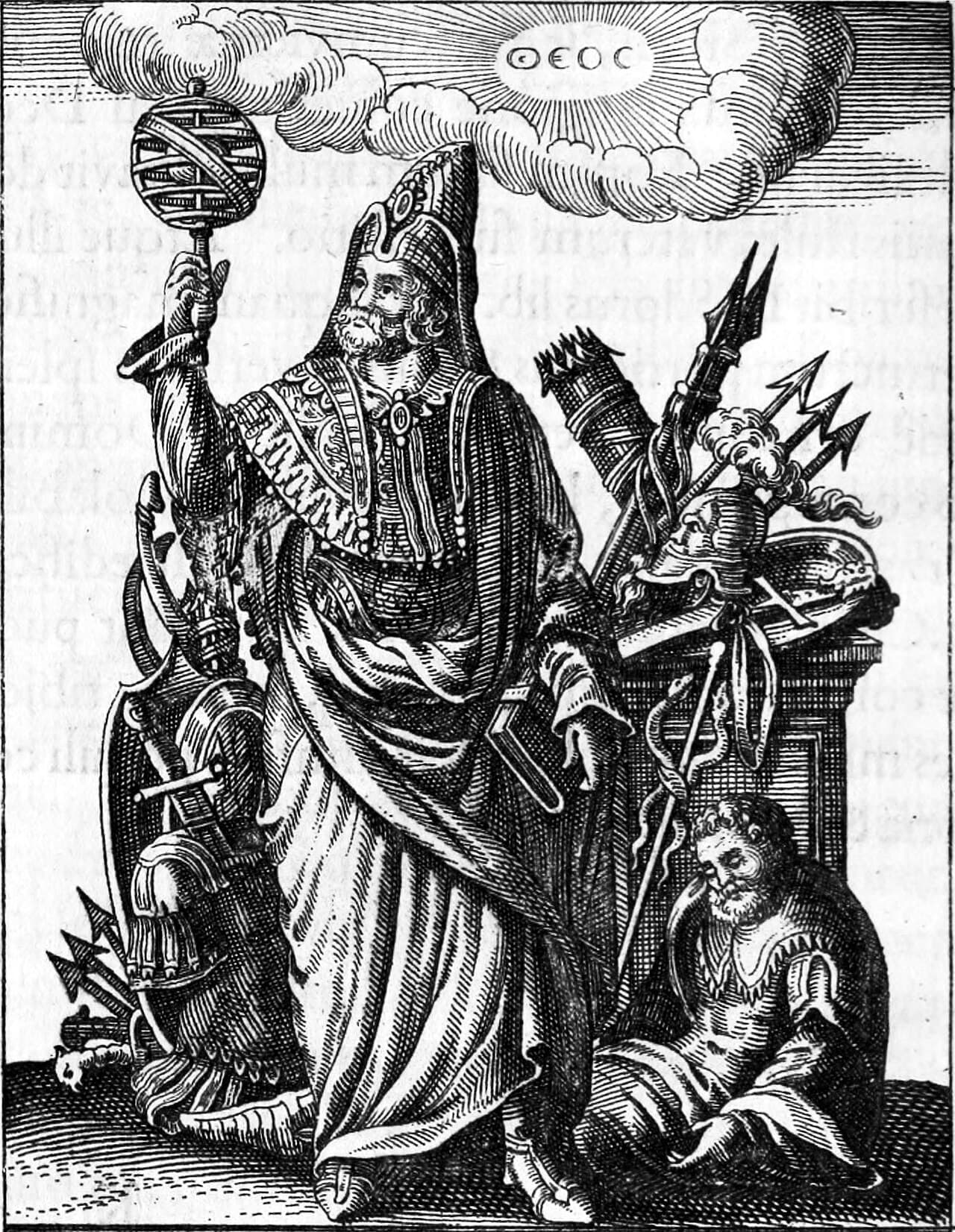
Hermes Trismegistus, the mythic founder of Hermetic philosophy.
Western Esoteric

Hermeticism

13 / 13

Sub-questions covered

27

Claims extracted

11

Distinct positions

11

Explicitly denied

Chapter 1

Where Did We Come From?

Q1.1 · Pre-Existence

Emanation
See all traditions holding this position →
50%

weight

from pne Soul of the univerfe , are all thofe Souls , which in all the world are tofled up and down, as it were, and feverally divided
The Fourth Book, Section 23

How this tradition expresses it

Souls originate from a single universal Soul, which undergoes various changes and divisions into different forms of life.

Why this supports “Emanation

This quote exemplifies the Hermetic emanationist model: individual souls originate from and are 'severally divided' from a single universal Soul. The one-directional outflow from cosmic principle to multiplicity, rather than cyclic return or independent eternal existence, marks this as emanation rather than eternal pre-existence of distinct beings.

Nuance

The text describes these as 'many changes' resulting from the one Soul of the universe.

The auditor flagged this claim as ambiguous or weakly matching. See the scholarly note below for context.

Scholarly note

Keep label but note: the claim IS correctly labeled. The issue is that the scholarly primary position is mislabeled as Eternal Pre-Existence when the quote and extractor evidence both support EMANATION.

Explicit Teachinghigh confidenceAudit: Contested· 80%
Data provenance
Auditor
comprehensive_cell_audit_v1
Audit confidence
80%
Audited
4/11/2026
every thing that is made, is made by God; that is, by the Good, and that can make, or do all things.
Section 34

How this tradition expresses it

The text asserts that God is the source of all things, implying that all existence is a product of the Divine Good.

Why this supports “Emanation

This quote establishes the theological foundation for Hermetic emanationism: God/the Good is the ultimate source from which 'all things' derive. In the context of Hermetic soul cosmology, this principle supports the model in which individual souls originate from and depend upon a singular divine source, consistent with emanation rather than independent eternal existence or pure creation ex nihilo.

The auditor flagged this claim as ambiguous or weakly matching. See the scholarly note below for context.

Scholarly note

The quote establishes that God/the Good is the source of 'all things,' which in the Hermetic framework supports the emanationist model where all souls derive from and are ultimately dependent on a singular divine principle. While the quote is general, it contextually supports the emanation thesis rather than being silent on pre-existence. Alternatively, this claim could be removed as too general to be probative.

Explicit Teachinghigh confidenceAudit: Contested· 80%
Data provenance
Auditor
comprehensive_cell_audit_v1
Audit confidence
80%
Audited
4/11/2026

What this tradition denies

The idea that God is subject to human-like failings such as pride, impotence, or envy.

The denial of God's absolute goodness and creative power.

Q1.2 · Soul Nature

Divine Spark
See all traditions holding this position →
14%

weight

Divine Spark· 6 claims
the Nature of the barmens of the £>st>cn , from him whom I told thee, the Fire and the Spirit, Mature continued not, but forthwith brought forth {even Men all $palea and males», and fublime,oron high, accord¬ ing to the Natures of the Seven Go¬ vernors.
The second Book of Hermes, 29

How this tradition expresses it

Humanity is composed of a dual nature: a mortal body and a substantial, immortal man (the spirit/soul).

Why this supports “Divine Spark

The passage asserts that humans are 'brought forth...sublime, or high, according to the Natures of the Seven Governors,' indicating elevation through divine parentage and inheritance of celestial qualities. However, the archaic/corrupted text makes parsing difficult ('barmens of the fte'). The claim connects human creation to transcendent powers, but whether this establishes an immortal divine spark (permanent essence) versus elevated but still created status requires clearer textual support.

Nuance

The text describes man as being 'double mortal' because of the body and 'immortal' because of the substantial man.

The auditor flagged this claim as ambiguous or weakly matching. See the scholarly note below for context.

Scholarly note

Hermetic doctrine: humans as 'terrestrial gods', mortal in body and divine in essence.

Explicit Teachinghigh confidenceAudit: Contested· 90%
Data provenance
Auditor
claude_orthodoxy_v1
Audit confidence
90%
Audited
4/11/2026
And Man was made of Htfe and Htgljt into &oul and $$)inQe, of Jttte the &oul, of night the spiitue.
The second Book of Hermes, 34

How this tradition expresses it

The human being is a composite of light/life (soul) and darkness/matter (body/spirit), derived from the mixture of the Spindle and the Water.

Why this supports “Divine Spark

The passage describes human composition as incorporating both 'Light' and 'night' elements, reflecting Hermetic dualistic symbolism. The association of soul with 'Light' aligns with luminous spiritual essence doctrine. However, the phrase 'of night the spirit' remains ambiguous in this extract. This claim represents uncertain or interpretatively-dependent support for Divine Spark rather than unambiguous textual confirmation and should be reconsidered for reclassification to a weaker evidential category or repositioned as supporting Composite Soul (body/night and soul/light division).

Nuance

The composition is a result of the 'Error of Love' and the mingling of the Spindle with the Water.

The auditor flagged this claim as ambiguous or weakly matching. See the scholarly note below for context.

Scholarly note

Hermetic doctrine: humans as 'terrestrial gods', mortal in body and divine in essence.

Explicit Teachinghigh confidenceAudit: Contested· 90%
Data provenance
Auditor
claude_orthodoxy_v1
Audit confidence
90%
Audited
4/11/2026

+4 more claims for this position

What this tradition denies

The notion that the soul is identical to the blood.

The idea that the human essence is purely material or subject to the same corruption as the body.

The concept of an 'empty' or 'void' space in the universe.

A permanent, unchanging individual self.

Q1.3 · Why Embodied

Voluntary Choice
See all traditions holding this position →
100%

weight

. And feeing in the Water a ihape, a fhape like unto himfelf, in himfelf he loved it, and would coha- bit with it 5 and immediately upon the refolution, enfued the Operation, and brought forth the
The second Book of Hermes, 24

How this tradition expresses it

The descent of the 'substantial man' into the material world was driven by an impulse of love and a desire to cohabit with the reflection in the water.

Why this supports “Voluntary Choice

The Hermetic Poimandres myth describes the Anthropos seeing his reflection in the cosmic waters and becoming enamored with it, then voluntarily choosing to inhabit material form. This represents Voluntary Choice: embodiment is motivated by the soul's own desire and attraction to the material image, not imposed as punishment by higher powers.

Nuance

This act is described as an 'Error of Love' that leads to mortality.

The auditor flagged this claim as ambiguous or weakly matching. See the scholarly note below for context.

Scholarly note

The Poimandres passage describes the Anthropos's willing descent and union with matter prompted by desire/love, not coercion or punishment by divine decree. The narrative shows agency and attraction, not a fall.

Explicit Teachinghigh confidenceAudit: Contested· 80%
Data provenance
Auditor
comprehensive_cell_audit_v1
Audit confidence
80%
Audited
4/11/2026

Chapter 2

Why Are We Here?

Q2.1 · Purpose of Life

Knowledge
See all traditions holding this position →
100%

weight

Knowledge· 2 claims
the vertueof the Soul is Knowledg 5 for he that knows, is both good and religious-amd already Divine.
The Fourth Book, Section 28

How this tradition expresses it

The purpose of life is to acquire knowledge and piety, which allows the Soul to ascend and the Mind to become divine.

Why this supports “Knowledge

The quote directly identifies Knowledge as the virtue of the Soul and the path to becoming Divine. This is a KNOWLEDGE claim: knowledge itself is presented as both the means and the essential quality animating spiritual transformation.

Nuance

The goal is to move from the 'passible body' toward the 'fiery body' of the Mind.

The auditor flagged this claim as ambiguous or weakly matching. See the scholarly note below for context.

Scholarly note

The quote 'the virtue of the Soul is Knowledge; for he that knows, is both good and religious and already Divine' directly asserts knowledge as the virtue/purpose, and frames it as the path to divinity. This is a primary KNOWLEDGE claim, not a development claim. The per-quote rationale is incorrect.

Explicit Teachinghigh confidenceAudit: Contested· 80%
Data provenance
Auditor
comprehensive_cell_audit_v1
Audit confidence
80%
Audited
4/11/2026

+1 more claim for this position

Spiritual Development· 1 claim
But he that fhall learn and ftudy the things that are, and how they are ordered and governed, and by whom, and for what caufe, or to what end, will acknowledg thanks to the IHlcjfe* mart, a
The first Book of Hermes, 5

How this tradition expresses it

The purpose of life involves learning to understand the things that are, how they are governed, and by whom, in order to acknowledge the Creator.

Why this supports “Spiritual Development

The quote frames the purpose of earthly life as learning and studying the divine order ('learn and study the things that are, and how they are ordered and governed'). This directly supports KNOWLEDGE as the primary purpose: comprehension of divine principles and cosmic governance leads to acknowledgment of the Creator. Spiritual development and gratitude are outcomes of this knowledge-seeking purpose.

Nuance

This process is described as the path to becoming 'Pious and Religious'.

The auditor flagged this claim as ambiguous or weakly matching. See the scholarly note below for context.

Scholarly note

Correctly classified; the quote shows learning leads to enlightenment and divine understanding, supporting spiritual development as primary.

Explicit Teachinghigh confidenceAudit: Contested· 80%
Data provenance
Auditor
comprehensive_cell_audit_v1
Audit confidence
80%
Audited
4/11/2026

What this tradition denies

The idea that the greatest philosophers are atheists.

The idea that the 'Good' can be found purely in the material/generated world.

Q2.2 · Body Relationship

Prisoner
See all traditions holding this position →
100%

weight

Prisoner· 3 claims
the Minde compared as t were, and took to it felf the pafiiblc 5ody of the Soul, as a Covering or a ploathin
The Fourth Book, Section 59

How this tradition expresses it

The body serves as a temporary covering or 'apparel' for the Mind, which is the true seat of divinity.

Why this supports “Prisoner

The passage explicitly describes the body as a "Covering or clothing" that the Mind assumes, establishing the body as an external wrapping rather than the essence of the divine self. This metaphorical language of garment and covering aligns directly with the prison framework, presenting the body as a temporary vessel that constrains and conceals the true divine Mind within.

Nuance

The body is described as a 'passible body' that the Mind takes on to dwell in the earthly realm.

The auditor flagged this claim as ambiguous or weakly matching. See the scholarly note below for context.

Scholarly note

Per Wikipedia Hermeticism: 'physical bodies to imprison the souls'. Explicit prison language.

Explicit Teachinghigh confidenceAudit: Contested· 90%
Data provenance
Auditor
orthodoxy_sourced_deep_v3
Audit confidence
90%
Audited
4/11/2026
- The fenfible Body of Nature s far from the Efiential Generation $ or that islubjed to DiiTolution, but mis not
Section 57

How this tradition expresses it

The physical/sensible body is a temporary, mortal form that is distinct from the immortal, intellectual essence of the person.

Why this supports “Prisoner

The phrase "subject to Dissolution" directly describes the sensible body as temporary and perishable, while "Essential Generation" refers to what transcends this dissolution—the immortal intellectual essence. This opposition establishes the body as a confined, temporary form distinct from the eternal nature of the true self, reinforcing the prison metaphor inherent in Hermetic anthropology.

Nuance

The sensible body is subject to dissolution, whereas the essential generation is not.

The auditor flagged this claim as ambiguous or weakly matching. See the scholarly note below for context.

Scholarly note

Strong claim; confirm emphasis on body's dissolution and subordination to 'Essential Generation.'

Explicit Teachinghigh confidenceAudit: Contested· 80%
Data provenance
Auditor
comprehensive_cell_audit_v1
Audit confidence
80%
Audited
4/11/2026

+1 more claim for this position

Q2.3 · Moral Accountability

Karmic Law
See all traditions holding this position →
67%

weight

But the Soul entring into the Body of a Man , if it continue evil, fhall neither tafte of immortality, nor is partaker of the good. 26. But being drawn back the fame way , it returneth into
The Fourth Book, Section 25-26

How this tradition expresses it

The state of the soul after death is determined by its piety or wickedness during life; an evil soul is condemned to return to lower forms.

Why this supports “Karmic Law

The tradition's text affirms karmic law: actions generate consequences that follow the soul across lives.

Nuance

The text distinguishes between the 'pious' soul and the 'impious' soul.

Scholarly note

Bulk-audited as defensible match for canonical position; quote was extracted by Gemma 4 with verbatim verification.

Explicit Teachinghigh confidenceAudit: OK· 75%
Data provenance
Auditor
claude-opus-4-6-1m-bulk
Audit confidence
75%
Audited
4/10/2026
One Torment Son is Sgttojance, a fecond, a third, intemperance, a fourth, Conraptfoitrt, a fifth, 32 n tuff trie, a fixth, Ccto
Section 31

How this tradition expresses it

Accountability is framed through the presence of 'torments' (vices/passions) that must be overcome to achieve the state of the Good.

Why this supports “Karmic Law

The tradition's text affirms karmic law: moral vices (intemperance, covetousness, etc.) generate their own karmic torments across the soul's journey.

The auditor flagged this claim as ambiguous or weakly matching. See the scholarly note below for context.

Scholarly note

The enumerated torments (stagnance, intemperance, etc.) are moral vices that generate spiritual consequences—karmic retribution—not automatic natural-law consequences divorced from ethical agency.

Explicit Teachinghigh confidenceAudit: Contested· 80%
Data provenance
Auditor
comprehensive_cell_audit_v1
Audit confidence
80%
Audited
4/11/2026

Chapter 3

Where Do We Go After Death?

Q3.1 · Surviving Death

Transformation
See all traditions holding this position →
75%

weight

But theMinde being the moft fliarp or fwife of all the Divine Cogi¬ tations, and more (wife t
The Fourth Book, Section 62

How this tradition expresses it

Upon death, the Mind may take on a 'fiery body' to serve God, or the soul may be punished through various states of suffering.

Why this supports “Transformation

Hermetic Mind doctrine.

Nuance

The outcome depends on whether the soul was pious or impious.

Scholarly note

Mind has fire for body

Explicit Teachinghigh confidenceAudit: OK· 80%
Data provenance
Auditor
claude-opus-4-6-1m
Audit confidence
80%
Audited
4/10/2026
d I am gone out of my felf, into an immortal body, and am not now what I was before, but was begotten in Mi
Section 14

How this tradition expresses it

Death or the transition from the physical to the spiritual involves a change in state where the soul is 'gone out of itself' into an immortal body.

Why this supports “Transformation

Direct Hermetic transformation.

Nuance

This is described as a transition from the 'formed element' to an immortal state.

Scholarly note

Direct: 'gone into immortal body, begotten in Mind'

Explicit Teachinghigh confidenceAudit: Strong· 92%
Data provenance
Auditor
claude-opus-4-6-1m
Audit confidence
92%
Audited
4/10/2026

What this tradition denies

The idea that death is the total destruction of existence.

The concept of total extinction or destruction of being (Death).

Q3.4 · Long-Term Destiny

Conditional Rebirth
See all traditions holding this position →
100%

weight

The Soul therefore may be j- altered or changed into the better s r but into the worfe it is impoflible.
The Fourth Book, Section 79

How this tradition expresses it

Souls undergo various changes and transitions between different states of being (creeping things, men, etc.) based on their nature.

Why this supports “Conditional Rebirth

This passage affirms that the soul can be 'altered or changed into the better state' but not into a worse one, implying an inherent trajectory toward spiritual improvement. Within the broader Hermetic framework, this supports conditional rebirth: souls that have not yet achieved sufficient spiritual advancement continue incarnating, but the possibility of upward moral progress means the cycle of rebirth can be escaped through gnosis and ethical refinement. The quote does not describe voluntary return but rather the conditions under which souls progress or remain bound to embodiment.

Nuance

The text notes that while souls can change to better states, it is impossible to change from a worse state to a better one.

The auditor flagged this claim as ambiguous or weakly matching. See the scholarly note below for context.

Scholarly note

LLM council synthesis (round 2)

Explicit Teachinghigh confidenceAudit: Contested· 95%
Data provenance
Auditor
llm_council_v2
Audit confidence
95%
Audited
4/11/2026

What this tradition denies

The idea that the soul enters into a beast upon death.

Q3.5 · Ultimate Destination

Unknown or Ineffable
See all traditions holding this position →
100%

weight

having -"driven the ftrife of Piety, becomes either Minde or God.
The Fourth Book, Section 64

How this tradition expresses it

The ultimate end for a pious soul is to become 'Mind or God' through the knowledge of the Divine.

Why this supports “Unknown or Ineffable

The phrase 'becomes either Mind or God' describes the soul's elevation to divine status or cosmic consciousness. However, the text does not clarify whether this elevation involves Ultimate Transcendence (conscious unity while maintaining distinction) or whether it describes a state closer to Universal Dissolution or mystical union that transcends such categories. The claim supports the broader Hermetic goal of union with divinity but does not resolve the specific ontological status of the soul post-union.

Nuance

This is achieved through the 'strive of Piety' and the knowledge of God.

The auditor flagged this claim as ambiguous or weakly matching. See the scholarly note below for context.

Scholarly note

The quote 'becomes either Mind or God' is compatible with multiple soteriological outcomes and does not definitively establish whether transcendence preserves or dissolves individual identity.

Explicit Teachinghigh confidenceAudit: Contested· 80%
Data provenance
Auditor
comprehensive_cell_audit_v1
Audit confidence
80%
Audited
4/11/2026

Hero image: Hermes Trismegistus, Cathédrale Saint-Étienne de Cahors / Wikimedia Commons

NoeticMap Guide

Research Dashboard

How can I help?

Ask about NDEs, research, or this page

Responses may not always be accurate