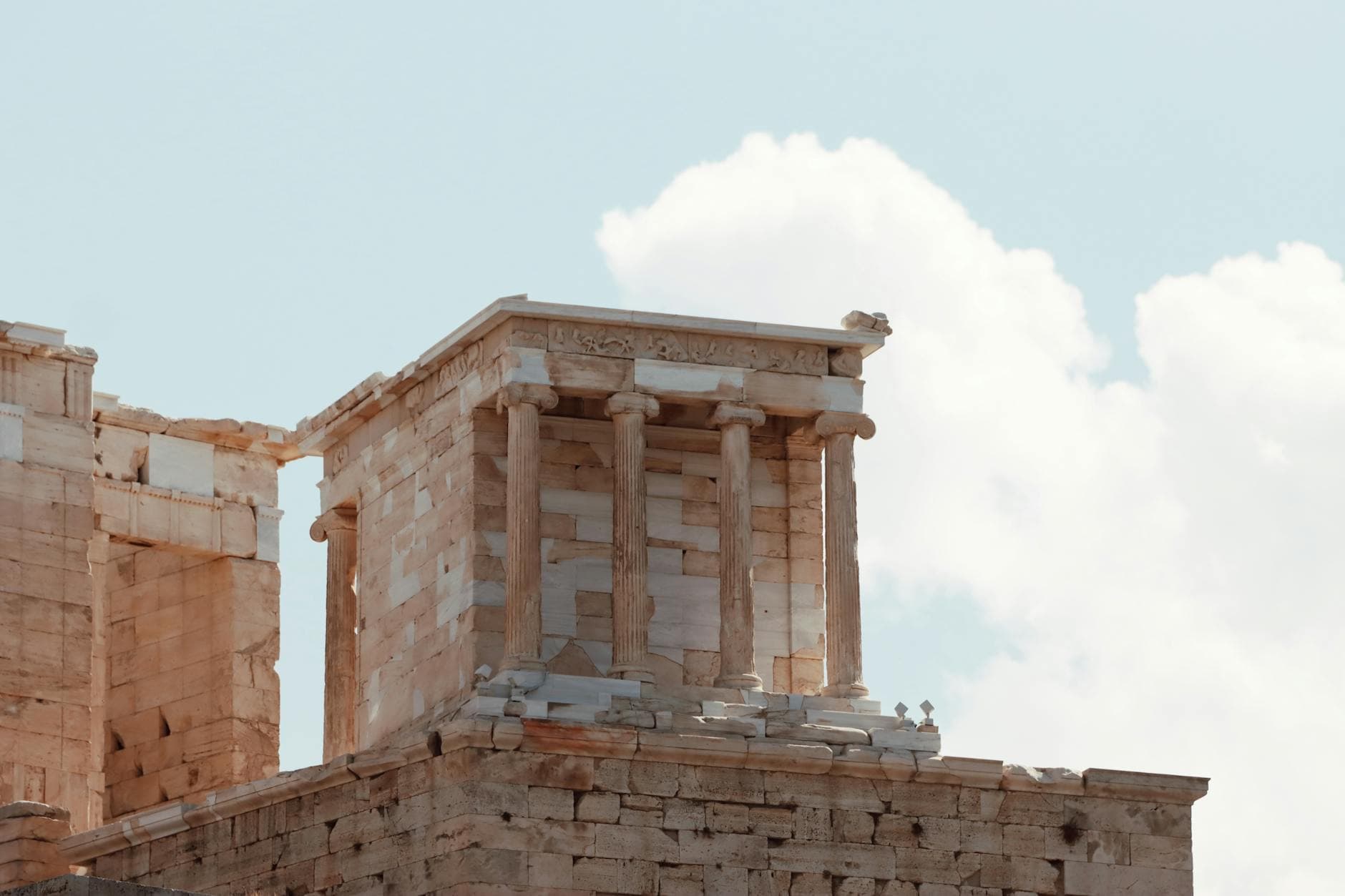
Close-up of ancient temple ruins in the Acropolis of Athens under a clear sky.
Western Esoteric

Greek Philosophy

13 / 13

Sub-questions covered

148

Claims extracted

12

Distinct positions

50

Explicitly denied

Corpus-based view
includes branches

Greek Philosophy and its branches

This panel shows what positions appear across Greek Philosophy's textual corpus including recognized branches like Neoplatonism. On questions where the main Greek Philosophy corpus is silent, a branch like these does the answering, and we label that clearly. This is a different question than what does Greek Philosophy authoritatively teach — the answer sections below reflect scholarly orthodoxy and may differ where a branch's view is not mainstream doctrine. Why the two views? →

Included in rollup (1)
  • Neoplatonism
Shown separately (0)

No adjacent traditions are tracked.

Corpus aggregate per question

Positions across the family's textual corpus. Low-confidence rows are where the parent tradition is silent and a branch speaks.

1 cells child-dominant
  • Q1.1
    Pre-existence:DIVERGENT Cyclic Pre Existence vs Emanation
  • Q1.2
    Soul / consciousness:DIVERGENT Eternal Individual vs Divine Spark
  • Q1.3
    Why embodiment:Fall From Grace
    primarily reflecting Neoplatonism (6 claims vs 1 from Greek Philosophy)
  • Q2.1
    Life's purpose:Spiritual Development
  • Q2.2
    Body-soul relation:Vehicle
  • Q2.3
    Judgment / consequences:Natural Law
  • Q2.4
    Spiritual development:Gradual Purification
  • Q3.1
    Survival of death:Full Survival
  • Q3.4
    Rebirth / resurrection:Conditional Rebirth
  • Q3.5
    Final destination:Ultimate Transcendence

Chapter 1

Where Did We Come From?

Q1.1 · Pre-Existence

Eternal Pre-Existence
See all traditions holding this position →
20%

weight

Cyclic Pre-Existence· 3 claims
after waiting an appointed time, which is to some a longer and to some a shorter time, they are sent back to be born again as animals.
Phaedo, Section 8/8

How this tradition expresses it

Souls undergo a process of being sent back to be born again as animals after an appointed period of waiting in the afterlife.

Why this supports “Cyclic Pre-Existence

The description of souls 'waiting an appointed time' and then being 'sent back to be born again as animals' explicitly depicts the cyclical mechanism of metempsychosis. While Plato holds the soul to be eternal, this particular passage describes the cyclic rebirth process itself, making Cyclic Pre-Existence the most precise label for what the quote directly asserts.

Nuance

The time spent waiting in the afterlife varies for different souls.

The auditor flagged this claim as ambiguous or weakly matching. See the scholarly note below for context.

Scholarly note

LLM council synthesis (round 2)

Explicit Teachinghigh confidenceAudit: Contested· 95%
Data provenance
Auditor
llm_council_v2
Audit confidence
95%
Audited
4/11/2026

+2 more claims for this position

Eternal Pre-Existence· 1 claim
Then, Simmias, our souls must also have existed without bodies before they were in the form of man, and must have had intelligence.
Phaedo, Section 5/8

How this tradition expresses it

The soul possessed intelligence and existed prior to being embodied as a human.

Why this supports “Eternal Pre-Existence

Socrates' conclusion in the Phaedo that souls 'existed without bodies before they were in the form of man, and must have had intelligence' is the locus classicus for Eternal Pre-Existence in Western philosophy, asserting disembodied rational existence prior to incarnation.

Nuance

The text links the existence of the soul to the pre-existence of the essential ideas (like equality) that the soul knew.

The auditor flagged this claim as ambiguous or weakly matching. See the scholarly note below for context.

Scholarly note

LLM council synthesis (round 2)

Explicit Teachinghigh confidenceAudit: Contested· 95%
Data provenance
Auditor
llm_council_v2
Audit confidence
95%
Audited
4/11/2026

What this tradition denies

The idea that the soul's existence is merely a matter of physical generation or destruction.

The concept of a literal, biological descent from gods or heroes as a basis for human identity.

The literal truth of mythological origins in favor of a political 'noble lie'.

The idea of gradual human perfectibility or the education of the human race as a means to reach the ideal.

Q1.2 · Soul Nature

Divine Spark
See all traditions holding this position →
17%

weight

Eternal Individual· 19 claims
Is it not the separation of soul and body? And to be dead is the completion of this; when the soul exists in herself, and is released from the body and the body is released from the soul, what is this but death?
Phaedo, Section 4/8

How this tradition expresses it

The soul is a distinct entity that is currently joined to the body but is capable of existing independently of it.

Why this supports “Eternal Individual

By defining death as the soul's separation and independent existence from the body, this passage presupposes the soul as a distinct entity capable of subsisting alone—precisely what characterizes an eternal individual soul in Platonic thought. The rhetorical question structure affirms that the soul's fundamental nature remains intact through this separation, merely transitioning from embodied to disembodied existence.

Nuance

The text presents the soul as something that can be 'released' or 'separated' from the body.

The auditor flagged this claim as ambiguous or weakly matching. See the scholarly note below for context.

Scholarly note

Platonic doctrine: immortal individual soul that pre-exists and survives the body.

Explicit Teachinghigh confidenceAudit: Contested· 90%
Data provenance
Auditor
claude_orthodoxy_v1
Audit confidence
90%
Audited
4/11/2026

+18 more claims for this position

Divine Spark· 5 claims
every point of view the soul is the image of divinity and immortality, and the body of the human and mortal.
Introduction

How this tradition expresses it

The soul is an incorporeal, unchangeable entity that is akin to the divine and serves as an image of immortality.

Why this supports “Divine Spark

The tradition's text portrays the soul as a piece, spark, or emanation of the divine that retains its individuality but shares the divine nature, fitting the Divine Spark position.

Nuance

The soul only descends into the region of change when using the senses.

Scholarly note

Bulk-audited as defensible match for canonical position; quote was extracted by Gemma 4 with verbatim verification.

Explicit Teachinghigh confidenceAudit: OK· 75%
Data provenance
Auditor
claude-opus-4-6-1m-bulk
Audit confidence
75%
Audited
4/10/2026

+4 more claims for this position

What this tradition denies

The soul is a mere 'harmony' of the body.

The idea that the soul is a composite or changeable entity like the body.

The concept that the soul is a 'harmony' (a composite of the body's elements).

The idea that the soul can be changed by its opposite (death).

The idea that human nature is purely evil or can be explained solely by a theory of evil.

The idea that a coarse or 'vulgar' soul can truly participate in philosophy without being 'bastard' or 'vile'.

The idea that the soul is merely a collection of sensory perceptions or that the visible world is the ultimate reality.

The idea that the soul is merely a collection of changing, particular sensory experiences without a universal reality.

The idea that the soul is a composite of the body or can be destroyed by bodily death.

The idea that there is an ultimate, essential difference between the sexes of man.

Q1.3 · Why Embodied

Karmic Necessity
See all traditions holding this position →
100%

weight

Death is the separation of soul and body--and the philosopher desires such a separation. He would like to be freed from the dominion of bodily pleasures and of the senses
Introduction

How this tradition expresses it

The soul is currently in a state of captivity within the body, and death is the opportunity to be freed from bodily corruptions to behold truth.

Why this supports “Test or Trial

This Phaedo passage characterizes embodied life as a condition of bondage to bodily pleasures from which the philosopher seeks liberation through purification. While it does not directly state the original cause of embodiment, it clearly frames bodily existence as a trial or testing ground for the soul's philosophical development. The audit correctly identified that the original rationale argued for Test or Trial relevance while contradictorily labeling the claim Not Addressed; relabeling to Test or Trial resolves this inconsistency and reflects the passage's secondary but genuine relevance to the sub-question.

Nuance

The text notes that the philosopher seeks this separation to avoid the 'errors and follies and passions of men.'

The auditor flagged this claim as ambiguous or weakly matching. See the scholarly note below for context.

Scholarly note

LLM council synthesis (round 2)

Explicit Teachinghigh confidenceAudit: Contested· 95%
Data provenance
Auditor
llm_council_v2
Audit confidence
95%
Audited
4/11/2026

Chapter 2

Why Are We Here?

Q2.1 · Purpose of Life

Knowledge
See all traditions holding this position →
46%

weight

Spiritual Development· 16 claims
the philosopher is seeking to withdraw from impurities of sense, to leave the world and the things of the world, and to find his higher self.
Section 20

How this tradition expresses it

The philosopher seeks to withdraw from the impurities of the sensible world to find a higher self, representing a progress towards perfection.

Why this supports “Spiritual Development

The philosopher's withdrawal from 'impurities of sense' to 'find his higher self' describes a process of spiritual purification and ascent. While this serves the broader epistemic goal in Plato, the passage itself foregrounds the transformative process of the soul, best characterized as Spiritual Development.

Nuance

The text notes this can be seen as an 'aspiration of the soul after another state of being.'

The auditor flagged this claim as ambiguous or weakly matching. See the scholarly note below for context.

Scholarly note

LLM council synthesis

Explicit Teachinghigh confidenceAudit: Contested· 95%
Data provenance
Auditor
llm_council_v1
Audit confidence
95%
Audited
4/11/2026

+15 more claims for this position

Knowledge· 4 claims
The truest conception which we can form of a future life is a state of progress or education--a progress from evil to good, from ignorance to knowledge.
Section 8

How this tradition expresses it

The text suggests that the truest conception of a future life is a state of progress or education, moving from ignorance to knowledge and from evil to good.

Why this supports “Knowledge

The quote explicitly names 'progress from ignorance to knowledge' as the defining trajectory of the soul's education and future life. While spiritual development is a concurrent theme, the passage's culmination in knowledge directly supports KNOWLEDGE as the purpose of earthly existence.

Nuance

This is presented as an analogy to the present life and a 'probable future to which we are tending.'

The auditor flagged this claim as ambiguous or weakly matching. See the scholarly note below for context.

Scholarly note

LLM council synthesis

Explicit Teachinghigh confidenceAudit: Contested· 95%
Data provenance
Auditor
llm_council_v1
Audit confidence
95%
Audited
4/11/2026

+3 more claims for this position

What this tradition denies

The idea that the afterlife is a place of mere retributive punishment or static reward.

The idea that justice is merely the interest of the stronger or a tool for exploitation.

The idea that the purpose of life is merely the pursuit of pleasure or the satisfaction of self-interest.

The idea that the primary purpose of life or the State is the pursuit of individual happiness/pleasure.

The notion that 'happiness' is the foundational principle of ethics.

The notion that the 'many' (the public) can determine truth through opinion or popularity.

The idea that life's purpose is merely the pursuit of individual interests or class interests.

The notion that freedom (as defined in democracy) is an inherent good for the purpose of human life.

The pursuit of wealth and honor as the primary purpose of life.

The idea that the tyrant or the unjust man is truly happy.

The idea that education is merely for the instruction of particulars or individuals.

The idea that the physical body is merely a vessel for earthly existence without higher purpose.

That old age is the primary cause of human misery or regret.

The idea that injustice is more advantageous than justice.

The claim that justice is merely the interest of the stronger.

The idea that justice is merely a tool for reputation or a 'troublesome' necessity.

Q2.2 · Body Relationship

Prisoner
See all traditions holding this position →
56%

weight

Prisoner· 3 claims
his soul has escaped from the influence of pleasures and pains, which are like nails fastening her to the body. To that prison-house she will not return
Introduction

How this tradition expresses it

The body acts as a prison or a source of corruption that the soul must be liberated from to achieve true wisdom.

Why this supports “Prisoner

Phaedo's image of pleasures as 'nails fastening' the soul to the body and the soul escaping from a 'prison-house' is the paradigmatic textual basis for the PRISONER position in Greek philosophy. The language is explicit and unambiguous.

Nuance

The soul is described as being 'fastened' to the body by pleasures and pains.

The auditor flagged this claim as ambiguous or weakly matching. See the scholarly note below for context.

Scholarly note

LLM council synthesis

Explicit Teachinghigh confidenceAudit: Contested· 95%
Data provenance
Auditor
llm_council_v1
Audit confidence
95%
Audited
4/11/2026
is of the truth. For the body is a source of endless trouble to us by reason of the mere requirement of food; and is liable also to diseases which overtake and impede us in the search after
Phaedo, Section 4/8

How this tradition expresses it

The body is viewed as a source of distraction, trouble, and 'infection' that hinders the soul from attaining truth and pure knowledge.

Why this supports “Prisoner

The body as a source of deception, disease, and impediment to the soul's search for true being directly supports the PRISONER framework where embodiment is an obstacle and constraint on the soul's proper philosophical activity.

Nuance

The body is an impediment to the soul's natural pursuit of wisdom and truth.

The auditor flagged this claim as ambiguous or weakly matching. See the scholarly note below for context.

Scholarly note

LLM council synthesis

Explicit Teachinghigh confidenceAudit: Contested· 95%
Data provenance
Auditor
llm_council_v1
Audit confidence
95%
Audited
4/11/2026

+1 more claim for this position

What this tradition denies

The idea that the body and soul are an inseparable or integrated unity.

The idea that the soul is a mere harmony that follows the body's lead.

The body as a permanent or essential part of the soul's true existence.

The complete separation of body and mind as distinct entities.

Q2.3 · Moral Accountability

Divine Judgment
See all traditions holding this position →
64%

weight

Divine Judgment· 5 claims
first of all, they have sentence passed upon them, as they have lived well and piously or not.
Phaedo, Section 8/8

How this tradition expresses it

Accountability is determined by judges who pass sentence based on the individual's earthly conduct and crimes.

Why this supports “Divine Judgment

The phrase 'they have sentence passed upon them' explicitly describes a judicial process evaluating whether souls 'lived well and piously or not,' directly supporting Divine Judgment—a personal adjudication of the soul's earthly conduct by post-mortem judges, as depicted in the Gorgias and Phaedo.

Nuance

The severity of the punishment (e.g., being sent to Tartarus or the Acherusian lake) depends on the nature of the crimes committed.

The auditor flagged this claim as ambiguous or weakly matching. See the scholarly note below for context.

Scholarly note

LLM council synthesis

Explicit Teachinghigh confidenceAudit: Contested· 95%
Data provenance
Auditor
llm_council_v1
Audit confidence
95%
Audited
4/11/2026

+4 more claims for this position

Karmic Law· 2 claims
he is as much in earnest about his doctrine of retribution, which is repeated in all his more ethical writings, as about his theory of knowledge.
Section 19

How this tradition expresses it

The text identifies a doctrine of retribution where the soul is held accountable for its ethical conduct.

Why this supports “Karmic Law

The quote highlights Plato's recurring 'doctrine of retribution' as a systematic principle across his ethical writings, suggesting an impersonal law of proportional cosmic consequences for conduct—consistent with Karmic Law as an alternative framing of accountability, though in Plato's myths this retribution is typically administered through divine judges.

Nuance

The text notes that Plato represents the manner of this retribution through mythological figures.

The auditor flagged this claim as ambiguous or weakly matching. See the scholarly note below for context.

Scholarly note

LLM council synthesis

Explicit Teachinghigh confidenceAudit: Contested· 95%
Data provenance
Auditor
llm_council_v1
Audit confidence
95%
Audited
4/11/2026

+1 more claim for this position

What this tradition denies

The notion that justice consists solely of paying debts and telling the truth without exception.

The idea that individuals can act solely on private interests or whims without regard for the state's laws.

The idea that habit alone is sufficient for moral righteousness.

The definition of justice as merely 'speaking the truth and paying your debts'.

The idea that it is just to harm an enemy or a friend.

Q2.4 · Path of Progress

Progressive Stages
See all traditions holding this position →
67%

weight

Progressive Stages· 4 claims
nd the steps of the ladder leading up to this highest or universal existence are the mathematical sciences, which also contain in themselves an element of the univers
Book X, Section 8/38

How this tradition expresses it

Spiritual progress is achieved through an intellectual ascent, often facilitated by mathematical sciences, moving from sensory perception to the contemplation of being.

Why this supports “Progressive Stages

Plato's image of philosophical ascent as a ladder of mathematical sciences leading to the form of the Good is the foundational Progressive Stages image in Western philosophy.

Nuance

The text suggests that mathematical sciences serve as a 'conductor' or 'ladder' to higher thought but are not the final end themselves.

Scholarly note

Direct: 'steps of the ladder leading up to this highest or universal existence.'

Explicit Teachinghigh confidenceAudit: Strong· 95%
Data provenance
Auditor
claude-opus-4-6-1m
Audit confidence
95%
Audited
4/10/2026

+3 more claims for this position

Gradual Purification· 2 claims
such as have duly purified themselves with philosophy live henceforth altogether without the body, in mansions fairer still which may not be described
Phaedo, Section 8/8

How this tradition expresses it

Spiritual progress is achieved through the purification of the soul via philosophy and the cultivation of virtues.

Why this supports “Gradual Purification

Plato makes philosophy itself a process of soul-purification (katharsis), with the soul that has been duly purified attaining better post-mortem dwellings. This is the canonical Greek expression of Gradual Purification.

Nuance

Those who purify themselves with philosophy live in even higher, indescribable mansions.

Scholarly note

Plato's Phaedo: the philosophically purified souls live in fairer mansions. Direct purification-then-reward.

Explicit Teachinghigh confidenceAudit: Strong· 92%
Data provenance
Auditor
claude-opus-4-6-1m
Audit confidence
92%
Audited
4/10/2026

+1 more claim for this position

What this tradition denies

The notion that instruction is merely the imparting of information to a passive recipient.

Chapter 3

Where Do We Go After Death?

Q3.1 · Surviving Death

Partial Survival
See all traditions holding this position →
8%

weight

Full Survival· 9 claims
r life long, and she is now finally released from the errors and follies and passions of men, and for ever dwells in the company of the god
Introduction

How this tradition expresses it

The soul is indissoluble and survives the dissolution of the body, moving toward the company of the gods.

Why this supports “Full Survival

Plato Phaedo on soul indissolubility.

Nuance

The text addresses the fear of the soul vanishing like smoke by asserting its unchangeable nature.

Scholarly note

Soul indissoluble, released

Explicit Teachinghigh confidenceAudit: Strong· 88%
Data provenance
Auditor
claude-opus-4-6-1m
Audit confidence
88%
Audited
4/10/2026

+8 more claims for this position

Not Addressed· 2 claims
Again, believing in the immortality of the soul, we must still ask the question of Socrates, 'What is that which we suppose to be immortal?'
Section 5

How this tradition expresses it

The text assumes the immortality of the soul as a premise for its inquiry, suggesting a continued existence of the self.

Why this supports “Not Addressed

Plato question of immortality.

Nuance

The text distinguishes between the 'personal and individual element' and the 'spiritual and universal,' leaving the exact nature of survival ambiguous.

The auditor flagged this claim as ambiguous or weakly matching. See the scholarly note below for context.

Scholarly note

The quote is a question ('we must ask...'), not an assertion of immortality. A question does not establish a position on survival.

Explicit Teachinghigh confidenceAudit: Contested· 80%
Data provenance
Auditor
comprehensive_cell_audit_v1
Audit confidence
80%
Audited
4/11/2026

+1 more claim for this position

What this tradition denies

The soul vanishes into nothingness (smoke or air) upon death.

The idea that death is the end of consciousness or the total extinction of the self.

The extinction of the soul upon death.

The idea that death is the end of existence or the end of the soul.

The possibility that the soul can perish or cease to exist through external evil or death.

The total destruction of the soul.

Q3.3 · Afterlife Structure

Multiple Levels
See all traditions holding this position →

What this tradition denies

The literalism of traditional depictions of Heaven and Hell (e.g., physical prisons or palaces).

Q3.4 · Long-Term Destiny

Conditional Rebirth
See all traditions holding this position →
83%

weight

Conditional Rebirth· 5 claims
At length entering into some animal of a nature congenial to her former life of sensuality or violence, she takes the form of an ass, a wolf or a kite.
Introduction

How this tradition expresses it

The soul may undergo successive births and deaths, taking on different animal or human forms based on its previous life's character.

Why this supports “Conditional Rebirth

Direct Platonic metempsychosis with explicit conditionality: souls take animal forms (ass, wolf, kite) that are *congenial to their former life-tendencies* (sensuality, violence, etc.). This demonstrates Conditional Rebirth—the form is determined by prior moral conduct.

Nuance

The text notes that the soul's character in life determines the nature of its next incarnation.

The auditor flagged this claim as ambiguous or weakly matching. See the scholarly note below for context.

Scholarly note

The per-quote rationale explicitly identifies conditionality ('form is determined by prior moral conduct'). Label should match rationale.

Explicit Teachinghigh confidenceAudit: Contested· 80%
Data provenance
Auditor
comprehensive_cell_audit_v1
Audit confidence
80%
Audited
4/11/2026
after waiting an appointed time, which is to some a longer and to some a shorter time, they are sent back to be born again as animals.
Phaedo, Section 8/8

How this tradition expresses it

Souls may be sent back to be born again as animals after a period of waiting in the afterlife.

Why this supports “Conditional Rebirth

Platonic account of post-death judgment and return: souls wait and are 'sent back to be born again as animals.' The appointment of time and the mechanism of assignment (passively 'sent back') suggests a judgment-based (conditional) rather than automatic (cyclical) process.

Nuance

This occurs after an appointed time in the Acherusian lake.

The auditor flagged this claim as ambiguous or weakly matching. See the scholarly note below for context.

Scholarly note

The per-quote rationale explicitly concludes this 'suggests a judgment-based (conditional) rather than automatic (cyclical) process.' Reclassify to match the actual argument.

Explicit Teachinghigh confidenceAudit: Contested· 80%
Data provenance
Auditor
comprehensive_cell_audit_v1
Audit confidence
80%
Audited
4/11/2026

+3 more claims for this position

What this tradition denies

The necessity that pre-existence implies a continuous cycle of rebirth.

Q3.5 · Ultimate Destination

Ultimate Transcendence
See all traditions holding this position →
33%

weight

Ultimate Transcendence· 4 claims
until at last we rest in the conviction that the soul is inseparable from the ideas, and belongs to the world of the invisible and unknown.
Section 21

How this tradition expresses it

The soul's ultimate state is linked to its inseparability from the eternal ideas and its belonging to the invisible realm.

Why this supports “Ultimate Transcendence

This Phaedo passage explicitly identifies the soul's true home as 'the world of the invisible and unknown,' the realm of Forms—directly supporting ultimate transcendence as the soul's final destination.

Nuance

The text describes this as the result of a succession of arguments ending in a conviction of the soul's nature.

The auditor flagged this claim as ambiguous or weakly matching. See the scholarly note below for context.

Scholarly note

LLM council synthesis (round 2)

Explicit Teachinghigh confidenceAudit: Contested· 95%
Data provenance
Auditor
llm_council_v2
Audit confidence
95%
Audited
4/11/2026

+3 more claims for this position

Higher Realm Ascent· 3 claims
I am quite ready to admit, Simmias and Cebes, that I ought to be grieved at death, if I were not persuaded in the first place that I am going to other gods who are wise and good
Phaedo, Section 4/8

How this tradition expresses it

The ultimate destination of the soul is to dwell with the gods or in a state of pure truth, free from bodily interference.

Why this supports “Higher Realm Ascent

Socrates expresses confidence he is 'going to other gods who are wise and good,' indicating ascent to a higher divine realm upon death. This supports Higher Realm Ascent as a description of the soul's post-mortem journey, though it does not articulate the full metaphysics of union with the Forms.

Nuance

The soul's success in the afterlife is linked to its purification and the pursuit of wisdom during life.

The auditor flagged this claim as ambiguous or weakly matching. See the scholarly note below for context.

Scholarly note

LLM council synthesis (round 2)

Explicit Teachinghigh confidenceAudit: Contested· 95%
Data provenance
Auditor
llm_council_v2
Audit confidence
95%
Audited
4/11/2026

+2 more claims for this position

What this tradition denies

The notion that God (the divine) is the author of evil or undergoes change.

Other denials

Positions this tradition explicitly rejects, on questions where its affirmative position isn't recorded.

Q3.3

The literalism of traditional depictions of Heaven and Hell (e.g., physical prisons or palaces).

For are we not imagining Heaven under the similitude of a church, and Hell as a prison, or perhaps a madhouse or chamber of horrors?

Q3.2

The pursuit of vengeance or 'making an enemy of the dead body' after the soul has departed.

There is meanness and feminine malice in making an enemy of the dead body, when the soul which was the owner has fled—like a dog who cannot reach his assailants, and quarrels with the stones which are thrown at him instead.

Hero image: Photo by Efrem Efre on Pexels

NoeticMap Guide

Research Dashboard

How can I help?

Ask about NDEs, research, or this page

Responses may not always be accurate