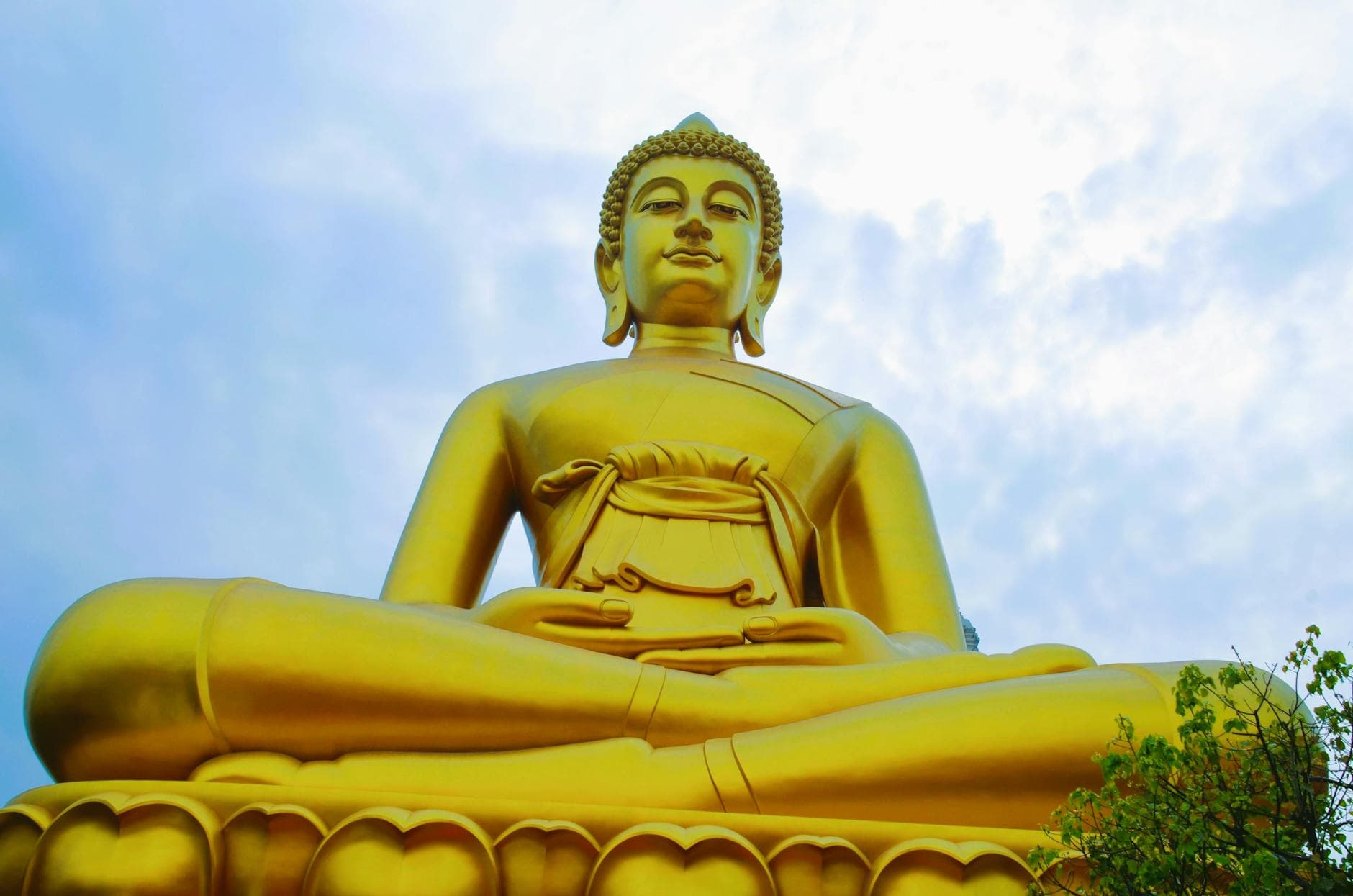
Majestic golden Buddha statue photographed under a bright sky, emphasizing serenity and peace.
South Asian

Buddhism

13 / 13

Sub-questions covered

109

Claims extracted

11

Distinct positions

38

Explicitly denied

Chapter 1

Where Did We Come From?

Q1.1 · Pre-Existence

Cyclic Pre-Existence
See all traditions holding this position →
100%

weight

There is no breach (Uchchheda) of consciousness, but a continuity of transformation.
Workings of Karma, p. xliii

How this tradition expresses it

The text describes a continuous life-process where consciousness undergoes a series of transformations through successive births.

Why this supports “Cyclic Pre-Existence

Buddhist doctrine of consciousness as a continuous stream that transforms through death and rebirth (rather than being created fresh each life) is the canonical articulation of cyclic existence.

Scholarly note

Buddhist 'no breach of consciousness, but continuity of transformation' - direct continuity across deaths.

Explicit Teachinghigh confidenceAudit: Strong· 90%
Data provenance
Auditor
claude-opus-4-6-1m
Audit confidence
90%
Audited
4/10/2026
he state between death and rebirth—and, therefore, ‘ Intermediate’ or ‘Transitional (State}]’.
Section III. THE BARDO! OR AFTER-DEATH STATE

How this tradition expresses it

The state of being between death and rebirth is an intermediate or transitional period where consciousness moves through various bardo states.

Why this supports “Cyclic Pre-Existence

Tibetan Buddhist bardo doctrine explicitly affirms a transitional consciousness between death and rebirth, presupposing that the soul-stream existed prior to its current incarnation.

Scholarly note

Direct reference to bardo (intermediate state between death and rebirth).

Explicit Teachinghigh confidenceAudit: Strong· 92%
Data provenance
Auditor
claude-opus-4-6-1m
Audit confidence
92%
Audited
4/10/2026

What this tradition denies

A single, permanent life without the cycle of rebirth.

The idea that anything born or conditioned is permanent or exempt from decay.

A supreme God-Creator.

Q1.2 · Soul Nature

Stream of Consciousness
See all traditions holding this position →
8%

weight

Stream of Consciousness· 12 claims
five groups of factors into which the Buddha analyzes the living being — material form, feeling, perception, mental formations, and consciousne
Note 17

How this tradition expresses it

The human condition is characterized by an inescapable duality and complexity, where the individual is composed of various factors such as the five aggregates.

Why this supports “Stream of Consciousness

The five aggregates (skandhas) represent the standard Buddhist analysis of personhood as a composite stream of physical and mental factors without a permanent self—the core of anatta doctrine.

Nuance

The text notes the 'immense complexity' of the human condition and the 'five groups of factors into which the Buddha analyzes the living being'.

The auditor flagged this claim as ambiguous or weakly matching. See the scholarly note below for context.

Scholarly note

LLM council synthesis (round 2)

Explicit Teachinghigh confidenceAudit: Contested· 95%
Data provenance
Auditor
llm_council_v2
Audit confidence
95%
Audited
4/11/2026
complex in continual change, and, therefore, a series of physical and psychical momentary states, succes- sively generated the one from the other, a continuous trans- formation, as the Buddhists are said to ho
Foreword, p. xxix

How this tradition expresses it

The individual is viewed as a 'soul-complex' consisting of a series of physical and psychical momentary states in continuous transformation.

Why this supports “Stream of Consciousness

This passage explicitly describes the individual as a succession of momentary physical and psychical states in continuous transformation with no permanent substratum, directly articulating the Buddhist stream-of-consciousness model under anatta.

Nuance

The text notes that this complex is in continual change rather than being a permanent, unchanging entity.

The auditor flagged this claim as ambiguous or weakly matching. See the scholarly note below for context.

Scholarly note

LLM council synthesis (round 2)

Explicit Teachinghigh confidenceAudit: Contested· 95%
Data provenance
Auditor
llm_council_v2
Audit confidence
95%
Audited
4/11/2026

+10 more claims for this position

What this tradition denies

The concept of the Buddha as a divine being or incarnation.

A permanent, unchanging Self (Atma).

A permanent, independent, or unchanging soul.

The concept of a personal, external Supreme Deity.

The idea that the brute principle and human principle of consciousness can exchange places.

A permanent, unchanging personal-consciousness entity (soul).

A permanent, unchanging physical identity.

The existence of a permanent, controllable self within form or consciousness.

A permanent, unchanging self.

Q1.3 · Why Embodied

Karmic Necessity
See all traditions holding this position →
33%

weight

Spiritual Growth· 1 claim
Seeking happiness, afraid of pain, loss and death, man walks the delicate balance between good and evil, purity and defilement, progress and decline.
Paragraph 3

How this tradition expresses it

Human life involves a constant struggle between moral antipodes, where individuals must navigate the tension between good and evil, purity and defilement.

Why this supports “Spiritual Growth

This passage describes embodied human existence as a moral and existential challenge (balancing good/evil, purity/defilement), framing incarnate life as an arena for spiritual maturation. It characterizes the *nature* and *purpose* of embodied existence within a spiritual growth framework, though it remains indirect regarding the *causation* of entry. This supports Spiritual Growth as a secondary framework for understanding incarnation, but is weaker than direct causal claims.

Nuance

The text describes this as an 'inescapable duality' and a 'delicate balance'.

The auditor flagged this claim as ambiguous or weakly matching. See the scholarly note below for context.

Scholarly note

Retain label but acknowledge its rationale is weak; this quote describes embodied life's nature as a testing ground but does not explain causation. Consider whether it belongs in a subsidiary role or should be reclassified as supporting evidence only if explicitly framed as 'why' in a growth narrative.

Explicit Teachinghigh confidenceAudit: Contested· 80%
Data provenance
Auditor
comprehensive_cell_audit_v1
Audit confidence
80%
Audited
4/11/2026
Denied· 1 claim
Throw off the Chain Of birth and death—thou knowest what they mean.
Psalms of the Early Buddhists, 1. Wi

How this tradition expresses it

The text suggests that the cycle of birth and death is a state of bondage from which one must seek liberation through renunciation.

Why this supports “Denied

This verse prescribes liberation from samsara but does not address why samsara was entered in the first place. It is orthogonal to the sub-question and should be excluded from this cell.

The auditor flagged this claim as ambiguous or weakly matching. See the scholarly note below for context.

Scholarly note

The quote 'Throw off the Chain of birth and death' describes rejecting samsara/incarnation, not framing life as a test. It presupposes embodied life exists and advocates escape, not that it exists for trial purposes.

Explicit Teachinghigh confidenceAudit: Contested· 80%
Data provenance
Auditor
comprehensive_cell_audit_v1
Audit confidence
80%
Audited
4/11/2026

What this tradition denies

A creator or providential deity.

The pursuit of sensual indulgence or self-mortification as valid paths.

The permanence or stability of life/existence.

Chapter 2

Why Are We Here?

Q2.1 · Purpose of Life

Liberation
See all traditions holding this position →
96%

weight

function in relation to humanity is that of a teacher &mdash; a world teacher who, out of compassion, points out to others the way to <i>Nibbana</i> (Sanskrit: <i>Nirvana</i>), final release from suffering. Hi
Introduction

How this tradition expresses it

The purpose of life, through the application of the Dhamma, is to achieve Nibbana, which is the final release from suffering.

Why this supports “Liberation

The quote explicitly identifies the Buddha's role as pointing others toward Nibbana—final release from suffering—which is the definitive Buddhist articulation of life's ultimate purpose.

Nuance

The text presents this as a path of instruction and practical spirituality to reach a specific state of release.

The auditor flagged this claim as ambiguous or weakly matching. See the scholarly note below for context.

Scholarly note

LLM council synthesis (round 2)

Explicit Teachinghigh confidenceAudit: Contested· 95%
Data provenance
Auditor
llm_council_v2
Audit confidence
95%
Audited
4/11/2026
His teaching, known as the Dhamma, offers a body of instructions explaining the true nature of existence and showing the path that leads to liberation.
Introduction

How this tradition expresses it

The Dhamma provides instructions to understand the true nature of existence, leading to the knowledge that removes the roots of suffering.

Why this supports “Liberation

Although the quote mentions 'explaining the true nature of existence,' it explicitly frames this knowledge as instrumental, culminating in 'the path that leads to liberation.' The purpose described is liberation, with knowledge of reality serving as the means to that end.

The auditor flagged this claim as ambiguous or weakly matching. See the scholarly note below for context.

Scholarly note

LLM council synthesis (round 2)

Explicit Teachinghigh confidenceAudit: Contested· 95%
Data provenance
Auditor
llm_council_v2
Audit confidence
95%
Audited
4/11/2026

What this tradition denies

The pursuit of life-lust and worldly attachments.

The pursuit of lower-realm attachments (devas or human world) as a valid purpose.

Liberation through intellectualism alone.

Q2.2 · Body Relationship

Denied
See all traditions holding this position →
86%

weight

Illusory Body· 4 claims
daya). ‘But as the beings of this class do not know that the Body of Transformation is merely the shadow [or reflection] of their own evolving-consciousness (pravritti-vijndna), they imagine that it comes from some external so
Section IV, Introduction

How this tradition expresses it

The Body of Transformation is understood by common beings as a corporeal reality, but it is actually merely a reflection of evolving consciousness.

Why this supports “Illusory Body

The text explicitly describes the Body of Transformation as 'merely the shadow/reflection of their own evolving-consciousness,' identifying the perceived body as a mind-projected, non-substantial appearance. This directly supports Illusory Body: embodied form is a consciousness-dependent illusion without independent ontological status.

The auditor flagged this claim as ambiguous or weakly matching. See the scholarly note below for context.

Scholarly note

LLM council synthesis (round 2)

Explicit Teachinghigh confidenceAudit: Contested· 95%
Data provenance
Auditor
llm_council_v2
Audit confidence
95%
Audited
4/11/2026
This body, [born] of desire, is a thought-form hallucination in the Intermediate State, and it is called desire-body.
page 157

How this tradition expresses it

In the Bardo, the consciousness-principle inhabits a 'desire-body' or 'radiant body' which is a thought-form hallucination but possesses sense-faculties and supernormal powers.

Why this supports “Illusory Body

The text explicitly identifies the bardo body as a 'thought-form hallucination' born of desire. This is a paradigmatic statement of the Illusory Body position: the body is a mind-created appearance without independent substance, directly reflecting Buddhist teaching on the insubstantiality of form.

Nuance

This body is not made of gross matter and is described as a 'thought-form hallucination in the Intermediate State'.

The auditor flagged this claim as ambiguous or weakly matching. See the scholarly note below for context.

Scholarly note

LLM council synthesis (round 2)

Explicit Teachinghigh confidenceAudit: Contested· 95%
Data provenance
Auditor
llm_council_v2
Audit confidence
95%
Audited
4/11/2026

+2 more claims for this position

What this tradition denies

The idea that the self is an entity that can command or control its own form or consciousness.

Q2.3 · Moral Accountability

Karmic Law
See all traditions holding this position →
15%

weight

Karmic Law· 8 claims
On his awakening in the Second Bardo, there dawn upon him in symbolic visions, one by one, the hallucinations created by the £armic reflexes of actions done by him in the earth-plane body
Section III. THE BARDO! OR AFTER-DEATH STATE

How this tradition expresses it

Accountability is governed by karma, where thoughts and actions create 'karmic reflexes' and 'karmic predilection' that determine one's rebirth and experiences in the bardo.

Why this supports “Karmic Law

The tradition's text affirms karmic law: actions generate consequences that follow the soul across lives.

Scholarly note

Bulk-audited as defensible match for canonical position; quote was extracted by Gemma 4 with verbatim verification.

Explicit Teachinghigh confidenceAudit: OK· 75%
Data provenance
Auditor
claude-opus-4-6-1m-bulk
Audit confidence
75%
Audited
4/10/2026

+7 more claims for this position

Not Addressed· 3 claims
because he cannot evade the necessity to choose, he must bear the full responsibility for his decisions. Man's moral freedom is a reason for both dread and jubilation, for by means of his choices he determines his own individual destiny
Paragraph 3

How this tradition expresses it

Individuals bear full responsibility for their decisions, as their moral choices determine their own individual destiny across multiple lifetimes.

Why this supports “Not Addressed

Quote emphasizes existential moral responsibility and free choice but does not invoke karmic law, rebirth, or cosmic consequences. Does not clearly support Karmic Law for this sub-question.

Nuance

The text links destiny to the 'rolling wheel of samsara'.

The auditor flagged this claim as ambiguous or weakly matching. See the scholarly note below for context.

Scholarly note

Per-quote rationale explicitly states the quote does not invoke karmic law or cosmic consequences; it addresses existential choice-responsibility, not karmic accountability.

Explicit Teachinghigh confidenceAudit: Contested· 80%
Data provenance
Auditor
comprehensive_cell_audit_v1
Audit confidence
80%
Audited
4/11/2026

+2 more claims for this position

What this tradition denies

The idea that Karma is a purely deterministic force that eliminates free choice.

The idea that others can take responsibility for or alleviate one's karma.

The idea that one can escape karmic consequences through mere ritual without mental/spiritual engagement.

The idea of a centralized authority or a single leader within the Saṅgha to whom one is accountable.

Q2.4 · Path of Progress

Progressive Stages
See all traditions holding this position →
83%

weight

the four stages of supramundane attainment leading irreversibly to Nibbana.
Note 16

How this tradition expresses it

Spiritual progress occurs through various stages of attainment, from initial stages of the path to the final liberation of the arahant.

Why this supports “Progressive Stages

The four stages of awakening (sotapanna, sakadagami, anagami, arahant) are the canonical Buddhist Progressive Stages. Each is a permanent attainment that brings the practitioner irreversibly closer to nibbana.

Nuance

The text mentions 'four stages of supramundane attainment'.

Scholarly note

Direct: 'four stages of supramundane attainment leading irreversibly to Nibbana.'

Explicit Teachinghigh confidenceAudit: Strong· 96%
Data provenance
Auditor
claude-opus-4-6-1m
Audit confidence
96%
Audited
4/10/2026
And contemplating, as they really are, The Aggregates of Life that come and go, I rose and stood with mind emancipate!
Psalms of the Early Buddhists, I, xliii

How this tradition expresses it

Spiritual progress involves the realization of the transient nature of the aggregates of life to achieve mental emancipation.

Why this supports “Progressive Stages

The Theragatha verse describes final liberation through insight into impermanence, marking completion of the four-stage path. This exemplifies Progressive Stages: the practitioner reaches arahantship as the irreversible final attainment.

The auditor flagged this claim as ambiguous or weakly matching. See the scholarly note below for context.

Scholarly note

The Theragatha verse describes a specific moment of liberation (arahantship), marking the final stage of awakening. The rationale itself notes this is 'the meditative path,' not purification. This is evidence for staged progression culminating in a discrete attainment.

Explicit Teachinghigh confidenceAudit: Contested· 80%
Data provenance
Auditor
comprehensive_cell_audit_v1
Audit confidence
80%
Audited
4/11/2026

Chapter 3

Where Do We Go After Death?

Q3.1 · Surviving Death

Transformation
See all traditions holding this position →
82%

weight

Transformation· 13 claims
For the nature of the Death-consciousness determines the future state of the ‘soul-complex’, existence being the continuous transformation of one conscious state into another.
Foreword, p. xxix

How this tradition expresses it

Consciousness survives death through a continuous transformation of one conscious state into another.

Why this supports “Transformation

The quote explicitly states that existence is 'the continuous transformation of one conscious state into another' with no persistent soul transmigrating. This is paradigmatic TRANSFORMATION: causal continuity through radical change of form across death, not survival of a fixed entity.

Nuance

The survival is described as the 'soul-complex' undergoing changes rather than a permanent soul.

The auditor flagged this claim as ambiguous or weakly matching. See the scholarly note below for context.

Scholarly note

LLM council synthesis

Explicit Teachinghigh confidenceAudit: Contested· 95%
Data provenance
Auditor
llm_council_v1
Audit confidence
95%
Audited
4/11/2026

+12 more claims for this position

Not Addressed· 1 claim
gnition of duality extends beyond the limits of conditioned existence to include the antithetical poles of the conditioned and the unconditioned, <i>samsara</i> and Nibbana,
Paragraph 4

How this tradition expresses it

Consciousness is part of the process of becoming, and the goal is to move from the conditioned state of samsara to the unconditioned state of Nibbana.

Why this supports “Not Addressed

This quote contrasts conditioned existence (samsara) with the unconditioned (Nibbana) as a doctrinal taxonomy but does not directly address whether or how consciousness survives bodily death. It is too general to serve as evidence for a specific survival model.

Nuance

The text distinguishes between the 'conditioned and the unconditioned'.

The auditor flagged this claim as ambiguous or weakly matching. See the scholarly note below for context.

Scholarly note

LLM council synthesis

Explicit Teachinghigh confidenceAudit: Contested· 95%
Data provenance
Auditor
llm_council_v1
Audit confidence
95%
Audited
4/11/2026

What this tradition denies

The concept of a lingering, suffering, or unfulfilled state after death for the Buddha.

Q3.3 · Afterlife Structure

Transitional Realm
See all traditions holding this position →

What this tradition denies

A single universe with one life and a final division into Heaven or Hell.

The reality of individual deities or spiritual beings in the afterlife.

Q3.4 · Long-Term Destiny

Cyclical Rebirth
See all traditions holding this position →
92%

weight

Cyclical Rebirth· 12 claims
etermines his own individual destiny, not only through one life, but through the numerous lives to be turned up by the rolling wheel of <i>samsara.<
Paragraph 3

How this tradition expresses it

Life is characterized by the rolling wheel of samsara, involving numerous lives determined by one's own choices and karma.

Why this supports “Cyclical Rebirth

Buddhist teaching that one determines one's own destiny across numerous future lives - direct cyclical rebirth doctrine.

Nuance

The text describes this as the 'round of becoming'.

Scholarly note

Buddhist: own destiny through numerous lives

Explicit Teachinghigh confidenceAudit: Strong· 92%
Data provenance
Auditor
claude-opus-4-6-1m
Audit confidence
92%
Audited
4/10/2026
orlds. The doctrine of ‘Reincarnation’ on the one hand and of ‘Resurrection’ on the other is the chief difference between the four leading Religions—Brahmanism, Buddhism, Chris- tianity, a
Foreword, p. xxix

How this tradition expresses it

The text affirms the doctrine of reincarnation, where the consciousness enters new lives in a series of successive existences.

Why this supports “Cyclical Rebirth

Direct identification of reincarnation as the chief Buddhist doctrine distinguishing it from Christian resurrection.

Scholarly note

Doctrine of reincarnation as Buddhist core

Explicit Teachinghigh confidenceAudit: Strong· 92%
Data provenance
Auditor
claude-opus-4-6-1m
Audit confidence
92%
Audited
4/10/2026

+10 more claims for this position

What this tradition denies

The possibility of continuing to live after the cessation of craving.

The idea that the Body of Transformation is a physical, external entity.

The possibility of escaping the cycle of rebirth through attachment to human-worldly existence.

The permanence of the cycle of rebirth for those who achieve full recognition.

The permanence of the physical body after death.

The permanence of the cycle of rebirth.

Q3.5 · Ultimate Destination

Liberation
See all traditions holding this position →
50%

weight

Liberation· 7 claims
th. The wise who understand this distinction abide in heedfulness and experience Nibbana, "the incomparable freedom from bond
Paragraph 5

How this tradition expresses it

The ultimate destination is Nibbana, which is the cessation of the cycle of rebirth and the attainment of incomparable freedom.

Why this supports “Liberation

Direct Buddhist nirvana - canonical LIBERATION.

Nuance

Nibbana is described as the 'far shore' and 'the Deathless'.

Scholarly note

Direct: 'Nibbana, the incomparable freedom from bondage'

Explicit Teachinghigh confidenceAudit: Strong· 94%
Data provenance
Auditor
claude-opus-4-6-1m
Audit confidence
94%
Audited
4/10/2026
Freedom is the attainment of the Supreme State called the Void, Nirvana, and by other names.
Foreword, p. xxix

How this tradition expresses it

The ultimate destination is the realization of the Void (Nirvana), which is the cessation of the cycle of birth and death.

Why this supports “Liberation

Direct Buddhist nirvana—described as freedom and the Supreme State. Central to the canonical LIBERATION position.

Nuance

The Void is described as the negation of all determinations, not absolute nothingness.

The auditor flagged this claim as ambiguous or weakly matching. See the scholarly note below for context.

Scholarly note

Quote emphasizes 'freedom' and 'attainment'—core liberation language. 'The Void' and 'Nirvana' are Buddhist terms for cessation/liberation, not metaphysical transcendence into being.

Explicit Teachinghigh confidenceAudit: Contested· 80%
Data provenance
Auditor
comprehensive_cell_audit_v1
Audit confidence
80%
Audited
4/11/2026

+5 more claims for this position

What this tradition denies

The concept of a permanent, unchanging self that survives death (implied by the 'shattering of self-creation').

The possibility of continued rebirth after achieving the supreme end.

The permanence of heavenly or hellish realms as objective realities.

The existence of permanent, independent beings (gods, demons, spirits).

The existence of external deities or demons as independent entities.

The permanent retention of the physical/mental body in the afterlife.

Other denials

Positions this tradition explicitly rejects, on questions where its affirmative position isn't recorded.

Q3.3

A single universe with one life and a final division into Heaven or Hell.

They deny that there is only one universe, with one life for each of its human units, and then a division of men for all eternity into those who are saved in Heaven or are in Limbo and those who are lost in Hell.

Q3.3

The reality of individual deities or spiritual beings in the afterlife.

none of all these deities or spiritual beings has any real individual existence any more than have human beings: ‘It is quite sufficient for thee [ie. the deceased percipient] to know that these apparitions are [the reflections of] thine own thought-forms’

Hero image: Photo by Meaw Zara on Pexels

NoeticMap Guide

Research Dashboard

How can I help?

Ask about NDEs, research, or this page

Responses may not always be accurate