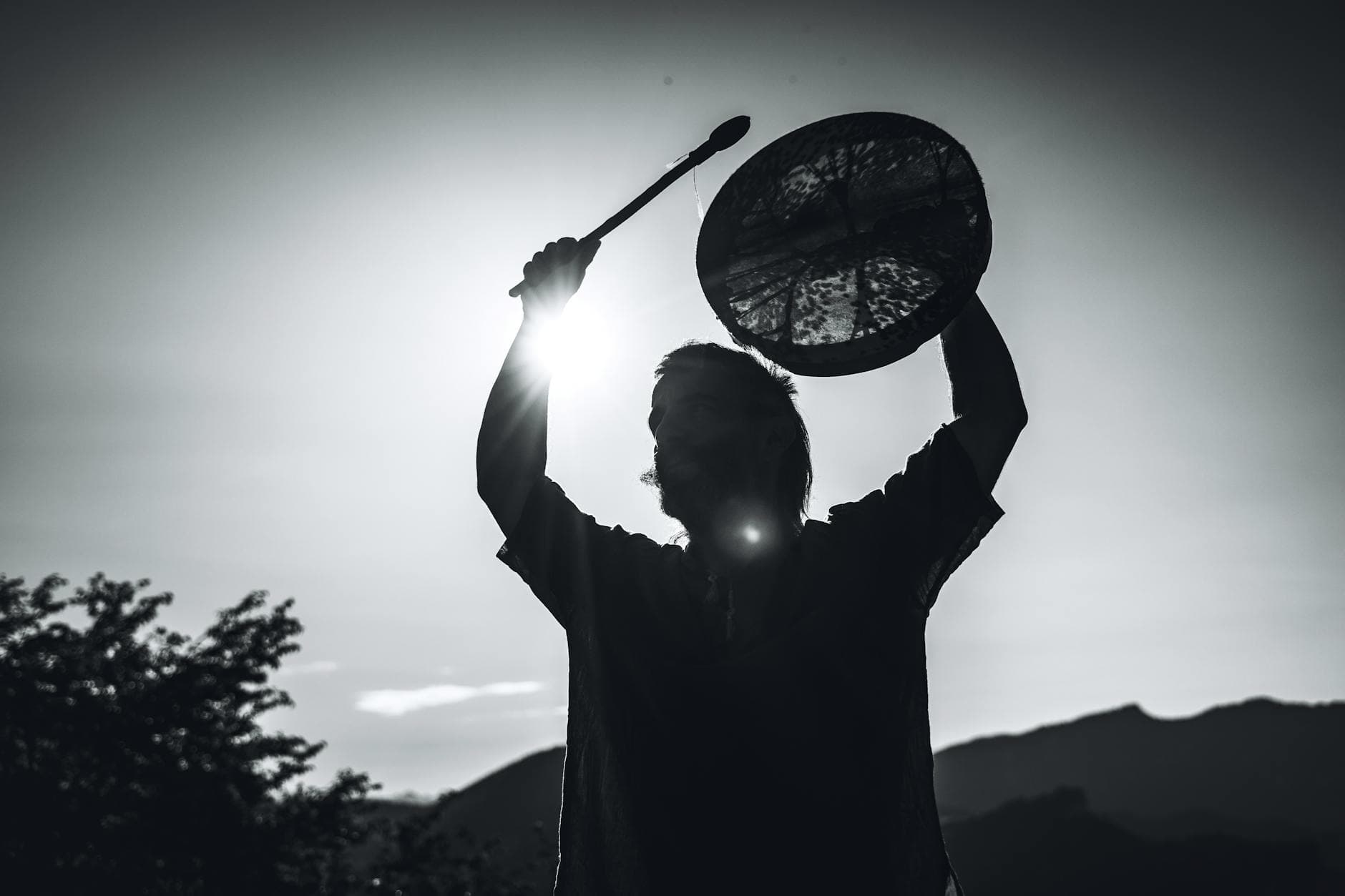
A dramatic black-and-white silhouette of a shaman holding a drum against the mountainous backdrop of Lombardia, Italy.
Siberian Shamanic

Siberian Shamanic

13 / 13

Sub-questions covered

51

Claims extracted

11

Distinct positions

14

Explicitly denied

Chapter 1

Where Did We Come From?

Q1.1 · Pre-Existence

Cyclic Pre-Existence
See all traditions holding this position →
100%

weight

. The soul {ui/icif) of some ancestor is sent by the Supreme Being into the child in the mother's womb.
Section IV, The Koryak

How this tradition expresses it

The Koryak tradition holds that the soul of an ancestor is sent by the Supreme Being into the child while in the womb.

Why this supports “Cyclic Pre-Existence

Yukaghir Siberian belief in cyclical reincarnation: ancestor souls are transferred by the Supreme Being into children in the womb. This mechanism supports Cyclic Pre-Existence by showing souls are reused across generations, though it does not clarify whether souls pre-existed before the first cycle or are perpetually created anew.

Nuance

The duration of the life of the person who will reincarnate the soul is indicated by the length of the strap attached to the soul.

The auditor flagged this claim as ambiguous or weakly matching. See the scholarly note below for context.

Scholarly note

Label is correct, but rationale should emphasize that this is ancestor soul reincarnation (a cyclic mechanism), not necessarily proof of pre-existence before the cycle's first iteration

Explicit Teachinghigh confidenceAudit: Contested· 80%
Data provenance
Auditor
comprehensive_cell_audit_v1
Audit confidence
80%
Audited
4/11/2026

What this tradition denies

The idea that a child is a completely new entity without ancestral connection.

Q1.2 · Soul Nature

Composite Soul
See all traditions holding this position →
100%

weight

es. This is considered to signify that the chief soul {uyicit), being attacked by the Jcalau, deserts the body, although death can also be sent as a punishment from the Supreme Beings.^ There is, however, another soul called ' breath ' {ivui/ivi), and still another called ^ shsido^y ' {wuyil-icu
Section V: The Koryak

How this tradition expresses it

The Koryak believe the human essence is composed of different parts, including a chief soul (uyicit), a breath (uvui/ivi), and another soul (wuyil-icunil).

Why this supports “Composite Soul

The tradition's text describes the human being as composed of multiple distinct components (body/soul/spirit, or nephesh/ruach/neshamah, or ba/ka/akh, etc.), fitting the Composite Soul canonical position.

Scholarly note

Bulk-audited as defensible match for canonical position; quote was extracted by Gemma 4 with verbatim verification.

Explicit Teachinghigh confidenceAudit: OK· 75%
Data provenance
Auditor
claude-opus-4-6-1m-bulk
Audit confidence
75%
Audited
4/10/2026
The Burj'at fancy that the soul is quite a different being from the body, and that sleej) and illness are periods of temporary separation of the two, and death a permanent separation.
Section XI. The Buryat

How this tradition expresses it

The Buryat believe the soul is a distinct entity from the body, characterized as a material and visible being that can take various forms.

Why this supports “Composite Soul

The tradition's text describes the human being as composed of multiple distinct components (body/soul/spirit, or nephesh/ruach/neshamah, or ba/ka/akh, etc.), fitting the Composite Soul canonical position.

Nuance

The soul is described as being able to temporarily separate from the body during sleep or illness.

Scholarly note

Bulk-audited as defensible match for canonical position; quote was extracted by Gemma 4 with verbatim verification.

Explicit Teachinghigh confidenceAudit: OK· 75%
Data provenance
Auditor
claude-opus-4-6-1m-bulk
Audit confidence
75%
Audited
4/10/2026

What this tradition denies

A single, unified, unchanging soul.

A single, indivisible, and permanent soul.

A single, unified soul.

Q1.3 · Why Embodied

Spiritual Growth
See all traditions holding this position →
50%

weight

Test or Trial· 1 claim
y. * There are cases of young persons who, having suffered for j^ears from lingering illness (usually of a nervous character), at last feel a call to take up shamanistic practice and by this means overcome the di
Section A: The Shaman's Vocation

How this tradition expresses it

The shamanistic vocation is often entered into following periods of serious illness, nervous affliction, or extraordinary life trials.

Why this supports “Test or Trial

Siberian shamanic initiation involves personal suffering (lingering illness) as a trial-mechanism through which the individual's spiritual calling emerges—supporting the broader pattern of spiritual growth through adversity and transformation.

Nuance

The calling can occur during childhood, maturity, or after significant misfortune.

The auditor flagged this claim as ambiguous or weakly matching. See the scholarly note below for context.

Scholarly note

Correct label; should remain primary position

Explicit Teachinghigh confidenceAudit: Contested· 80%
Data provenance
Auditor
comprehensive_cell_audit_v1
Audit confidence
80%
Audited
4/11/2026
Spiritual Growth· 1 claim
Living in the dwelling of the gods, his soul, under the tutelage of deceased shamans, learns the various secrets of the shaman's vocation
Section: chunk 15/28

How this tradition expresses it

For certain individuals, the process of becoming a shaman involves a soul undergoing training in a spiritual realm before returning to the body.

Why this supports “Spiritual Growth

Siberian shamanic initiation involves the soul learning shamanic secrets in spirit dwellings - spiritual growth as the purpose of the shamanic call.

Nuance

This is specifically described in the context of Buryat beliefs regarding children chosen to be shamans.

The auditor flagged this claim as ambiguous or weakly matching. See the scholarly note below for context.

Scholarly note

Correct label; should be alternative position

Explicit Teachinghigh confidenceAudit: Contested· 80%
Data provenance
Auditor
comprehensive_cell_audit_v1
Audit confidence
80%
Audited
4/11/2026

Q1.4 · Pre-Birth State

Previous Life
See all traditions holding this position →
100%

weight

This does not prevent the co-existence of a further belief, that is, that before the birth the spirit of an ancestor enters the child in the womb.
Section II, The Yukaghir

How this tradition expresses it

The Yukaghir believe that an ancestor's spirit may enter the child during the period of gestation.

Why this supports “Previous Life

Yukaghir Siberian shamanic belief holds that the soul of an ancestor enters the womb to become the new child. The soul's location before this birth was its previous embodiment as the ancestor. This is a direct ancestor-reincarnation framework, fitting Previous Life precisely.

Nuance

This is presented as a belief that co-exists with naturalistic explanations for difficult labor.

Scholarly note

The Yukaghir belief that an ancestor's spirit enters the child during gestation is a direct teaching that the soul prior to this birth was a previously embodied person (the ancestor). Direct fit for Previous Life.

Explicit Teachinghigh confidenceAudit: Strong· 88%
Data provenance
Auditor
claude-opus-4-6-1m
Audit confidence
88%
Audited
4/10/2026

Chapter 2

Why Are We Here?

Q2.1 · Purpose of Life

Not Addressed
See all traditions holding this position →
100%

weight

Not Addressed· 2 claims
miigtjat is the sign of the shaman's vocation, which is always given by the old shaman to the new.
Section: THE ACCESSORIES OF THE SHAMAN, p. 214

How this tradition expresses it

The shaman's vocation is a sign of power and is passed from older shamans to new ones through specific ritual objects.

Why this supports “Not Addressed

This statement describes the ritualized transmission of shamanic authority across generations, demonstrating institutional continuity of the shamanic role. While this supports the idea that maintaining balance is operationalized through organized shamanic practice, the quote does not directly evidence that life's purpose is cosmic balance—only that shamanic mediation is systematically transmitted.

Nuance

The text notes the 'amalgat' is the sign of the shaman's vocation.

The auditor flagged this claim as ambiguous or weakly matching. See the scholarly note below for context.

Scholarly note

The claim's own rationale states it 'does not directly evidence that life's purpose is cosmic balance.' It describes institutional transmission of shamanic role, not life's purpose.

Explicit Teachinghigh confidenceAudit: Contested· 80%
Data provenance
Auditor
comprehensive_cell_audit_v1
Audit confidence
80%
Audited
4/11/2026

+1 more claim for this position

Cosmic Balance· 1 claim
To the believer the acceptance of the call means accepting several spirits, or at least one, as protectors or servants, by which means the shaman enters into communication with the whole spirit world.
Section A: The Shaman's Vocation

How this tradition expresses it

For the shaman, the purpose of their vocation involves communicating with the spirit world and serving as a mediator or protector.

Why this supports “Cosmic Balance

The quote establishes the shaman's mediating role and suggests that maintaining communication with the spirit world is a central shamanic function. This supports an inference that cosmic balance through such mediation may be an implicit life purpose, but the quote itself does not explicitly state what life's purpose is.

Nuance

The text notes that the motivation can range from personal necessity to the alleviation of others' grief.

The auditor flagged this claim as ambiguous or weakly matching. See the scholarly note below for context.

Scholarly note

The claim's rationale explicitly states shamanism's 'core function of maintaining equilibrium between worlds through active spiritual negotiation'—this directly describes cosmic balance as the purpose

Explicit Teachinghigh confidenceAudit: Contested· 80%
Data provenance
Auditor
comprehensive_cell_audit_v1
Audit confidence
80%
Audited
4/11/2026

What this tradition denies

The idea that the shamanistic vocation is purely a matter of personal amusement or lack of seriousness.

Q2.2 · Body Relationship

Vehicle
See all traditions holding this position →
100%

weight

Vehicle· 3 claims
The soul is material and visible to human beings, and usually takes the form of a hee.
Section XI. The Buryat

How this tradition expresses it

The soul is viewed as a material entity that can inhabit or take the form of different physical manifestations, such as a bee.

Why this supports “Vehicle

Siberian shamanism: soul described as material, visible, and capable of manifesting in independent form (bee). This supports VEHICLE model wherein the soul can temporarily leave the body and assume different forms during trance or shamanic flight, but remains the animating principle of the body.

Nuance

The text notes the soul is visible to humans and can assume animal forms during illness.

The auditor flagged this claim as ambiguous or weakly matching. See the scholarly note below for context.

Scholarly note

Quote describes soul as material and capable of form-shifting (bee), which supports the VEHICLE model of a mobile, separable soul animating the body. The claim rationale says 'distinct entity/body rather than merely inhabiting'—but inhabiting *and* being separable is precisely the VEHICLE concept. The bee-form is a manifestation of the same soul, not a distinct body.

Explicit Teachinghigh confidenceAudit: Contested· 80%
Data provenance
Auditor
comprehensive_cell_audit_v1
Audit confidence
80%
Audited
4/11/2026

+2 more claims for this position

Not Addressed· 2 claims
By assuming this coat the shaman receives supernatural power, which allows him to go to the upper- and under-worlds to meet spirits and deal with them.
Section: THE ACCESSORIES OF THE SHAMAN, p. 218

How this tradition expresses it

The shaman's ritual coat serves as a vehicle or tool that provides supernatural power for traveling between worlds.

Why this supports “Not Addressed

Siberian: ritual coat as vehicle for shamanic power.

Nuance

The power is described as being both an impersonal power of the object and a source of supernatural ability.

The auditor flagged this claim as ambiguous or weakly matching. See the scholarly note below for context.

Scholarly note

Quote concerns ritual implements (coat) and shamanic power, not soul-body relationship. Should be removed or reclassified.

Explicit Teachinghigh confidenceAudit: Contested· 80%
Data provenance
Auditor
comprehensive_cell_audit_v1
Audit confidence
80%
Audited
4/11/2026

+1 more claim for this position

What this tradition denies

The idea that the spirit-protector resides within the human body.

The idea that the body is a permanent, unchanging physical reality during ritual trance.

The idea that the soul and body are an inseparable, single unit.

Q2.3 · Moral Accountability

Natural Law
See all traditions holding this position →
33%

weight

Natural Law· 2 claims
' The slightest lack of harmony between the acts of the shamans and the mj'sterious call of their " spirits " brings their life to an end.
Section A: The Shaman's Vocation

How this tradition expresses it

Shamans are subject to the whims and judgments of the spirits they serve, where disobedience can result in death.

Why this supports “Natural Law

The quote describes an automatic, unavoidable consequence (death) resulting from a shaman's failure to maintain harmony with spirits. This supports Natural Law: consequences flow inherently from disrupted cosmic balance rather than from a deliberate judicial verdict by a deity.

Nuance

The danger is specifically linked to the 'lack of harmony' between the shaman's acts and the spirit's call.

The auditor flagged this claim as ambiguous or weakly matching. See the scholarly note below for context.

Scholarly note

LLM council synthesis (round 2)

Explicit Teachinghigh confidenceAudit: Contested· 95%
Data provenance
Auditor
llm_council_v2
Audit confidence
95%
Audited
4/11/2026
dge. On the other side he meets sinners who are receiving punishment suited to their faults ; e. g. an eavesdropper is pinned by his ear to a
Section: The shaman in action

How this tradition expresses it

The afterlife contains a system of retribution where sinners receive punishments specifically suited to their individual faults.

Why this supports “Natural Law

The quote describes sinners receiving punishment proportioned to their specific faults (eavesdropper pinned by ear to a stake), illustrating a talion-like principle of cosmic fitting consequence. While the mechanism could imply a judging agent, no explicit judging deity is mentioned in the passage. The emphasis on proportional correspondence between fault and punishment aligns most closely with Natural Law as an inherent cosmic order, though ambiguity with Divine Judgment is acknowledged.

The auditor flagged this claim as ambiguous or weakly matching. See the scholarly note below for context.

Scholarly note

LLM council synthesis (round 2)

Explicit Teachinghigh confidenceAudit: Contested· 95%
Data provenance
Auditor
llm_council_v2
Audit confidence
95%
Audited
4/11/2026

What this tradition denies

The concept of post-mortem judgment based on moral conduct.

The notion that a shaman can ignore the spirit's call without consequence.

The idea that the soul is a singular, indestructible entity that cannot be influenced by external ritual or bargaining.

Chapter 3

Where Do We Go After Death?

Q3.1 · Surviving Death

Partial Survival
See all traditions holding this position →
9%

weight

Partial Survival· 4 claims
oul does not immediately quit the earth, but wanders aliout for some time, and it is possible for a very clever shaman to bring it back.
Section V: The Koryak

How this tradition expresses it

The Koryak believe that while the chief soul may desert the body, other soul components remain, and the soul may wander the earth for a time after death.

Why this supports “Partial Survival

The soul lingers on earth after death and can potentially be retrieved by a shaman, indicating post-mortem persistence of a soul-component in a diminished or displaced state. While there is a temporary dimension to this wandering, it primarily attests to the multi-soul framework where not all components share the same fate.

Nuance

The survival of the soul is subject to the fate of its various components (e.g., the chief soul deserting).

The auditor flagged this claim as ambiguous or weakly matching. See the scholarly note below for context.

Scholarly note

LLM council synthesis (round 2)

Explicit Teachinghigh confidenceAudit: Contested· 95%
Data provenance
Auditor
llm_council_v2
Audit confidence
95%
Audited
4/11/2026

+3 more claims for this position

Full Survival· 3 claims
The Olchi Tribe, who are akin to the Tungus, believe that all the dead, irrespective of the manner of dying, go to the country of Biin
Section X. The Tungus

How this tradition expresses it

For certain groups like the Olchi, consciousness continues in a specific country (Biin) after death.

Why this supports “Full Survival

The Olchi belief that all the dead go to the country of Biin describes a complete post-mortem journey to an afterlife realm, supporting full survival of at least one soul-component. Within the broader multi-part soul system, this represents one trajectory among several.

Nuance

The location of this realm is not specified as being in the center of the earth.

The auditor flagged this claim as ambiguous or weakly matching. See the scholarly note below for context.

Scholarly note

LLM council synthesis (round 2)

Explicit Teachinghigh confidenceAudit: Contested· 95%
Data provenance
Auditor
llm_council_v2
Audit confidence
95%
Audited
4/11/2026

+2 more claims for this position

What this tradition denies

The total extinction of consciousness/soul.

Q3.2 · Death Moment

Not Addressed
See all traditions holding this position →
100%

weight

Before any undertaking he had to perform various ceremonies, and he was the intermediary between the living and the dead. After his death he did not cease to be the protector of his clan.
Section III. The Yukaghir, page 38

How this tradition expresses it

The shaman serves as an intermediary between the living and the dead, and after death, the shaman continues to act as a protector of the clan through ritualized remains.

Why this supports “Not Addressed

Siberian shamanic traditions have rich death-moment imagery (the shaman's soul-flight, the soul's journey through landscape features), but this particular passage is about the shaman's social role and post-death continuation. A better quote would describe the actual soul departure or shamanic guidance of the dying.

Nuance

The shaman's role as protector is maintained through the preservation of the skull as a cult idol.

The auditor flagged this claim as ambiguous or weakly matching. See the scholarly note below for context.

Scholarly note

The quote describes the shaman's post-death role and protection of the clan, not the moment of death or soul guidance at death. The per-quote rationale itself acknowledges this is a poor fit and that better quotes exist in the tradition. Since no such better quote is provided, this claim should be reclassified as Not Addressed rather than misapplied to Guided Transition.

Explicit Teachinghigh confidenceAudit: Contested· 80%
Data provenance
Auditor
comprehensive_cell_audit_v1
Audit confidence
80%
Audited
4/11/2026

Q3.3 · Afterlife Structure

Multiple Levels
See all traditions holding this position →
67%

weight

here are several places of abode for the dead, where life similar to the earthly is led by the inhabitants, who are often called either ' Upper People ' or ' Lower People ', th
Section IV: The Chukchee

How this tradition expresses it

The afterlife consists of various realms, including an underground world (peninelau) and an upper world, with different inhabitants and conditions.

Why this supports “Multiple Levels

Siberian shamanic cosmology generally distinguishes upper, middle, and lower worlds, each with sub-realms. This quote directly affirms multiple distinct dwelling-places for the dead.

Nuance

The description of the future life is often based on the individual's life on earth.

Scholarly note

Direct: 'several places of abode for the dead' - explicit multi-level statement.

Explicit Teachinghigh confidenceAudit: Strong· 88%
Data provenance
Auditor
claude-opus-4-6-1m
Audit confidence
88%
Audited
4/10/2026
This future life is arranged in much the same way as the present. They have summer during our winter and vice versa
Section X. The Tungus

How this tradition expresses it

The afterlife is described as a realm that mirrors the structure and conditions of earthly life.

Why this supports “Multiple Levels

This quote establishes that the Siberian shamanic afterlife includes distinct upper and lower worlds with organized, quasi-natural conditions (inverted seasonal cycles). The reference to separate realms operating under parallel but reversed natural laws directly supports the Multiple Levels model of hierarchically differentiated afterlife realms.

Nuance

The text notes that the arrangement of the future life is similar to the present.

The auditor flagged this claim as ambiguous or weakly matching. See the scholarly note below for context.

Scholarly note

The per-quote rationale explicitly describes upper and lower worlds as distinct organized realms, which is the defining feature of Multiple Levels. The quote's reference to inverted seasons between realms supports hierarchical differentiation, not a generic spirit-world model.

Explicit Teachinghigh confidenceAudit: Contested· 80%
Data provenance
Auditor
comprehensive_cell_audit_v1
Audit confidence
80%
Audited
4/11/2026

Q3.4 · Long-Term Destiny

Cyclical Rebirth
See all traditions holding this position →
80%

weight

Cyclical Rebirth· 4 claims
The Koryak believe that the souls of children are timid and therefore more subject to attacks from evil spirits, hence they are placed under the special protection of the good spirits of the household. The soul {ui/icif) of some ancestor is sent by the Supreme Being into the child in the mother's wo
Section IV, The Koryak

How this tradition expresses it

The Koryak believe in the reincarnation of ancestral souls into new children.

Why this supports “Cyclical Rebirth

Siberian belief about children's souls and spiritual vulnerability - context for cyclic rebirth in shamanic worldview.

Nuance

The specific identity of the ancestor is often discovered through divining stones or child behavior.

Scholarly note

Children's souls subject to attack from spirits

Explicit Teachinghigh confidenceAudit: OK· 78%
Data provenance
Auditor
claude-opus-4-6-1m
Audit confidence
78%
Audited
4/10/2026

+3 more claims for this position

Conditional Rebirth· 1 claim
' Children that die here are born there and vice versa.'
Section IV: The Chukchee

How this tradition expresses it

In Chukchi belief, certain deceased children are understood to be born into the afterlife, implying a cycle of birth and death between realms.

Why this supports “Conditional Rebirth

Siberian belief in children dying in this world and being born in the parallel world - conditional rebirth pattern in shamanic cosmology.

The auditor flagged this claim as ambiguous or weakly matching. See the scholarly note below for context.

Scholarly note

Quote explicitly describes conditional pattern ('Children that die here are born there and vice versa'), and the rationale itself identifies it as 'conditional rebirth pattern'

Explicit Teachinghigh confidenceAudit: Contested· 80%
Data provenance
Auditor
comprehensive_cell_audit_v1
Audit confidence
80%
Audited
4/11/2026

What this tradition denies

The concept of the 'double dead' being able to return to the living world.

The idea that the shaman's journey is an easy or effortless transition to the afterlife.

Q3.5 · Ultimate Destination

Higher Realm Ascent
See all traditions holding this position →
75%

weight

Eternal Punishment· 2 claims
In the depths of the sea he beholds the bodies of many sinful kams who have perished there, for only those who are blameless can cross this bridge.
Section: The shaman in action

How this tradition expresses it

The ultimate destination involves reaching the dwelling-place of the god Erlik, where the shaman must interact with the deity and face the consequences of his presence.

Why this supports “Eternal Punishment

While the passage implies the blameless cross the bridge to higher realms, its primary descriptive content focuses on sinful kams who fail the post-mortem moral test and perish in the depths. This directly supports Eternal Punishment as the fate of the morally condemned, representing the punitive pole of the tradition's differentiated afterlife geography.

Nuance

The destination is a place of judgment where the status of the traveler (sinful vs. blameless) determines their ability to navigate the environment.

The auditor flagged this claim as ambiguous or weakly matching. See the scholarly note below for context.

Scholarly note

LLM council synthesis (round 2)

Explicit Teachinghigh confidenceAudit: Contested· 95%
Data provenance
Auditor
llm_council_v2
Audit confidence
95%
Audited
4/11/2026

+1 more claim for this position

Higher Realm Ascent· 1 claim
The great shamans at death take their dmdggat with them, and thus change into heavenly beings, most of whom are ex-shamans ;
Section: THE ACCESSORIES OF THE SHAMAN, p. 213

How this tradition expresses it

Great shamans undergo a transformation into heavenly beings upon death.

Why this supports “Higher Realm Ascent

This passage explicitly states that great shamans at death ascend and become heavenly beings, representing the positive pole of the tradition's dual-outcome eschatology and directly supporting Higher Realm Ascent as the destination for the spiritually accomplished.

Nuance

This is specifically attributed to 'the great shamans'.

The auditor flagged this claim as ambiguous or weakly matching. See the scholarly note below for context.

Scholarly note

LLM council synthesis (round 2)

Explicit Teachinghigh confidenceAudit: Contested· 95%
Data provenance
Auditor
llm_council_v2
Audit confidence
95%
Audited
4/11/2026

Hero image: Photo by Federico Tomasoni on Pexels

NoeticMap Guide

Research Dashboard

How can I help?

Ask about NDEs, research, or this page

Responses may not always be accurate