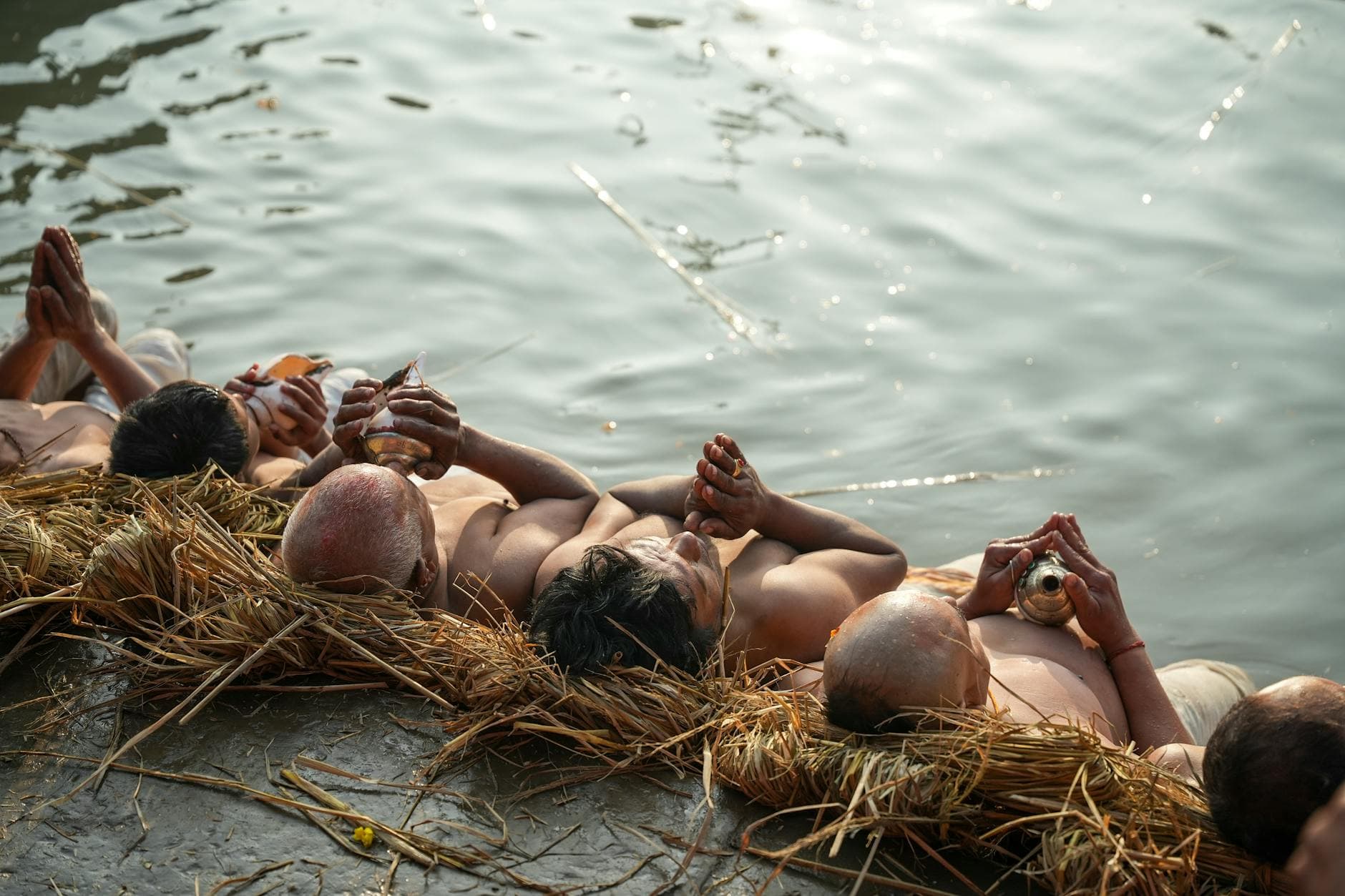
Devotees perform sacred rituals by the riverbank, symbolizing spiritual devotion.
Iranian

Mandaeism

13 / 13

Sub-questions covered

183

Claims extracted

11

Distinct positions

50

Explicitly denied

Chapter 1

Where Did We Come From?

Q1.1 · Pre-Existence

Emanation
See all traditions holding this position →
11%

weight

Emanation· 7 claims
hen the fruit was still in the fruit, when the ather was still in the ather, when the great Mana’) of glory was there, out of the mighty, great 30 Manas,
69, 2—70, 9

How this tradition expresses it

Existence originated from a primordial state where the great Mana of glory existed within the 'great fruit' or 'great aether', from which all subsequent realities emerged.

Why this supports “Emanation

Mandaean cosmogonic poetry of the great Mana of Glory existing before all else describes the primordial emanation source from which all subsequent being unfolds.

Nuance

The text describes a process of unfolding from a vast, endless, and speechless primordial state.

Scholarly note

Mandaean cosmogony (the great Mana of glory before all else) - emanation framework.

Explicit Teachinghigh confidenceAudit: OK· 78%
Data provenance
Auditor
claude-opus-4-6-1m
Audit confidence
78%
Audited
4/10/2026
l was with my father and my Mother. Receive a greeting from them.
chunk 14/45

How this tradition expresses it

The speaker describes a state of existence prior to the current world, involving a period of time spent with 'Father and Mother' before being sent into the world.

Why this supports “Emanation

This greeting explicitly references a pre-worldly existence with divine parental figures, reflecting the Mandaean doctrine that souls originate from the House of Life through emanation rather than returning cyclically. The soul's prior state with "Father and Mother" (divine emanatory principles) and subsequent sending into the material world exemplifies the one-directional descent of consciousness from the divine pleroma characteristic of emanationist cosmology.

The auditor flagged this claim as ambiguous or weakly matching. See the scholarly note below for context.

Scholarly note

Mandaean cosmology: soul from house of Life via emanation, not cyclic rebirth.

Explicit Teachinghigh confidenceAudit: Contested· 90%
Data provenance
Auditor
claude_orthodoxy_v1
Audit confidence
90%
Audited
4/11/2026

+5 more claims for this position

What this tradition denies

The idea that darkness is the primary or eternal state.

The idea that the current life is the only state of existence.

The idea that humans are native to this world.

Q1.2 · Soul Nature

Divine Spark
See all traditions holding this position →
3%

weight

Divine Spark· 24 claims
. Rays of the 25 Glory, light and glory go from his face and between the leaves of his wreath. Al
First book, 4, 18

How this tradition expresses it

The divine essence is described as a source of light and radiance that spreads to all beings.

Why this supports “Divine Spark

This quote describes the radiance of a celestial being or Uthra rather than directly addressing the essential nature of the human soul. While consistent with Mandaean light-theology, it does not specifically speak to human essential nature.

The auditor flagged this claim as ambiguous or weakly matching. See the scholarly note below for context.

Scholarly note

The quote describes rays of celestial radiance consistent with light-theology and the soul's divine-spark nature. The rationale concedes it is 'consistent with Mandaean light-theology'; it should be reclassified as supporting evidence.

Explicit Teachinghigh confidenceAudit: Contested· 80%
Data provenance
Auditor
comprehensive_cell_audit_v1
Audit confidence
80%
Audited
4/11/2026
the soul is oppressed in the body: an action that God does not like and for people are not beautiful.
chunk 4/45, 158

How this tradition expresses it

The soul is a distinct entity from the physical body, capable of being oppressed by the body or being saved through righteous works.

Why this supports “Divine Spark

The depiction of the soul as oppressed within the physical body, with God's displeasure at this state, reflects the core Mandaean Gnostic view of the soul as an exiled divine spark of light trapped in matter, awaiting liberation.

Nuance

The text suggests the soul's state is heavily influenced by the 'ugly works' committed in the body.

The auditor flagged this claim as ambiguous or weakly matching. See the scholarly note below for context.

Scholarly note

LLM council synthesis

Explicit Teachinghigh confidenceAudit: Contested· 95%
Data provenance
Auditor
llm_council_v1
Audit confidence
95%
Audited
4/11/2026

+22 more claims for this position

What this tradition denies

The concept of a limited or finite supreme being.

The idea of a purely spiritual or non-material existence for the inhabitant of the world.

The idea that the body and soul were created as a single, unified entity from the start.

A single, unified nature of humanity without the presence of 'unevenness' or duality.

Q1.3 · Why Embodied

Fall From Grace
See all traditions holding this position →
7%

weight

Not Addressed· 3 claims
to him: 'Life gave me the task and said to me: 'Go and say to him: A son who is of you, your The root of your tribe and your consort, want to stir up in throwing the worlds of light aga
143, 15

How this tradition expresses it

The speaker enters the world of darkness because they were sent there by 'Life' to perform specific tasks or deliver messages.

Why this supports “Not Addressed

Mandaean salvation history depicts divine envoys (uthras) being given specific tasks by Life and sent into the world. Direct sending-narrative.

Nuance

The mission involves interacting with the giants of darkness.

The auditor flagged this claim as ambiguous or weakly matching. See the scholarly note below for context.

Scholarly note

This quote describes divine sending of uthras to accomplish a task in the world, but does not explain why souls/humans enter embodied life; it addresses redeemer activity, not the origin of embodiment

Explicit Teachinghigh confidenceAudit: Contested· 80%
Data provenance
Auditor
comprehensive_cell_audit_v1
Audit confidence
80%
Audited
4/11/2026

+2 more claims for this position

Divine Assignment· 3 claims
Then | created him l his wife Hawwa, that this world might be awakened and strengthened.
chunk 15/45, 171, 36-37

How this tradition expresses it

The creation of the physical world and the placement of souls into bodies serves to awaken and strengthen the world.

Why this supports “Divine Assignment

The quote explicitly presents the creation of Adam and Eve as a deliberate divine act to 'awaken and strengthen' the physical world, indicating that embodied existence serves a cosmic function assigned by divine intention rather than resulting from punishment or exile. This reflects the Divine Assignment position where incarnation is an ordained role within cosmic order.

The auditor flagged this claim as ambiguous or weakly matching. See the scholarly note below for context.

Scholarly note

The per-quote rationale explicitly argues that embodiment is 'necessary participation' and 'not as punishment but as necessary' — this contradicts Fall From Grace framing and should be reclassified to match its own supporting logic

Explicit Teachinghigh confidenceAudit: Contested· 80%
Data provenance
Auditor
comprehensive_cell_audit_v1
Audit confidence
80%
Audited
4/11/2026

+2 more claims for this position

What this tradition denies

The pursuit of worldly wealth and power as a valid purpose for life.

The idea that the world was created to satisfy human desire or for the benefit of life.

The mission was not a result of personal desire or whim, but a divine mandate.

Chapter 2

Why Are We Here?

Q2.1 · Purpose of Life

Knowledge
See all traditions holding this position →
4%

weight

Knowledge· 23 claims
you have children and they remain alive, teach as soon as you understand yourself on knowledge, the right wisdom and let 5 walk the path of the KuSta.
chunk 4/45, 160

How this tradition expresses it

The purpose of life involves following the commands of the Lord, practicing virtues like gentleness and mercy, and teaching children wisdom.

Why this supports “Knowledge

The explicit command to teach children 'knowledge, the right wisdom' and the path of KuSta frames life's purpose as the transmission and acquisition of gnosis, with righteous conduct as the practical expression of that knowledge.

Nuance

Failure to teach children or follow the path of KuSta results in being 'condemned in the Court of Justice'.

The auditor flagged this claim as ambiguous or weakly matching. See the scholarly note below for context.

Scholarly note

LLM council synthesis

Explicit Teachinghigh confidenceAudit: Contested· 95%
Data provenance
Auditor
llm_council_v1
Audit confidence
95%
Audited
4/11/2026
For this world passes away, and its possessions go lose. (95) 31. Do not worship Satan and idols. Rather, they should be your servants and obey in the worl
Section 30-31

How this tradition expresses it

Life involves adhering to the 'right' (KuSta) and the 'faith', avoiding the deceptions of Satan and the attachments to worldly possessions.

Why this supports “Knowledge

The prohibition on worshipping Satan and the command to obey represent the behavioral and moral corollaries of maintaining kushta (truth/righteousness). These flow from and reinforce the acquisition of divine knowledge (manda), the soteriological engine.

Nuance

The text emphasizes that worldly possessions are transient and that one must maintain integrity through specific moral conduct.

The auditor flagged this claim as ambiguous or weakly matching. See the scholarly note below for context.

Scholarly note

The command 'do not worship Satan' is a directive to maintain kushta (truth/righteousness), which the scholarly note identifies as an indispensable corollary of knowledge acquisition, not an independent moral test. Reclassify as KNOWLEDGE with emphasis on the practical/behavioral dimension.

Explicit Teachinghigh confidenceAudit: Contested· 80%
Data provenance
Auditor
comprehensive_cell_audit_v1
Audit confidence
80%
Audited
4/11/2026

+21 more claims for this position

What this tradition denies

The idea that earthly life is the primary focus of the Mandaeans.

The text denies that the 'lying Messiah' (the false Christ) offers true salvation or wisdom.

The idea that ignorance excuses sinful behavior.

The idea that the planets/wickedness are the rightful masters of the human soul.

The idea that the current world/human condition is the intended or perfect state.

The pursuit of evil or harmful speech as a valid way of life.

The idea that the speaker's presence in the dark world is for the purpose of consuming food or drink.

The text rejects the idea that the current world/existence is a place of reliable confidence or stability for the soul.

The idea that human consumption of nature is inherently thankful or purposeful in a spiritual sense.

The purpose of life is not to serve the planetary powers or the 'wicked' rulers of the world.

The purpose of life is not found in the 'beauty of the body' or 'darkened shadows'.

The idea that earthly life is the final or primary state for the righteous.

The purpose of the emissary's presence is not to engage with the sinful or the unruly.

The sufficiency of asceticism (fasting/monasticism) for salvation.

The idea that earthly wealth, status, or power provides salvation or support in the afterlife.

Q2.2 · Body Relationship

Prisoner
See all traditions holding this position →
100%

weight

Prisoner· 20 claims
He creates a king for the world and throws a soul into his body. A soul in his body he throws, and they eat physical food.
Section 89

How this tradition expresses it

The soul is placed within a body to inhabit the physical world, functioning as a vessel for the interaction between the spiritual and the material.

Why this supports “Prisoner

The repeated verb 'throws a soul into his body' depicts the soul's embodiment as a forceful, involuntary act of insertion into material form, where it is bound to corporeal necessities like eating. This language of being cast into flesh is paradigmatic of the PRISONER framework in Mandaean cosmology.

The auditor flagged this claim as ambiguous or weakly matching. See the scholarly note below for context.

Scholarly note

LLM council synthesis

Explicit Teachinghigh confidenceAudit: Contested· 95%
Data provenance
Auditor
llm_council_v1
Audit confidence
95%
Audited
4/11/2026
He took off his dress to him in the Jordan, he took off his dress to him from flesh and blood"), he clothed him with a robe of And covered him with a good, pure turban of lig
chunk 16/45, line 192-193

How this tradition expresses it

The body is viewed as a garment or covering for the soul, which can be stripped away to reveal the true state of the being.

Why this supports “Prisoner

The ritual removal of the 'dress of flesh and blood' and re-clothing in 'a robe of light' literalizes the Mandaean understanding that the material body is an outer covering—a prison garment—that must be stripped away to reveal and liberate the soul's true luminous nature. Baptismal disrobing enacts escape from bodily confinement.

The auditor flagged this claim as ambiguous or weakly matching. See the scholarly note below for context.

Scholarly note

LLM council synthesis

Explicit Teachinghigh confidenceAudit: Contested· 95%
Data provenance
Auditor
llm_council_v1
Audit confidence
95%
Audited
4/11/2026

+18 more claims for this position

What this tradition denies

The text denies that the term 'Nasoraeans' is synonymous with being Christian.

The idea that physical suffering or infirmity determines the soul's salvation.

The concept of a permanent, unified physical existence as the primary reality.

The identity of the soul with the physical body.

Q2.3 · Moral Accountability

Divine Judgment
See all traditions holding this position →
32%

weight

Divine Judgment· 13 claims
If you do not teach them, and teach, and you will be condemned in the Court of Justice.
chunk 4/45, 160

How this tradition expresses it

Individuals are held accountable for their sins and actions in a divine court of justice.

Why this supports “Divine Judgment

Explicitly names the 'Court of Justice' as the venue of condemnation, directly invoking a divine tribunal that holds individuals accountable for their conduct and teaching.

Nuance

Accountability is tied to specific actions like adultery, theft, or failing to teach children.

The auditor flagged this claim as ambiguous or weakly matching. See the scholarly note below for context.

Scholarly note

LLM council synthesis

Explicit Teachinghigh confidenceAudit: Contested· 95%
Data provenance
Auditor
llm_council_v1
Audit confidence
95%
Audited
4/11/2026
He judges the souls, every man according to the works he has done. (96) 32. Do not learn the magic of Satan and do not bear
Section 31-32

How this tradition expresses it

Individuals are held accountable by the 'high King of Light' based on their specific works, sins, and adherence to truth.

Why this supports “Divine Judgment

States that a divine figure 'judges the souls, every man according to the works he has done,' clearly affirming personal divine judgment with consequences (blazing fire) for transgression.

Nuance

Judgment is tied to specific actions such as bribery, theft, or worshiping idols.

The auditor flagged this claim as ambiguous or weakly matching. See the scholarly note below for context.

Scholarly note

LLM council synthesis

Explicit Teachinghigh confidenceAudit: Contested· 95%
Data provenance
Auditor
llm_council_v1
Audit confidence
95%
Audited
4/11/2026

+11 more claims for this position

What this tradition denies

The idea that one can escape accountability through deception or bribery.

The idea that the wicked are victims of external fate; they are the authors of their own destruction.

The text denies that righteousness is merely an internal state, implying that actions (works of hands) carry weight and can lead to guilt or shame.

The text denies that those who follow the 'prophets of lies' or 'the strange man' are righteous or will be protected.

The idea that one can live without accountability to the 'house of life' or the 'Kusta'.

The idea that mere verbal profession of faith is sufficient for salvation or righteousness.

The idea that one can escape accountability through worldly status or lack of zeal.

Chapter 3

Where Do We Go After Death?

Q3.1 · Surviving Death

Full Survival
See all traditions holding this position →
42%

weight

Full Survival· 17 claims
All souls part at they leave their body and ascend to the light, because do not distort the first teaching and do not distort the first speech- turn.
chunk 4/45, 184

How this tradition expresses it

Upon death, the soul departs from the body to ascend or face judgment based on its earthly conduct.

Why this supports “Full Survival

This passage explicitly states that souls 'leave their body and ascend to the light,' directly affirming that the conscious soul survives death intact and ascends. The emphasis is on continuity of the soul's existence, supporting Full Survival.

Nuance

The text describes different fates for souls depending on their righteousness or wickedness.

The auditor flagged this claim as ambiguous or weakly matching. See the scholarly note below for context.

Scholarly note

LLM council synthesis

Explicit Teachinghigh confidenceAudit: Contested· 95%
Data provenance
Auditor
llm_council_v1
Audit confidence
95%
Audited
4/11/2026
hat the bodies die by water, but the souls die by The light sha
chunk 6/45, 185

How this tradition expresses it

The soul survives bodily death, with the potential to ascend to the light or face darkness based on its previous life.

Why this supports “Full Survival

By contrasting the death of the body with the salvation of the soul, this text explicitly affirms that consciousness survives physical destruction. This directly supports Full Survival.

Nuance

The survival of the soul is contrasted with the death of the body.

The auditor flagged this claim as ambiguous or weakly matching. See the scholarly note below for context.

Scholarly note

LLM council synthesis

Explicit Teachinghigh confidenceAudit: Contested· 95%
Data provenance
Auditor
llm_council_v1
Audit confidence
95%
Audited
4/11/2026

+15 more claims for this position

Q3.3 · Afterlife Structure

Multiple Levels
See all traditions holding this position →
25%

weight

they will to ascend and look at the great place of light and the luminous abode, to which our eyes look up.
chunk 21/45

How this tradition expresses it

The afterlife consists of a 'great place of light' or 'luminous abode' for the righteous, contrasted with a 'great darkness' for those who did not follow the path.

Why this supports “Multiple Levels

This quote describes the final destination ('place of light and luminous abode') that righteous souls reach after ascending through the purgatorial journey. It evidences the existence of a luminous final realm as the endpoint of the multi-stage afterlife structure, though it does not explicitly detail the intermediate mathara (guardhouses) themselves.

The auditor flagged this claim as ambiguous or weakly matching. See the scholarly note below for context.

Scholarly note

The quote describes the destination (World of Light) that completes the purgatorial ascent, but the per-quote rationale correctly notes it does not evidence intermediate levels. This claim should either be reclassified to evidence the final station of a multi-level system, OR the rationale should explicitly state it evidences only the endpoint, not the intermediate structure.

Explicit Teachinghigh confidenceAudit: Contested· 80%
Data provenance
Auditor
comprehensive_cell_audit_v1
Audit confidence
80%
Audited
4/11/2026
we dwell in a place where there is neither food nor evil smell. Its fragrance is wonderful, and the splendor of my brothers is lovely on me
258, 36-38

How this tradition expresses it

The ultimate destination for the righteous is the 'House of Life', a realm of light and fragrance.

Why this supports “Multiple Levels

This quote describes conditions in the final luminous realm (World of Light)—the destination of the righteous after passage through intermediate levels. It evidences the characteristics of the final station in the multi-level purgatorial ascent structure, but does not directly describe the intermediate mathara or the passage process itself.

Nuance

The destination is characterized by the absence of evil and the presence of divine splendor.

The auditor flagged this claim as ambiguous or weakly matching. See the scholarly note below for context.

Scholarly note

Retain label but rewrite rationale: This quote describes conditions in the final luminous realm (World of Light). It does NOT directly evidence the intermediate mathara (guardhouses) that constitute the multi-level structure. It is supporting evidence for the existence of a final destination within a multi-stage system, but requires Claim 4 to complete the picture of intermediate levels.

Explicit Teachinghigh confidenceAudit: Contested· 80%
Data provenance
Auditor
comprehensive_cell_audit_v1
Audit confidence
80%
Audited
4/11/2026

Q3.4 · Long-Term Destiny

One Life Only
See all traditions holding this position →

What this tradition denies

The text rejects the legitimacy of the 'Rhomaean Christ' and his claims to divinity or authority.

The concept of an endless or eternal cycle without consequence or end.

The text does not explicitly mention reincarnation, but it presents death as a definitive transition to an afterlife of light or darkness, rather than a return to earthly life.

The text does not support cyclical rebirth into new lives, but rather a movement from the 'garb of life' toward the 'House of Life'.

The permanence of earthly existence for the righteous.

Q3.5 · Ultimate Destination

Ultimate Transcendence
See all traditions holding this position →
5%

weight

Higher Realm Ascent· 4 claims
So listen for hear and be instructed, my chosen ones, so that you 25 climb up victorious and look at the place of li
chunk 4/45, 204

How this tradition expresses it

The ultimate goal is to ascend to the 'place of light' or the 'house of life'.

Why this supports “Higher Realm Ascent

The exhortation to 'climb up victorious and look at the place of light' explicitly describes the soul's upward journey (masiqta) to the luminous realm, the core spatial-cosmic imagery of Mandaean soteriology.

Nuance

Success is achieved by those who persevere in the KuSta and follow the teachings of the Messenger.

The auditor flagged this claim as ambiguous or weakly matching. See the scholarly note below for context.

Scholarly note

LLM council synthesis

Explicit Teachinghigh confidenceAudit: Contested· 95%
Data provenance
Auditor
llm_council_v1
Audit confidence
95%
Audited
4/11/2026

+3 more claims for this position

Knowledge· 1 claim
44. Who disengages souls and who follows the paths of KuSta and faith 25, he will be allowed to walk the path of the Kusta and the faith and he will ascend in the way of the be
Section 44

How this tradition expresses it

The ultimate goal is to ascend to the 'place of light' or the 'high King of Light' through faith and righteous living.

Why this supports “Knowledge

Adherence to the 'first Teaching' against false teachings emphasizes the centrality of correct gnosis. Doctrinal fidelity is framed as defense of true knowledge rather than as a test independent of knowledge acquisition.

Nuance

Success is contingent upon following the 'path of the Kusta and the faith'.

The auditor flagged this claim as ambiguous or weakly matching. See the scholarly note below for context.

Scholarly note

The rejection of false teachings and loyalty to the 'first Teaching' is fundamentally about maintaining fidelity to the correct gnosis, not testing moral obedience per se. The quote contrasts true and false knowledge.

Explicit Teachinghigh confidenceAudit: Contested· 80%
Data provenance
Auditor
comprehensive_cell_audit_v1
Audit confidence
80%
Audited
4/11/2026

What this tradition denies

The existence of death or destruction for the supreme being.

The authority of false prophets and the 'lying Messiah' who claim divine status.

The permanence of the wicked or the darkness.

The text denies that the wicked or those who follow false paths will find peace or ascent in the afterlife.

The text denies that the 'earth' as understood by children of men is the true reality.

The possibility of an endless or unchanging state of being for those who turn toward darkness.

The possibility of the wicked finding a share in the light.

The possibility of salvation for those who are not zealous or who fail to follow the truth.

The idea that one can enter the light without purification.

Other denials

Positions this tradition explicitly rejects, on questions where its affirmative position isn't recorded.

Q3.4

The text rejects the legitimacy of the 'Rhomaean Christ' and his claims to divinity or authority.

Do not praise with singing the Nbu-Christ in the world sing. If he takes a different form, call him the lustful Oros

Q3.4

The concept of an endless or eternal cycle without consequence or end.

They rebelled and denied their father. There is nothing that is endless.

Q3.4

The text does not explicitly mention reincarnation, but it presents death as a definitive transition to an afterlife of light or darkness, rather than a return to earthly life.

When we leave this world, when our foreheads are turned and our merits will come before us

Q3.4

The text does not support cyclical rebirth into new lives, but rather a movement from the 'garb of life' toward the 'House of Life'.

He laid a path and set up a waystone for the sake of his brothers, whom he left here in the garb of life among whom he had dwelt.

Q3.4

The permanence of earthly existence for the righteous.

Why do you want to stay in the Tibil, why beat you back and forth in the ephemeral?

Hero image: Photo by Bijen Amatya on Pexels

NoeticMap Guide

Research Dashboard

How can I help?

Ask about NDEs, research, or this page

Responses may not always be accurate