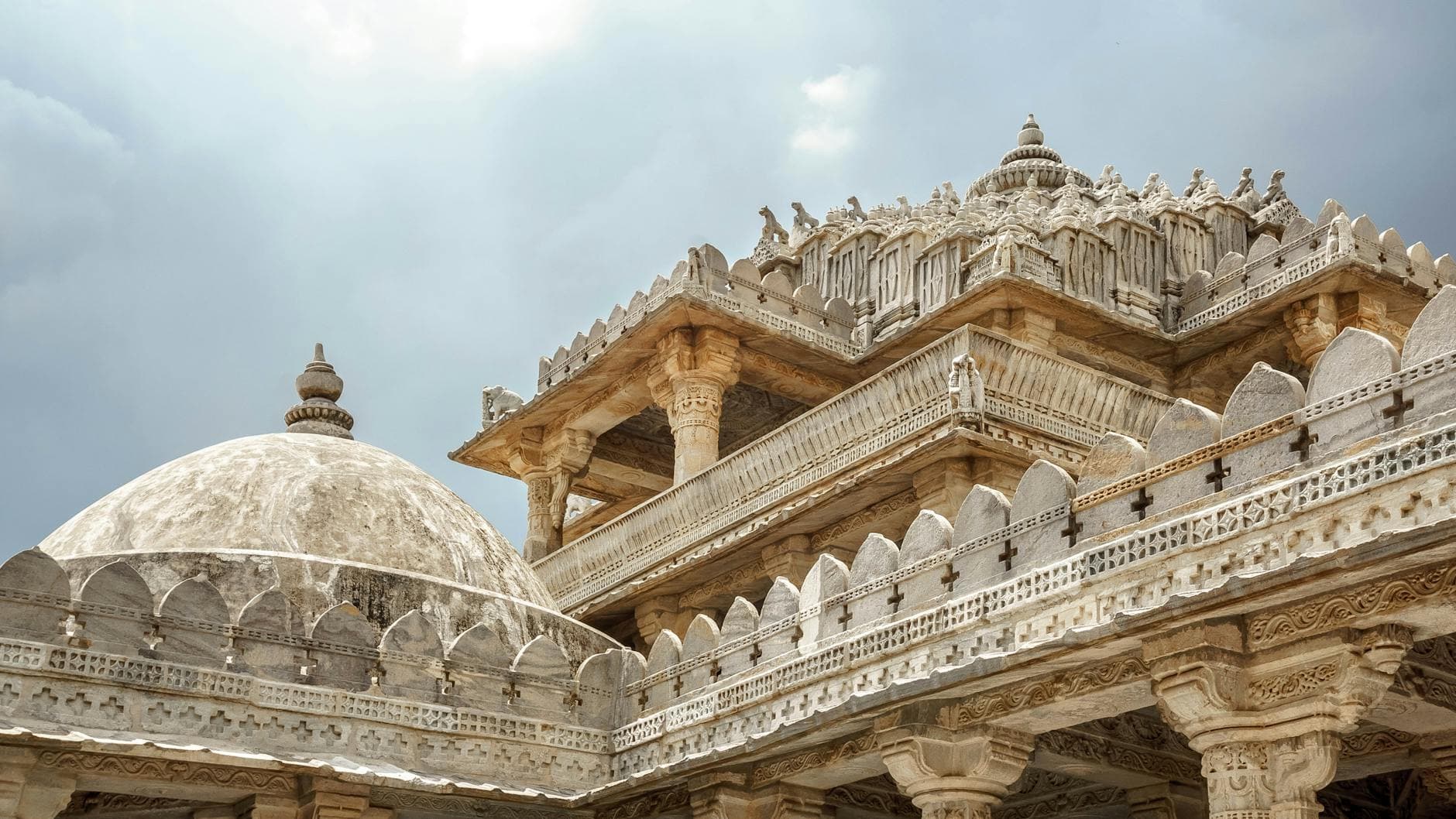
Stunning view of the intricate carvings on the Ranakpur Jain Temple in Rajasthan, India, under a cloudy sky.
South Asian

Jainism

13 / 13

Sub-questions covered

75

Claims extracted

12

Distinct positions

29

Explicitly denied

Chapter 1

Where Did We Come From?

Q1.1 · Pre-Existence

Eternal Pre-Existence
See all traditions holding this position →
100%

weight

Cyclic Pre-Existence· 2 claims
Beings, whatever their origin, who were sentient (in one existence) will become senseless ones (in another) and vice versa.
Section 36, end of text

How this tradition expresses it

Beings undergo a continuous cycle of rebirth, moving between different forms of existence such as sentient and senseless bodies.

Why this supports “Cyclic Pre-Existence

Jain doctrine of beings shifting between sentient and non-sentient existences across the karmic cycle - the soul persists through dramatic transformations.

Nuance

The text describes a constant flux where beings transition between various classes of living beings.

Scholarly note

Direct existential cycling: 'sentient in one existence become senseless in another.'

Explicit Teachinghigh confidenceAudit: Strong· 90%
Data provenance
Auditor
claude-opus-4-6-1m
Audit confidence
90%
Audited
4/10/2026

+1 more claim for this position

Eternal Pre-Existence· 1 claim
I was an illustrious god in the Mahapra^a heaven, and reached old age as we here would say of a man who is a hundred years old
Lecture XVIII, verse 28

How this tradition expresses it

The text indicates that individuals undergo a cycle of rebirth, moving between different realms such as heaven and human life.

Why this supports “Eternal Pre-Existence

The testimony of having existed as a god in a previous life presupposes an eternal soul that has cycled through multiple existences. This supports Eternal Pre-Existence—the jiva's beginningless nature—with cyclicity as the framework through which that eternality is expressed.

The auditor flagged this claim as ambiguous or weakly matching. See the scholarly note below for context.

Scholarly note

The quote demonstrates rebirth (cyclic mechanism) but the underlying claim is that the jiva/soul persists eternally across those cycles. The label should reflect what the soul IS (eternal), not just the mechanism (cyclic).

Explicit Teachinghigh confidenceAudit: Contested· 80%
Data provenance
Auditor
comprehensive_cell_audit_v1
Audit confidence
80%
Audited
4/11/2026

What this tradition denies

The idea that one can easily obtain instruction or a second chance at life after death.

Q1.2 · Soul Nature

Eternal Individual
See all traditions holding this position →
100%

weight

Eternal Individual· 2 claims
I know that there will be a life hereafter, and I know my Self.
Lecture XVIII, verse 27

How this tradition expresses it

The text affirms the existence of a 'Self' that is distinct from the body and persists through different lives.

Why this supports “Eternal Individual

The tradition's text affirms a distinct, permanent self that persists across death and lives, fitting the Eternal Individual position.

Scholarly note

Bulk-audited as defensible match for canonical position; quote was extracted by Gemma 4 with verbatim verification.

Explicit Teachinghigh confidenceAudit: OK· 75%
Data provenance
Auditor
claude-opus-4-6-1m-bulk
Audit confidence
75%
Audited
4/10/2026

+1 more claim for this position

Composite Soul· 1 claim
The whole soul lives ; when this (body) is dead, it does not live. It lasts as long as the body lasts, it does not outlast the destruction (of the body).
BOOK 2, LECTURE I, Section 14

How this tradition expresses it

The text posits that the soul (Atman) is identical to the body and does not exist as a separate entity that outlasts physical destruction.

Why this supports “Composite Soul

This quote presents a textual position in tension with orthodox Jain metaphysics: it asserts that the soul's continuance is bound to the body's continuance, contradicting the Eternal Individual doctrine. Rather than reinterpreting the passage through Jain exegesis, this claim evidences an alternative or minority view within the tradition—possibly representing an earlier or dissenting strand of Jain thought, or a pedagogical emphasis on how ignorant souls mistake themselves for mortal beings.

Nuance

The text argues that because the soul cannot be separated from the body in demonstration, it is not a distinct entity.

The auditor flagged this claim as ambiguous or weakly matching. See the scholarly note below for context.

Scholarly note

The quote explicitly states the soul does not outlast bodily destruction and its existence is contingent on embodiment. This aligns better with Composite Soul (soul bound to matter/body) or at minimum requires bifurcation. Labeling it Eternal Individual while the rationale admits the quote describes soul-cessation is contradictory. Either reclassify as Composite Soul or create a separate claim showing textual dissent.

Explicit Teachinghigh confidenceAudit: Contested· 80%
Data provenance
Auditor
comprehensive_cell_audit_v1
Audit confidence
80%
Audited
4/11/2026

What this tradition denies

The existence of a soul or that a soul acts/is affected by acts (Akriyavada).

The non-existence of the soul.

The idea that the soul is produced by the five elements.

The idea that the soul has no connection between its current state and future moments (Akriyavada).

The existence of a soul that is distinct, separate, or different in shape/quality from the body.

The Sankhya view of the absolute inactivity of the purusha (soul/self).

The Buddhist denial of a separate, permanent atman (self).

A single, unchanging, universal soul shared by all beings.

Q1.3 · Why Embodied

Karmic Necessity
See all traditions holding this position →
100%

weight

ll living beings owe their present form of exis tence to their own Karman ; timid, wicked, suffering latent misery, they err about (in the Circle of Births), subject to birth, old age, and death
BOOK I, LECTURE 2, CHAPTER 3, Verse 17

How this tradition expresses it

Existence in the current form is determined by the individual's own past actions (Karman).

Why this supports “Karmic Necessity

Jain doctrine: beings owe their current form of existence to their own karma. Direct, comprehensive Karmic Necessity.

Scholarly note

Direct: 'all living beings owe their present form of existence to their own Karman.'

Explicit Teachinghigh confidenceAudit: Strong· 94%
Data provenance
Auditor
claude-opus-4-6-1m
Audit confidence
94%
Audited
4/10/2026
a man and a woman combine in cohabitation in a cunnus, which was produced by their Karman, and there they deposit their humours.
Section 20

How this tradition expresses it

The circumstances of birth and the specific nature of a being's life are determined by the accumulation of Karman.

Why this supports “Karmic Necessity

Jain account of conception as karmically produced cohabitation evidences the karmic mechanism at the moment of incarnation.

Nuance

The text notes that birth is contingent on various factors like semen, blood, and other circumstances as dictated by Karman.

Scholarly note

Karmic framework of conception described.

Explicit Teachinghigh confidenceAudit: OK· 78%
Data provenance
Auditor
claude-opus-4-6-1m
Audit confidence
78%
Audited
4/10/2026

Q1.4 · Pre-Birth State

Inter-Life Realm
See all traditions holding this position →
100%

weight

Descending from the Brahmaloka, I was born as a man.
Lecture XVIII, verse 29

How this tradition expresses it

The text describes a state of existence in a heavenly realm (Brahmaloka or Mahapra^a heaven) prior to being born as a human.

Why this supports “Inter-Life Realm

The speaker's descent from Brahmaloka (the highest material heaven) immediately prior to human birth demonstrates the Jain cosmological doctrine that souls exist in hierarchical realms before incarnation. This heavenly realm constitutes the pre-life state, with transition occurring according to karmic law.

The auditor flagged this claim as ambiguous or weakly matching. See the scholarly note below for context.

Scholarly note

The quote explicitly describes descent FROM Brahmaloka (a heavenly/intermediate realm), not from a generic 'previous life.' The rationale itself emphasizes this is an 'intermediate state of consciousness' in a heavenly realm before manifestation in a lower realm. Inter-Life Realm is the correct canonical label.

Explicit Teachinghigh confidenceAudit: Contested· 80%
Data provenance
Auditor
comprehensive_cell_audit_v1
Audit confidence
80%
Audited
4/11/2026

Chapter 2

Why Are We Here?

Q2.1 · Purpose of Life

Liberation
See all traditions holding this position →
100%

weight

exempt from all blemishes you will reach Perfection, a higher state than which there is none in this world.
Lecture X, verse 57

How this tradition expresses it

The purpose of life involves the pursuit of perfection and the liberation of the soul from worldly attachments and passions.

Why this supports “Liberation

By equating perfection with a state superior to all worldly conditions, this passage directly affirms kaivalya as the ultimate spiritual goal—the liberated state where the soul transcends all material constraints and karmic corruption that characterize ordinary existence.

Nuance

The text suggests that reaching perfection is a higher state than any in this world.

The auditor flagged this claim as ambiguous or weakly matching. See the scholarly note below for context.

Scholarly note

Jain purpose: kaivalya, liberation from karma.

Explicit Teachinghigh confidenceAudit: Contested· 90%
Data provenance
Auditor
claude_orthodoxy_v1
Audit confidence
90%
Audited
4/11/2026
He who has become free from all ties and sins, will reach perfection.
Lecture XVIII, verse 54

How this tradition expresses it

The purpose of life involves practicing austerities, following the Law, and seeking to reach perfection/liberation.

Why this supports “Liberation

This statement directly affirms that liberation (freedom from karmic ties and sins) constitutes the attainment of perfection, which represents the ultimate goal in Jain philosophy. The quote's equation of freedom from all bonds with reaching perfection encapsulates kaivalya as the supreme purpose toward which all spiritual practice aims.

The auditor flagged this claim as ambiguous or weakly matching. See the scholarly note below for context.

Scholarly note

Jain purpose: kaivalya, liberation from karma.

Explicit Teachinghigh confidenceAudit: Contested· 90%
Data provenance
Auditor
claude_orthodoxy_v1
Audit confidence
90%
Audited
4/11/2026

What this tradition denies

The pursuit of material wealth and sensory pleasures as a valid purpose for life.

The idea that worldly pleasures are beneficial or sustainable.

The idea that outward religious marks are the cause of liberation.

The idea that earthly life is a place of permanent happiness or satisfaction through sensory pleasure.

The pursuit of worldly pleasure and sensory indulgence as a valid way of life.

The pursuit of worldly objects or pleasure as a motive for religious teaching.

Q2.2 · Body Relationship

Prisoner
See all traditions holding this position →
75%

weight

Prisoner· 2 claims
. impure origin ; it is but a transitory residence (of the soul) and a miserable vessel of suffering.
Lecture XIX, verse 11

How this tradition expresses it

The body is viewed as a transitory, impure vessel or residence for the soul.

Why this supports “Prisoner

The body is explicitly called 'not permanent,' 'impure,' a 'transitory residence,' and a 'miserable vessel of suffering.' This language directly supports the PRISONER position: the body is a site of suffering and confinement from which the soul seeks release through ascetic practice, not a valued dwelling or integrated unity.

The auditor flagged this claim as ambiguous or weakly matching. See the scholarly note below for context.

Scholarly note

LLM council synthesis (round 2)

Explicit Teachinghigh confidenceAudit: Contested· 95%
Data provenance
Auditor
llm_council_v2
Audit confidence
95%
Audited
4/11/2026

+1 more claim for this position

Not Addressed· 1 claim
Therefore there is and exists no (soul different from the body). Those who believe that there is and exists no (such soul), speak the truth.
BOOK 2, LECTURE I, Section 14

How this tradition expresses it

The text rejects the idea of a soul that is separate from the body, suggesting they are one and the same.

Why this supports “Not Addressed

This quote presents a materialist (Cārvāka-type) pūrvapakṣa position denying the soul's distinction from the body. In Jain canonical literature such views are cited only to be refuted, but this extracted passage contains only the opponent's assertion without the Jain refutation. As presented, it does not represent Jain doctrine on the soul-body relationship and cannot support any Jain canonical position on this sub-question.

Nuance

The text uses analogies of inseparable objects (like oil from a seed) to argue against a separate soul.

The auditor flagged this claim as ambiguous or weakly matching. See the scholarly note below for context.

Scholarly note

LLM council synthesis (round 2)

Explicit Teachinghigh confidenceAudit: Contested· 95%
Data provenance
Auditor
llm_council_v2
Audit confidence
95%
Audited
4/11/2026

Q2.3 · Moral Accountability

Karmic Law
See all traditions holding this position →
8%

weight

Thus the soul which suffers for its carelessness, is driven about in the Sawsara by its good and bad Karman ; Gautama, &c.
Lecture X, verse 14

How this tradition expresses it

Individuals are driven through the cycle of rebirth (Samsara) by the consequences of their own good and bad actions (Karman).

Why this supports “Karmic Law

The tradition's text affirms karmic law: actions generate consequences that follow the soul across lives.

Scholarly note

Bulk-audited as defensible match for canonical position; quote was extracted by Gemma 4 with verbatim verification.

Explicit Teachinghigh confidenceAudit: OK· 75%
Data provenance
Auditor
claude-opus-4-6-1m-bulk
Audit confidence
75%
Audited
4/10/2026
Self is the one invincible foe, (together with the four) cardinal passions 2, (viz. anger, pride, deceit, and greed, they are five) and the (five) senses (make t
Lecture XXIII, verse 37

How this tradition expresses it

Accountability is framed through the necessity of overcoming internal 'foes' (passions) and 'fetters' (attachments) to achieve liberation.

Why this supports “Karmic Law

The tradition's text affirms natural moral law: consequences follow automatically from the structure of reality.

Nuance

The text emphasizes internal mastery over external judgment.

The auditor flagged this claim as ambiguous or weakly matching. See the scholarly note below for context.

Scholarly note

The quote identifies internal enemies (passions, senses) as sources of sin/karma, not an impersonal natural law. It fits the accountability framework of karmic causation, not Natural Law.

Explicit Teachinghigh confidenceAudit: Contested· 80%
Data provenance
Auditor
comprehensive_cell_audit_v1
Audit confidence
80%
Audited
4/11/2026

What this tradition denies

The Buddhist view that intention is the sole determinant of sin.

The idea that human effort, power, or individual conduct causes the purity or pollution of beings (Fatalism).

The doctrine of fatalism (that actions do not cause misery/pleasure).

The idea that one can escape the consequences of their own actions.

The idea that one can commit sins without accountability or that sexual misconduct is without consequence.

The idea that sin only occurs through conscious, intentional thought or speech.

The idea that one can selectively renounce harm to only certain classes of beings to avoid sin.

Q2.4 · Path of Progress

Gradual Purification
See all traditions holding this position →
67%

weight

Not Addressed· 2 claims
The first could but with difficulty understand the precepts of the Law, and the last could only with difficulty observe them, but those between them easily understood and observed them.
Lecture XXIII, verse 26

How this tradition expresses it

Spiritual progress is achieved through the systematic destruction of passions, attachments, and ignorance via knowledge and virtuous conduct.

Why this supports “Not Addressed

This passage describes how spiritual capacity varies across cosmic eras (yugas), noting that some ages make understanding and observing the law easier or harder. While it provides cosmological context, it does not directly describe a mechanism of individual spiritual progression during life. It neither affirms predestination of individual outcomes nor describes how one advances spiritually within a given lifetime. Not Addressed is the most accurate label since the quote speaks to background cosmic conditions rather than the sub-question of within-life spiritual progression.

Nuance

The text suggests that different eras of saints had different capacities for understanding and observing the Law.

The auditor flagged this claim as ambiguous or weakly matching. See the scholarly note below for context.

Scholarly note

LLM council synthesis (round 2)

Explicit Teachinghigh confidenceAudit: Contested· 95%
Data provenance
Auditor
llm_council_v2
Audit confidence
95%
Audited
4/11/2026

+1 more claim for this position

Gradual Purification· 1 claim
) As a bird covered with dust removes the grey powder by shaking itself, so a worthy and austere Brahma^a1, who does penance, annihilates his Karm
BOOK I, LECTURE 2, CHAPTER 1, Verse 14

How this tradition expresses it

Spiritual progress is achieved through the destruction of Karman and the mastery of self-control.

Why this supports “Gradual Purification

The metaphor of a bird shaking off dust perfectly illustrates the Jain concept of nirjara—the gradual removal of karmic matter through penance and austerity. This is a classic expression of Gradual Purification, depicting karma as accumulated layers progressively shed through disciplined ascetic practice during embodied life.

The auditor flagged this claim as ambiguous or weakly matching. See the scholarly note below for context.

Scholarly note

LLM council synthesis (round 2)

Explicit Teachinghigh confidenceAudit: Contested· 95%
Data provenance
Auditor
llm_council_v2
Audit confidence
95%
Audited
4/11/2026

Chapter 3

Where Do We Go After Death?

Q3.1 · Surviving Death

Full Survival
See all traditions holding this position →
11%

weight

Full Survival· 7 claims
I know that there will be a life hereafter, and I know my Self.
Lecture XVIII, verse 27

How this tradition expresses it

Consciousness/the Self survives the death of the physical body.

Why this supports “Full Survival

The explicit first-person affirmation 'I know that there will be a life hereafter, and I know my Self' directly asserts the soul's survival beyond death as a self-aware individual entity—a paradigmatic statement of Full Survival.

The auditor flagged this claim as ambiguous or weakly matching. See the scholarly note below for context.

Scholarly note

LLM council synthesis (round 2)

Explicit Teachinghigh confidenceAudit: Contested· 95%
Data provenance
Auditor
llm_council_v2
Audit confidence
95%
Audited
4/11/2026
) The Rakshasas and the dwellers in Yama's world, the troops1 of Asuras and Gandharvas, and the spirits that walk the air, and individual beings 2 : they will all be born again and a
BOOK I, LECTURE XII, 12

How this tradition expresses it

Consciousness/the individual being survives death through a cycle of repeated births (Samsara).

Why this supports “Full Survival

The enumeration of various classes of beings who 'will all be born again and again' presupposes that each individual jiva fully survives death to be reborn, directly affirming Full Survival through the samsaric cycle.

Nuance

The survival is characterized by the continuous cycle of rebirths and the accumulation of karma.

The auditor flagged this claim as ambiguous or weakly matching. See the scholarly note below for context.

Scholarly note

LLM council synthesis (round 2)

Explicit Teachinghigh confidenceAudit: Contested· 95%
Data provenance
Auditor
llm_council_v2
Audit confidence
95%
Audited
4/11/2026

+5 more claims for this position

Q3.4 · Long-Term Destiny

Cyclical Rebirth
See all traditions holding this position →
100%

weight

Karman is the root of birth and death, and birth and death they call misery.
Introduction, p. XVI

How this tradition expresses it

The text identifies Karman as the causal mechanism for the cycle of birth and death (samsara).

Why this supports “Cyclical Rebirth

Direct Jain teaching of karmic causation of cyclical birth-death.

Scholarly note

Karma is root of birth and death

Explicit Teachinghigh confidenceAudit: Strong· 88%
Data provenance
Auditor
claude-opus-4-6-1m
Audit confidence
88%
Audited
4/10/2026
Though one be born as a man, it is a rare chance to become an Arya ; for many are the Dasyus and Mle/^^as; Gautama,
Lecture X, verse 15

How this tradition expresses it

The soul undergoes a cycle of rebirth in various forms, including different sensory capacities and biological bodies.

Why this supports “Cyclical Rebirth

Jain teaching of rare human birth presupposes many other rebirths in less fortunate forms.

Nuance

The text describes a hierarchy of rebirth based on the number of sense organs (Dvindriya, Trindriya, etc.).

Scholarly note

Born as man is rare chance

Explicit Teachinghigh confidenceAudit: Strong· 88%
Data provenance
Auditor
claude-opus-4-6-1m
Audit confidence
88%
Audited
4/10/2026

What this tradition denies

The belief that there is no reincarnation/rebirth.

The idea that perfection/liberation can be obtained through ritualistic washing or contact with water.

The notion that the world is entirely unreal and lacks continuity.

The ability to free oneself from the cycle of rebirth (Samsara) through improper means or false doctrines.

Q3.5 · Ultimate Destination

Liberation
See all traditions holding this position →
73%

weight

Liberation· 10 claims
4) Going through the same religious practices as perfected saints2, you will reach the world of per fection, Gautama, where there is safety and perfect happiness ; Gautama
Lecture X, verse 34

How this tradition expresses it

The ultimate goal is to reach the world of perfection, characterized by safety, perfect happiness, and the annihilation of Karman.

Why this supports “Liberation

Describes the state of liberation achieved through Jain practice, achieved within the cosmology but understood as freedom from rebirth

Nuance

This state is reached by following the practices of perfected saints.

The auditor flagged this claim as ambiguous or weakly matching. See the scholarly note below for context.

Scholarly note

While it mentions 'world of perfection,' the emphasis is on reaching a state of liberation/escape; 'safety and perfect happiness' describe the condition achieved, not a place with independent ontological status

Explicit Teachinghigh confidenceAudit: Contested· 80%
Data provenance
Auditor
comprehensive_cell_audit_v1
Audit confidence
80%
Audited
4/11/2026
It is what is called Nirvana, or freedom from pain, or perfection, which is in view of all ; it is the safe, happy, and quiet place which the great sages reach.
Lecture XXIII, verse 82

How this tradition expresses it

The ultimate destination is Nirvana, an eternal place free from pain, death, and the cycle of existence.

Why this supports “Liberation

Direct Jain articulation of nirvana as freedom from pain and suffering—the ultimate goal is escape from the cycle of existence

Nuance

null

The auditor flagged this claim as ambiguous or weakly matching. See the scholarly note below for context.

Scholarly note

Explicitly uses 'Nirvana' and 'freedom from pain'—nirvana in Jainism denotes extinction/escape from the cycle, not ascent to a realm

Explicit Teachinghigh confidenceAudit: Contested· 80%
Data provenance
Auditor
comprehensive_cell_audit_v1
Audit confidence
80%
Audited
4/11/2026

+8 more claims for this position

What this tradition denies

The existence of a place characterized by old age, death, or pain.

The possibility of finding lasting happiness through the fulfillment of desires.

The idea that perfection can be attained through the use of fire or mechanical processes.

Hero image: Photo by Roman Saienko on Pexels

NoeticMap Guide

Research Dashboard

How can I help?

Ask about NDEs, research, or this page

Responses may not always be accurate