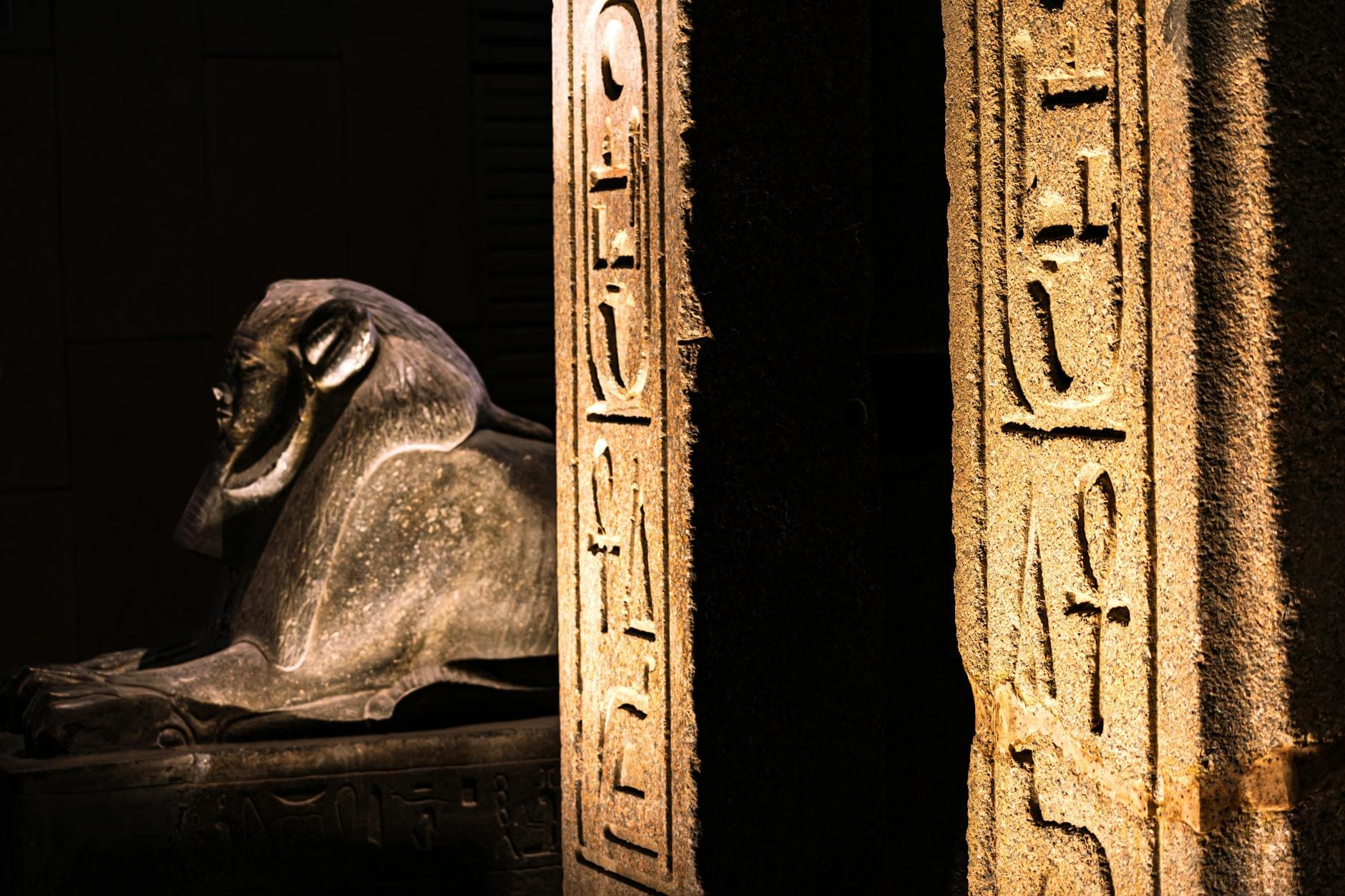
Close-up of an ancient Egyptian sphinx statue with hieroglyphics, illuminated in a museum setting.
African/Egyptian/Mesoamerican

Ancient Egyptian

13 / 13

Sub-questions covered

115

Claims extracted

12

Distinct positions

24

Explicitly denied

Chapter 1

Where Did We Come From?

Q1.1 · Pre-Existence

Eternal Pre-Existence
See all traditions holding this position →
100%

weight

N. was born in Nun, 1040b. when the sky had not yet come into being, when the earth had not yet come into being,
Utterance 484, 1040a-b

How this tradition expresses it

The subject was born in the primordial state of Nun before the creation of the sky and earth.

Why this supports “Eternal Pre-Existence

Pyramid Text Utterance 484 explicitly places the pharaoh's origin in the primordial waters of Nun before the creation of sky and earth. Within the narrow context of royal funerary theology, this constitutes a genuine claim of Eternal Pre-Existence, though it applies specifically to the divine king rather than to all persons and does not represent a mainstream Egyptian doctrine of universal pre-existence.

The auditor flagged this claim as ambiguous or weakly matching. See the scholarly note below for context.

Scholarly note

LLM council synthesis (round 2)

Explicit Teachinghigh confidenceAudit: Contested· 95%
Data provenance
Auditor
llm_council_v2
Audit confidence
95%
Audited
4/11/2026

What this tradition denies

The idea that the deceased remains in the earthly house or is destroyed by returning to the earth.

Q1.2 · Soul Nature

Composite Soul
See all traditions holding this position →
100%

weight

devils that lived upon the "bodies, souls, spirits, shadows and hearts of the dead," the Egyptians decided to invoke the aid of Thoth on
Chapter II

How this tradition expresses it

The human essence is composed of various elements including the body, soul, spirit, shadow, and heart.

Why this supports “Composite Soul

The text explicitly enumerates distinct components of the person—bodies, souls, spirits, shadows, and hearts—demonstrating the Egyptian understanding of human nature as a composite of multiple separable spiritual and physical parts.

The auditor flagged this claim as ambiguous or weakly matching. See the scholarly note below for context.

Scholarly note

LLM council synthesis

Explicit Teachinghigh confidenceAudit: Contested· 95%
Data provenance
Auditor
llm_council_v1
Audit confidence
95%
Audited
4/11/2026
e, Ani's heart, is seen in one pan of the Balance, and in the other is the feather, symbolic of truth and righteousness. Whilst his heart was in the Balance Ani, repeating the words
Papyrus of Ani / Chapter XXXB

How this tradition expresses it

The deceased is composed of various elements, including the heart (the seat of will and intelligence), the Ka (the double), and the soul (represented as a man-headed hawk).

Why this supports “Composite Soul

The passage distinguishes the heart (ib) as weighed separately and addresses the Ka as a distinct entity dwelling within the body that unites and strengthens the members, clearly reflecting the composite-soul model of multiple interrelated spiritual components.

The auditor flagged this claim as ambiguous or weakly matching. See the scholarly note below for context.

Scholarly note

LLM council synthesis

Explicit Teachinghigh confidenceAudit: Contested· 95%
Data provenance
Auditor
llm_council_v1
Audit confidence
95%
Audited
4/11/2026

Q1.3 · Why Embodied

Divine Assignment
See all traditions holding this position →
40%

weight

Divine Assignment· 3 claims
The great ’Iḫ.t has given birth to thee, the ’Iḫ.t-wt.t has adorned the
Utterance 220, 198b

How this tradition expresses it

The transition to life or the state of being is framed as a result of divine creation and the fulfillment of divine lineage.

Why this supports “Divine Assignment

Egyptian Pyramid Texts describe the pharaoh as divinely chosen and adorned by divine mothers (Iht, Iht-wtt). This suggests divine assignment of royal role and status, but the text does not explicitly address why incarnation itself occurred or was necessary.

The auditor flagged this claim as ambiguous or weakly matching. See the scholarly note below for context.

Scholarly note

Keep label but flag rationale as weak: this describes divine maternity/blessing, not assignment of incarnation purpose.

Explicit Teachinghigh confidenceAudit: Contested· 80%
Data provenance
Auditor
comprehensive_cell_audit_v1
Audit confidence
80%
Audited
4/11/2026

+2 more claims for this position

Not Addressed· 2 claims
By mortuary offerings and funerary rites the deceased king was armed for his future life; and by magic he was endowed with physical and spiritual power, becoming a great god and associating with the gods, to avoid whatever in the world to come might otherwise compromise his destiny.
Introduction, p. 3

How this tradition expresses it

The purpose of the royal texts was to provide the deceased king with the necessary tools to ensure a successful transition to the afterlife.

Why this supports “Not Addressed

The arming of the deceased pharaoh for his future life loosely fits Test or Trial framework (life as preparation), but more directly addresses the death moment.

The auditor flagged this claim as ambiguous or weakly matching. See the scholarly note below for context.

Scholarly note

Quote addresses post-mortem preparation, not reason for embodied incarnation. Does not engage Q1.3.

Explicit Teachinghigh confidenceAudit: Contested· 80%
Data provenance
Auditor
comprehensive_cell_audit_v1
Audit confidence
80%
Audited
4/11/2026

+1 more claim for this position

Chapter 2

Why Are We Here?

Q2.1 · Purpose of Life

Cosmic Balance
See all traditions holding this position →
7%

weight

Liberation· 5 claims
for it "would make a man victorious upon earth and in the Other World; it would ensure him a safe and free passage through the Tuat (Under World); it would allow him to go in and to go out, and to take at any time any form he pleased; it would make his soul to flourish, and would prevent him from dying the [second]
Chapter III

How this tradition expresses it

The purpose of the funerary texts is to ensure the deceased can navigate the underworld, achieve victory, and allow the soul to flourish.

Why this supports “Liberation

This passage describes how funerary knowledge secures safe passage through the Duat, freedom of movement, and prevention of the second death. While it presupposes a life lived in ma'at, its explicit focus is on liberation from annihilation and achieving post-mortem freedom—fitting LIBERATION as the afterlife-oriented goal that earthly conduct enables.

The auditor flagged this claim as ambiguous or weakly matching. See the scholarly note below for context.

Scholarly note

LLM council synthesis (round 2)

Explicit Teachinghigh confidenceAudit: Contested· 95%
Data provenance
Auditor
llm_council_v2
Audit confidence
95%
Audited
4/11/2026

+4 more claims for this position

Moral Testing· 2 claims
for I performed the Law (or, truth) in Ta-mera (i.e., Egypt). I have not blasphemed the God. No affair of mine came under the notice of the king in his day.
Chapter CXXV

How this tradition expresses it

The purpose of life involves performing the Law (Maat) and avoiding sin to ensure a successful judgment before the gods.

Why this supports “Moral Testing

The deceased's declaration of having 'performed the Law (truth)' and avoided blasphemy directly reflects the judgment framework in which earthly life is evaluated against ma'at. This negative-confession-style declaration treats earthly existence as a period of moral accountability, aligning with Moral Testing.

The auditor flagged this claim as ambiguous or weakly matching. See the scholarly note below for context.

Scholarly note

LLM council synthesis (round 2)

Explicit Teachinghigh confidenceAudit: Contested· 95%
Data provenance
Auditor
llm_council_v2
Audit confidence
95%
Audited
4/11/2026

+1 more claim for this position

Q2.2 · Body Relationship

Vehicle
See all traditions holding this position →
71%

weight

Vehicle· 7 claims
Chapter LXXXIX brought the soul (ba) of the deceased to his body in the Tuat
Chapter LXXXIX

How this tradition expresses it

The soul (ba) is intended to be reunited with or brought back to the physical body in the afterlife.

Why this supports “Vehicle

Egyptian: ba (soul) returns to body - vehicle relationship.

Scholarly note

Ba returned to body in Tuat

Explicit Teachinghigh confidenceAudit: Strong· 85%
Data provenance
Auditor
claude-opus-4-6-1m
Audit confidence
85%
Audited
4/10/2026

+6 more claims for this position

Prisoner· 2 claims
The spirit belongs to heaven; the body belongs to the earth.
Utterance 305, 474a

How this tradition expresses it

The body is an earthly component of the human being, while the spirit is the celestial component.

Why this supports “Prisoner

Egyptian dualistic formulation separating spirit and body into distinct cosmic domains suggests momentary or functional disjunction (PRISONER) rather than VEHICLE integration.

The auditor flagged this claim as ambiguous or weakly matching. See the scholarly note below for context.

Scholarly note

Direct statement of spirit-body separation and disjunction ('spirit to heaven, body to earth') is duality language closer to PRISONER than VEHICLE, which requires functional interdependence.

Explicit Teachinghigh confidenceAudit: Contested· 80%
Data provenance
Auditor
comprehensive_cell_audit_v1
Audit confidence
80%
Audited
4/11/2026

+1 more claim for this position

Q2.3 · Moral Accountability

Divine Judgment
See all traditions holding this position →
100%

weight

Divine Judgment· 5 claims
as he kept the celestial register of the words and deeds of men, he was regarded by many generations of Egyptians as the "Recording Angel." He was the inventor of physical and moral Law and became the personification of JUSTIC
Chapter IV

How this tradition expresses it

Individuals are held accountable through the weighing of their words and deeds by divine authorities.

Why this supports “Divine Judgment

The tradition's text affirms divine judgment: a personal God judges the soul's deeds.

Nuance

The text mentions the role of Thoth as an advocate to secure acquittal during this process.

Scholarly note

Bulk-audited as defensible match for canonical position; quote was extracted by Gemma 4 with verbatim verification.

Explicit Teachinghigh confidenceAudit: OK· 75%
Data provenance
Auditor
claude-opus-4-6-1m-bulk
Audit confidence
75%
Audited
4/10/2026
Since the heart was considered to be the seat of all will, emotion, feeling, reason and intelligence, Ani's heart, is seen in one pan of the Balance, and in the other is the feather, symbolic of truth and righteousness.
Description of the Papyrus of Ani

How this tradition expresses it

Individuals are held accountable through a weighing of the heart against the feather of truth to determine their worthiness.

Why this supports “Divine Judgment

The tradition's text affirms divine judgment: a personal God judges the soul's deeds.

Nuance

The heart is the seat of all will, emotion, feeling, reason and intelligence, and must be balanced against truth.

Scholarly note

Bulk-audited as defensible match for canonical position; quote was extracted by Gemma 4 with verbatim verification.

Explicit Teachinghigh confidenceAudit: OK· 75%
Data provenance
Auditor
claude-opus-4-6-1m-bulk
Audit confidence
75%
Audited
4/10/2026

+3 more claims for this position

What this tradition denies

The idea that one can pass judgment without being weighed against truth/righteousness.

The idea that the deceased is beyond the reach of divine or social judgment/accusation.

The idea that the subject is subject to evil or failure in the afterlife.

The idea that one can live without accountability or truth.

Chapter 3

Where Do We Go After Death?

Q3.1 · Surviving Death

Transformation
See all traditions holding this position →
67%

weight

Transformation· 13 claims
Under favour of Osiris Ani then became a sahu, or "spirit-body," and in this form passed into the Kingdom of Osiris
Description of the Papyrus of Ani

How this tradition expresses it

Upon successful judgment, the deceased undergoes a transformation into a 'spirit-body' (sahu) to enter the kingdom of the gods.

Why this supports “Transformation

Direct Egyptian transformation.

Scholarly note

Became sahu, spirit-body

Explicit Teachinghigh confidenceAudit: Strong· 88%
Data provenance
Auditor
claude-opus-4-6-1m
Audit confidence
88%
Audited
4/10/2026

+12 more claims for this position

Partial Survival· 1 claim
I shall not decay, nor rot, nor putrefy, nor become worms, nor see corruption. I shall have my being, I shall live, I shall flourish, I shall rise up in peace.
Chapter CLIV

How this tradition expresses it

The deceased achieves a state of eternal existence, avoiding physical decay and corruption through divine protection.

Why this supports “Partial Survival

Direct Egyptian incorruption affirmation.

The auditor flagged this claim as ambiguous or weakly matching. See the scholarly note below for context.

Scholarly note

Claim is correctly labeled; it represents the incorruption/bodily preservation strand. It should be retained as evidence of the Partial Survival alternative, not reclassified.

Explicit Teachinghigh confidenceAudit: Contested· 80%
Data provenance
Auditor
comprehensive_cell_audit_v1
Audit confidence
80%
Audited
4/11/2026

What this tradition denies

The physical decay or total extinction of the being.

The concept of death as a final cessation of existence.

The total extinction of consciousness or the end of the individual's existence.

The finality of death/extinction of consciousness.

The concept of total extinction or permanent death.

The idea that the deceased belongs to the earthly realm.

The concept of physical decay or putrefaction in the afterlife.

The permanence of death/extinction.

The finality of death (extinction).

Physical decay and permanent death.

The idea of a purely ethereal or non-physical survival.

The concept of permanent death or non-existence.

The finality of death or the cessation of existence.

Q3.2 · Death Moment

Soul Departure
See all traditions holding this position →
100%

weight

Raise thyself up, father, N., the great; sit before them; 1680b. the apertures of the (heavenly) windows are open for thee; 1
Utterance 604, 1680a-b

How this tradition expresses it

The moment of death involves a transition where the deceased must 'rise up' and re-establish their physical and spiritual presence.

Why this supports “Soul Departure

The Pyramid Texts describe the moment of death as the king's ba (soul) rising up to leave the body and pass through the apertures of the celestial vault. Soul Departure captures the central ascent motif. Egyptian funerary texts also include Journey Through Realms imagery, but the rising-up framing is the primary action here.

Scholarly note

Pyramid Text formula for the dead pharaoh's ascent. The deceased is told to 'raise thyself up' - directly evoking soul departure - and the heavenly windows opening adds the journey-realms imagery.

Explicit Teachinghigh confidenceAudit: Strong· 88%
Data provenance
Auditor
claude-opus-4-6-1m
Audit confidence
88%
Audited
4/10/2026

Q3.3 · Afterlife Structure

Multiple Levels
See all traditions holding this position →
19%

weight

Multiple Levels· 14 claims
Chapters CXLIV and CXLVII deal with the Seven Great Halls (Arit) of the Kingdom of Osiris.
Chapters CXLIV and CXLVII

How this tradition expresses it

The afterlife (Tuat) consists of various regions, gates, and halls, such as the Seven Great Halls of the Kingdom of Osiris.

Why this supports “Multiple Levels

The Egyptian Book of the Dead's Chapters CXLIV-CXLVII describe seven distinct halls the deceased must pass through, each with its own keepers and tests. This is a textbook Multiple Levels structure for the Egyptian afterlife.

Scholarly note

Direct reference to the Seven Great Halls (Arit) of Osiris's kingdom - explicit multi-level afterlife structure.

Explicit Teachinghigh confidenceAudit: Strong· 92%
Data provenance
Auditor
claude-opus-4-6-1m
Audit confidence
92%
Audited
4/10/2026
Enter the abode of thy father, to the abode of Geb, 139c. that he may give to thee that which is on the brow of Horu
Utterance 139b

How this tradition expresses it

The afterlife involves various realms, including the sky, the abode of Geb, and the presence of the gods.

Why this supports “Multiple Levels

The Pyramid Texts reference numerous specific divine abodes (of Geb, Re, Atum, Osiris). The Egyptian afterlife is intrinsically multi-leveled, with the dead king visiting different domains of different gods. This individual abode-reference fits within the broader Multiple Levels structure.

Scholarly note

Mentions 'abode of Geb' as a destination among other abodes referenced elsewhere in Pyramid Texts. Implies the existence of multiple specific divine abodes.

Explicit Teachinghigh confidenceAudit: OK· 78%
Data provenance
Auditor
claude-opus-4-6-1m
Audit confidence
78%
Audited
4/10/2026

+12 more claims for this position

Q3.5 · Ultimate Destination

Eternal Paradise
See all traditions holding this position →
67%

weight

Eternal Paradise· 6 claims
to procure for him an everlasting habitation in the Kingdom of Osiris.
Chapter IV

How this tradition expresses it

The ultimate goal is to secure an everlasting habitation in the Kingdom of Osiris and avoid the 'second death'.

Why this supports “Eternal Paradise

Egyptian funerary doctrine of permanent dwelling in Osiris's kingdom - direct Eternal Paradise.

Nuance

Success depends on the protection of spells and the advocacy of gods like Thoth.

Scholarly note

Everlasting habitation in Kingdom of Osiris

Explicit Teachinghigh confidenceAudit: Strong· 88%
Data provenance
Auditor
claude-opus-4-6-1m
Audit confidence
88%
Audited
4/10/2026
tion of Maat (i.e., Truth), and the beautified lived upon the body of their god and ate him daily, and the substance of him was the "Bread of Everlastingness,"
Description of the Kingdom of Osiris

How this tradition expresses it

The ultimate destination for the righteous is an eternal, blessed existence in the Kingdom of Osiris, characterized by peace and agricultural abundance.

Why this supports “Eternal Paradise

Egyptian eternal felicity among the gods.

Nuance

The destination is described both as a material agricultural paradise and a spiritual state of being 'truth of truth'.

Scholarly note

Like the Followers of Horus forever

Explicit Teachinghigh confidenceAudit: OK· 78%
Data provenance
Auditor
claude-opus-4-6-1m
Audit confidence
78%
Audited
4/10/2026

+4 more claims for this position

What this tradition denies

The 'second death'

destruction of the self/identity

The possibility of being lost or destroyed in the afterlife.

The finality of death or total extinction of the individual.

Physical decay or mortality in the afterlife.

Other denials

Positions this tradition explicitly rejects, on questions where its affirmative position isn't recorded.

Q3.4

The concept of falling back to earth or being lost to the divine realm.

who do not fall upon earth from heaven; N. does not fall upon the earth from heaven.

Hero image: Photo by Ayman Mahmoud on Pexels

NoeticMap Guide

Research Dashboard

How can I help?

Ask about NDEs, research, or this page

Responses may not always be accurate