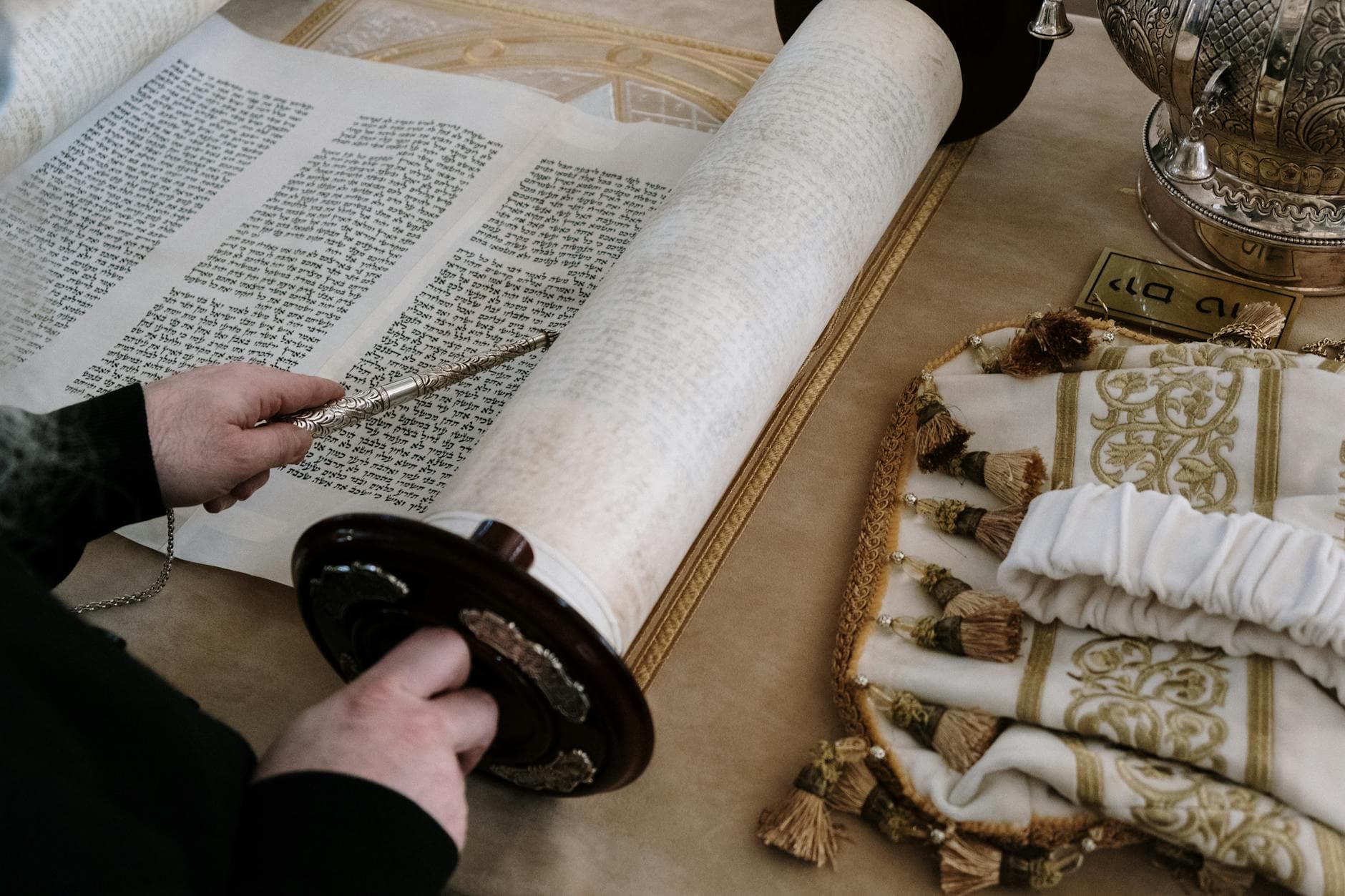
Person reading a Torah scroll using a yad in a traditional synagogue setting.
Abrahamic

Kabbalah

13 / 13

Sub-questions covered

126

Claims extracted

12

Distinct positions

39

Explicitly denied

Chapter 1

Where Did We Come From?

Q1.1 · Pre-Existence

Created Pre-Existence
See all traditions holding this position →
25%

weight

Not Addressed· 2 claims
it is not preordained whether a man will be righteous or wicked.
Chapter 1

How this tradition expresses it

The text suggests that the soul's destiny and character are not preordained, as the choice to be righteous or wicked is not fixed before life.

Why this supports “Not Addressed

The Bahir's 'not preordained whether a man will be righteous or wicked' is about moral free will, not soul pre-existence.

Nuance

The text notes that the answer to how righteousness/wickedness is not preordained is further explained in later chapters.

The auditor flagged this claim as ambiguous or weakly matching. See the scholarly note below for context.

Scholarly note

The Bahir quote concerns moral free will and predestination, not pre-existence of souls. It should be classified as Not Addressed rather than contradicting pre-existence doctrine.

Explicit Teachinghigh confidenceAudit: Contested· 80%
Data provenance
Auditor
comprehensive_cell_audit_v1
Audit confidence
80%
Audited
4/11/2026

+1 more claim for this position

Created Pre-Existence· 2 claims
ch spark] descended into this world, to be clothed in a body and vital soul, for the sole purpose of mending them and separating them from the evil of the three impure kelipot,
Chapter 37

How this tradition expresses it

The soul exists as a 'spark' that has descended into the material world from higher realms to undergo a process of mending and separation from evil.

Why this supports “Created Pre-Existence

The passage explicitly describes souls as "sparks" that have "descended" from higher realms into physical embodiment, affirming their pre-material existence in supernal domains. This descent is purposeful and redemptive—souls enter bodies specifically to rectify spiritual defects and purify themselves from impurity, establishing the core Kabbalistic cosmology of pre-existent souls undergoing tikkun olam through incarnation.

Nuance

The descent is described as a 'profound descent and a state of true exile' compared to the soul's prior state.

The auditor flagged this claim as ambiguous or weakly matching. See the scholarly note below for context.

Scholarly note

Kabbalistic doctrine: souls created and dwell in supernal realms before descending.

Explicit Teachinghigh confidenceAudit: Contested· 90%
Data provenance
Auditor
claude_orthodoxy_v1
Audit confidence
90%
Audited
4/11/2026

+1 more claim for this position

What this tradition denies

The idea that the current order was the only state of existence.

The idea that the heavens and earth were created simultaneously or that one was not prior to the other in a specific sequence.

Preordained righteousness or wickedness.

Q1.2 · Soul Nature

Composite Soul
See all traditions holding this position →
4%

weight

Not Addressed· 3 claims
He made the letter Nun reign, and bound to it a crown, and formed with it Scorpio in the World, and Marcheshwan in the Year, and the spleen in the Person.
Section 2/2

How this tradition expresses it

The human person is composed of specific biological organs and internal elements that correspond to the cosmic structure of the letters and the celestial order.

Why this supports “Not Addressed

This Sefer Yetzirah letter-correspondence passage maps Hebrew letters to zodiac signs, months, and bodily organs. It describes cosmological-anatomical correspondences, not the internal composition or essential nature of the soul. It does not directly address Q1.2.

Nuance

The text links specific letters to specific organs (e.g., spleen, gall, rumen) to form the 'Person'.

The auditor flagged this claim as ambiguous or weakly matching. See the scholarly note below for context.

Scholarly note

LLM council synthesis

Explicit Teachinghigh confidenceAudit: Contested· 95%
Data provenance
Auditor
llm_council_v1
Audit confidence
95%
Audited
4/11/2026

+2 more claims for this position

Created Soul· 1 claim
and formed with them the soul of every formed being and the soul of every being He has yet to form.
Section: Three Mothers, Seven Pairs, and Twelve Simple Letters

How this tradition expresses it

The soul of every being is formed through the combination and manipulation of the twenty-two letters of foundation.

Why this supports “Created Soul

This Sefer Yetzirah passage describes God forming the souls of all beings using Hebrew letters, addressing the origin of the soul as divinely created rather than its internal composition. It supports Created Soul rather than Composite Soul.

The auditor flagged this claim as ambiguous or weakly matching. See the scholarly note below for context.

Scholarly note

LLM council synthesis

Explicit Teachinghigh confidenceAudit: Contested· 95%
Data provenance
Auditor
llm_council_v1
Audit confidence
95%
Audited
4/11/2026

What this tradition denies

A single, uniform soul type.

The identity of the human person with the pure/divine soul (except in the case of the tzaddik).

The idea that the body and the soul are of the same essential nature or that the body is the primary reality.

The idea that the soul is a single, undifferentiated entity without an animal component.

The idea that the soul's essence is divisible into parts corresponding to the body's organs.

The idea that the primordial light was entirely lost or ceased to exist after the first day.

Q1.3 · Why Embodied

Divine Assignment
See all traditions holding this position →
75%

weight

Not Addressed· 1 claim
with three linguistic tools: with Counting, with Writing, and with Speech.
Section: Wondrous

How this tradition expresses it

The process of creation involves the use of linguistic tools (counting, writing, and speech) to shape the world and its inhabitants.

Why this supports “Not Addressed

This Sefer Yetzirah passage describes the cosmic linguistic tools, not directly the purpose of human incarnation.

The auditor flagged this claim as ambiguous or weakly matching. See the scholarly note below for context.

Scholarly note

Own rationale admits it 'does not directly' address human incarnation purpose. It describes cosmological tools, not soteriological intent.

Explicit Teachinghigh confidenceAudit: Contested· 80%
Data provenance
Auditor
comprehensive_cell_audit_v1
Audit confidence
80%
Audited
4/11/2026
Spiritual Growth· 1 claim
e essential thing is to govern and rule the nature that is in the left ventricle [of the heart] by means of the Divine light that irradiates the divine soul in the mind.1
Chapter 16

How this tradition expresses it

Human existence involves the struggle to govern the animalistic nature of the heart through the intellect and the love of G-d.

Why this supports “Spiritual Growth

The quote describes the soul's active work to govern the animal nature through divine intellect. While this describes spiritual practice, it does not establish why the soul was created/sent into embodiment. It describes the mechanism of tikkun but not its ultimate purpose (whether self-directed growth or divine mandate).

Nuance

The necessity of this struggle depends on whether one's nature is naturally inclined toward righteousness or toward mundane desires.

The auditor flagged this claim as ambiguous or weakly matching. See the scholarly note below for context.

Scholarly note

Lurianic Kabbalah: soul descends for tikkun (repair of self and cosmos), not as a test.

Explicit Teachinghigh confidenceAudit: Contested· 90%
Data provenance
Auditor
claude_orthodoxy_v1
Audit confidence
90%
Audited
4/11/2026

What this tradition denies

The independence of the Shekinah from human action.

Chapter 2

Why Are We Here?

Q2.1 · Purpose of Life

Spiritual Development
See all traditions holding this position →
91%

weight

Spiritual Development· 21 claims
Moses was saying, "If you follow my decrees, you will inherit both this world and the next."
Rabbi Amorai section

How this tradition expresses it

The purpose of life involves following divine decrees to inherit both the present world and the World to Come.

Why this supports “Spiritual Development

The tradition's text frames the purpose of life as the progressive development of the soul toward higher states.

Nuance

Success is contingent upon following the decrees of Moses.

Scholarly note

Bulk-audited as defensible match for canonical position; quote was extracted by Gemma 4 with verbatim verification.

Explicit Teachinghigh confidenceAudit: OK· 75%
Data provenance
Auditor
claude-opus-4-6-1m-bulk
Audit confidence
75%
Audited
4/10/2026
it is [study with the intent] to attach one’s soul to G–d through the comprehension of the Torah, each one according to his intellect
Chapter 6

How this tradition expresses it

A primary purpose of life is to attach one's soul to G-d through the comprehension and study of the Torah.

Why this supports “Spiritual Development

The tradition's text frames the purpose of life as the progressive development of the soul toward higher states.

Nuance

The text emphasizes that study must be done 'for its own sake' to achieve this attachment.

Scholarly note

Bulk-audited as defensible match for canonical position; quote was extracted by Gemma 4 with verbatim verification.

Explicit Teachinghigh confidenceAudit: OK· 75%
Data provenance
Auditor
claude-opus-4-6-1m-bulk
Audit confidence
75%
Audited
4/10/2026

+19 more claims for this position

What this tradition denies

The idea that all actions are equally purposeful or directed toward the Divine.

The idea that human purpose is solely found in intellectual comprehension.

The idea that the 'other gods' (kelipot/sitra achara) possess an independent, holy essence.

The idea that the struggle against evil is a sign of worthlessness or failed prayer.

The idea that the physical existence is the ultimate end or purpose of human life.

The idea that the purpose of creation was for the benefit of the higher worlds.

Service performed solely for selfish motives or personal glorification.

The idea that service can be accomplished through love alone without fear.

The idea that the purpose of life is merely for personal satisfaction or non-spiritual ends.

The idea that spiritual progress is purely internal or contemplative without external action.

The idea that secular conversation has a place in the Synagogue.

The idea that the Holy Spirit descends purely of its own accord without human agency.

The idea that human life has no purpose or that the righteous do not affect the divine realm.

The idea that life has a purpose independent of knowing God through Torah.

Q2.2 · Body Relationship

Integrated Unity
See all traditions holding this position →
92%

weight

Vehicle· 9 claims
There is one soul which originates in the kelipah and sitra achara, [and] which is clothed in the blood of a human being, giving life to the body
Chapter 1

How this tradition expresses it

The soul is clothed in the blood of a human being, which gives life to the body and contains the elemental characteristics that drive human nature.

Why this supports “Vehicle

The Tanya describes the nefesh ha-behamit as 'clothed in the blood' and 'giving life to the body,' employing the classic Kabbalistic garment (levush) metaphor where the soul animates the body as an instrument—a VEHICLE relationship in which the body is enlivened and directed by the soul.

The auditor flagged this claim as ambiguous or weakly matching. See the scholarly note below for context.

Scholarly note

LLM council synthesis (round 2)

Explicit Teachinghigh confidenceAudit: Contested· 95%
Data provenance
Auditor
llm_council_v2
Audit confidence
95%
Audited
4/11/2026
in such case the energy of the meat and wine consumed by him is degraded and absorbed temporarily in the utter evil of the three unclean kelipot, and his body temporarily becomes a garment and vehicle for them
Chapter 7

How this tradition expresses it

The body acts as a garment or vehicle for the soul's vitality, and the nature of the body can be affected by the impurity of the actions it performs.

Why this supports “Vehicle

The Tanya explicitly uses the terms 'garment and vehicle' (levush u-merkavah) for the body in relation to spiritual forces, whether holy or from the kelipot. This is direct VEHICLE language: the body serves as a conduit and instrument for whatever spiritual energies inhabit it.

Nuance

The text notes that certain impurities can become 'tied and bound' to the body, requiring purgation.

The auditor flagged this claim as ambiguous or weakly matching. See the scholarly note below for context.

Scholarly note

LLM council synthesis (round 2)

Explicit Teachinghigh confidenceAudit: Contested· 95%
Data provenance
Auditor
llm_council_v2
Audit confidence
95%
Audited
4/11/2026

+7 more claims for this position

Q2.3 · Moral Accountability

Divine Judgment
See all traditions holding this position →
6%

weight

Divine Judgment· 12 claims
One case is speaking of when Israel does the will of God, while the other is speaking of when they do not do His will.
Discussion on the letter ח

How this tradition expresses it

Accountability is tied to doing the will of God; failure to do so results in the 'fire' of anger/punishment.

Why this supports “Divine Judgment

The tradition's text affirms divine judgment: a personal God judges the soul's deeds.

Nuance

The Attribute of Mercy can encompass/surround the people when they do God's will.

Scholarly note

Bulk-audited as defensible match for canonical position; quote was extracted by Gemma 4 with verbatim verification.

Explicit Teachinghigh confidenceAudit: OK· 75%
Data provenance
Auditor
claude-opus-4-6-1m-bulk
Audit confidence
75%
Audited
4/10/2026
he is judged according to the majority [of his acts] and he is deemed “righteous” in his verdict, since he is acquitted in law.
Chapter 1

How this tradition expresses it

Accountability is determined by the majority of one's actions and the specific nature (good or evil) that dominates an individual's life.

Why this supports “Divine Judgment

The tradition's text affirms divine judgment: a personal God judges the soul's deeds.

Nuance

The text distinguishes between the legal verdict of righteousness/wickedness and the true spiritual rank of the soul.

Scholarly note

Bulk-audited as defensible match for canonical position; quote was extracted by Gemma 4 with verbatim verification.

Explicit Teachinghigh confidenceAudit: OK· 75%
Data provenance
Auditor
claude-opus-4-6-1m-bulk
Audit confidence
75%
Audited
4/10/2026

+10 more claims for this position

What this tradition denies

The idea that the wicked can easily begin to serve G-d without repentance.

The idea that purely instinctive or habit-based service is equivalent to intelligent service.

The idea that righteousness can be achieved without sacrifice or effort.

The notion that the righteous are entirely immune to the 'hard shell' of impurity in all circumstances.

The idea that the righteous can rely solely on their own strength or works as an absolute source of certainty.

The idea that punishment is eternal regardless of the body's physical state.

The idea that God's justice is bypassed or that He does not account for human sin when providing sustenance.

Q2.4 · Path of Progress

Gradual Purification
See all traditions holding this position →
100%

weight

Not Addressed· 2 claims
Of all peoples it is only Israel of whose children it says that they shall be taught by the Lord, therefore out of them prophecy comes forth.
Sifra de-Tzniuta

How this tradition expresses it

The text suggests that certain individuals, such as children of Israel, possess an inherent capacity for prophecy through their learning and divine instruction.

Why this supports “Not Addressed

The Zohar's claim about Israel being taught directly by God concerns Israel's special covenantal relationship, not personal spiritual progression through stages.

The auditor flagged this claim as ambiguous or weakly matching. See the scholarly note below for context.

Scholarly note

The per-quote rationale explicitly states this concerns Israel's special covenantal relationship with God, not personal spiritual progression through stages.

Explicit Teachinghigh confidenceAudit: Contested· 80%
Data provenance
Auditor
comprehensive_cell_audit_v1
Audit confidence
80%
Audited
4/11/2026

+1 more claim for this position

Gradual Purification· 1 claim
Sea. But in this generation it is the merit of R. Simeon alone that makes it possible for us to behold these wonders through
Sifra de-Tzniuta, chunk 6/12

How this tradition expresses it

Spiritual progress and the revelation of wisdom are tied to the merit of the righteous and the study of the Torah.

Why this supports “Gradual Purification

The Zohar's statement that R. Simeon's merit enables the current generation to perceive spiritual wonders suggests a model in which spiritual capacity (perception of divine truths) accumulates and refines through accumulated merit—a form of gradual purification or refinement. This represents an interpretive inference from merit-based theology supporting a Gradual Purification framework, rather than explicit pedagogical stages.

Nuance

The text suggests that certain mysteries are revealed through the merit of specific righteous individuals.

The auditor flagged this claim as ambiguous or weakly matching. See the scholarly note below for context.

Scholarly note

The quote describes merit-based spiritual capacity through accumulated transmission, which better fits Gradual Purification (merit-based refinement) than explicit personal progressive stages.

Explicit Teachinghigh confidenceAudit: Contested· 80%
Data provenance
Auditor
comprehensive_cell_audit_v1
Audit confidence
80%
Audited
4/11/2026

Chapter 3

Where Do We Go After Death?

Q3.1 · Surviving Death

Full Survival
See all traditions holding this position →
33%

weight

Full Survival· 7 claims
the quality of tzaddikim is superior to theirs, for the abode of the souls of the righteous is in the world of Beriah, whereas the abode of the angels is in the world of Yetzirah.
Chapter 39

How this tradition expresses it

Consciousness survives death, but its station in the afterlife is determined by the quality of the soul's service and its capacity for intelligent love and fear.

Why this supports “Full Survival

Assigning the souls of the righteous a specific abode in the world of Beriah (above angels in Yetzirah) directly indicates that souls continue to exist after bodily death as distinct entities within the Kabbalistic cosmological hierarchy.

Nuance

Different types of souls (neshamot vs. ruach) inhabit different worlds (Beriah vs. Yetzirah/Asiyah).

The auditor flagged this claim as ambiguous or weakly matching. See the scholarly note below for context.

Scholarly note

LLM council synthesis (round 2)

Explicit Teachinghigh confidenceAudit: Contested· 95%
Data provenance
Auditor
llm_council_v2
Audit confidence
95%
Audited
4/11/2026

+6 more claims for this position

Transformation· 4 claims
the union of the divine soul and its absorption into the light of G–d which is clothed in the Torah and commandments in which it occupies itself so that they become One in reality
Chapter 42

How this tradition expresses it

The soul's ultimate state involves absorption into the light of God, which is described as a union where they become one.

Why this supports “Transformation

The soul's 'union and absorption into the light of God' becoming 'One in reality' is the paradigmatic Kabbalistic transformation: individual consciousness does not simply persist unchanged but undergoes mystical unification with the divine, representing a fundamental change in ontological status while still presupposing survival.

Nuance

This is the 'higher union' sought by the soul.

The auditor flagged this claim as ambiguous or weakly matching. See the scholarly note below for context.

Scholarly note

LLM council synthesis (round 2)

Explicit Teachinghigh confidenceAudit: Contested· 95%
Data provenance
Auditor
llm_council_v2
Audit confidence
95%
Audited
4/11/2026

+3 more claims for this position

What this tradition denies

The finality of death for the righteous.

Q3.3 · Afterlife Structure

Multiple Levels
See all traditions holding this position →
100%

weight

Multiple Levels· 2 claims
." The World to Come is likened to the sea, as it is written (Job 11:9), "It is wider than the sea." The present world is referred to as the South
Rabbi Amorai section

How this tradition expresses it

The afterlife is characterized by the 'World to Come' (the sea) and the present world (the South).

Why this supports “Multiple Levels

The Bahir's contrast between 'this world' and 'the World to Come' as Soul versus Sea is a metaphysical metaphor for the relative scales of immanent and transcendent reality. It doesn't directly enumerate multiple afterlife levels.

The auditor flagged this claim as ambiguous or weakly matching. See the scholarly note below for context.

Scholarly note

Compares 'World to Come' (sea) with 'present world' (Soul) - this is more about transition between this world and the next than about multiple levels in the afterlife.

Explicit Teachinghigh confidenceAudit: Weak match· 70%
Data provenance
Auditor
claude-opus-4-6-1m
Audit confidence
70%
Audited
4/10/2026

+1 more claim for this position

Transitional Realm· 1 claim
the four pairs? the Patriarchs and their wives, who lie in Hebron, are asleep and not dead: their bodies are all intact, just as when they lived on earth
Sifra de-Tzniuta, chunk 7/12

How this tradition expresses it

The afterlife involves various states of existence, including a period of 'sleep' or transition for the righteous in the Holy Land.

Why this supports “Transitional Realm

The description of the Patriarchs 'asleep and not dead' with 'bodies all intact' depicts a dormant intermediate state—neither living earthly life nor experiencing final afterlife judgment. This reflects a Transitional Realm where righteous souls await resurrection or ultimate communion with the divine, suggesting a distinct phase between mortality and eternal reward.

Nuance

The text describes the state of the Patriarchs as being 'asleep' rather than truly dead, maintaining an intact body.

The auditor flagged this claim as ambiguous or weakly matching. See the scholarly note below for context.

Scholarly note

The per-quote rationale explicitly describes 'transitional state between earthly life and ultimate spiritual existence' and 'intermediate realm distinct from both mortal existence and final judgment'—these are definitional markers of Transitional Realm. The claim's own supporting text contradicts its label.

Explicit Teachinghigh confidenceAudit: Contested· 80%
Data provenance
Auditor
comprehensive_cell_audit_v1
Audit confidence
80%
Audited
4/11/2026

What this tradition denies

The idea that the earthly Paradise remains empty when souls ascend.

Q3.4 · Long-Term Destiny

Conditional Rebirth
See all traditions holding this position →
100%

weight

For, as we have said, while some souls go, others come, to wit, those souls who are being cleansed and purified during the six days of the week, but who are not yet sufficiently perfected to be able to abide in Paradise permanently, but on the Sabbath are permitted to enjoy its delights for a space, so that the place is never empty.
Sifra de-Tzniuta (chunk 3/12)

How this tradition expresses it

The text implies a movement of souls between the earthly and heavenly realms, where souls are 'cleansed and purified' before being permitted to abide in Paradise.

Why this supports “Conditional Rebirth

Zoharic teaching on conditional soul cycles: souls undergo rebirth and purification until sufficiently perfected to permanently abide in Paradise. Rebirth is conditional on incomplete tikkun (spiritual repair), not automatic or eternal.

Nuance

This is presented as a process of purification and transition rather than a simple reincarnation loop.

The auditor flagged this claim as ambiguous or weakly matching. See the scholarly note below for context.

Scholarly note

The Zoharic passage explicitly describes souls being 'not yet sufficiently perfected' (i.e., conditional on incomplete tikkun) and granted periodic respite on Sabbath. This is the hallmark of conditional rebirth pending spiritual completion, not automatic cosmic cycling. The claim's own rationale acknowledges the souls are 'being cleansed and purified'—a condition-dependent process.

Direct Implicationmedium confidenceAudit: Contested· 80%
Data provenance
Auditor
comprehensive_cell_audit_v1
Audit confidence
80%
Audited
4/11/2026

What this tradition denies

The concept of a single, uniform death for all people.

The notion that the soul's existence in the afterlife is purely physical or lacks a connection to earthly identity.

Q3.5 · Ultimate Destination

Ultimate Transcendence
See all traditions holding this position →
79%

weight

Ultimate Transcendence· 11 claims
luded. The word יְרָשָׁה (he shall inherit) thus contains the letters “רֵשׁ יָהּ” (inherit God). What do
Rabbi Amorai section
View original(english_with_hebrew_wordplay)

The word יְרָשָׁה (he shall inherit) thus contains the letters "רֵשׁ יָהּ" (inherit God)... everything will be given to you if you only keep My ways.

How this tradition expresses it

The ultimate destination involves inheriting the 'sea' (the World to Come) and the presence of God.

Why this supports “Ultimate Transcendence

The Bahir's reading of 'inheritance' as 'inheriting God' (resh-yah) indicates the soul's ultimate destination is not a place but divine presence itself—union with God as the final inheritance, consistent with Ultimate Transcendence.

Nuance

Inheritance is conditional upon keeping God's ways.

The auditor flagged this claim as ambiguous or weakly matching. See the scholarly note below for context.

Scholarly note

LLM council synthesis (round 2)

Explicit Teachinghigh confidenceAudit: Contested· 95%
Data provenance
Auditor
llm_council_v2
Audit confidence
95%
Audited
4/11/2026
the most worthless, all derive, as it were, from the supreme mind which is chochmah ilaah (supernal wisdom).2
Chapter 2

How this tradition expresses it

The highest aspect of the soul is derived from the supernal wisdom (Chochmah Ilaah) and maintains an essential unity with its divine source.

Why this supports “Ultimate Transcendence

Tanya teaches that every level of the soul (nefesh, ruach, neshamah) derives from supernal wisdom (chochmah ilaah), implying the soul's origin and ultimate return is to the highest divine source, supporting transcendent reunion with the Infinite.

The auditor flagged this claim as ambiguous or weakly matching. See the scholarly note below for context.

Scholarly note

LLM council synthesis (round 2)

Explicit Teachinghigh confidenceAudit: Contested· 95%
Data provenance
Auditor
llm_council_v2
Audit confidence
95%
Audited
4/11/2026

+9 more claims for this position

What this tradition denies

The possibility of total rectification for certain types of sins.

The claim of independence by the 'other gods' or the wicked.

The idea that the Divine is affected by the events of the world in the same way a human is.

The possibility of attaining the highest spiritual heights through improper conduct.

Hero image: Photo by cottonbro studio on Pexels

NoeticMap Guide

Research Dashboard

How can I help?

Ask about NDEs, research, or this page

Responses may not always be accurate