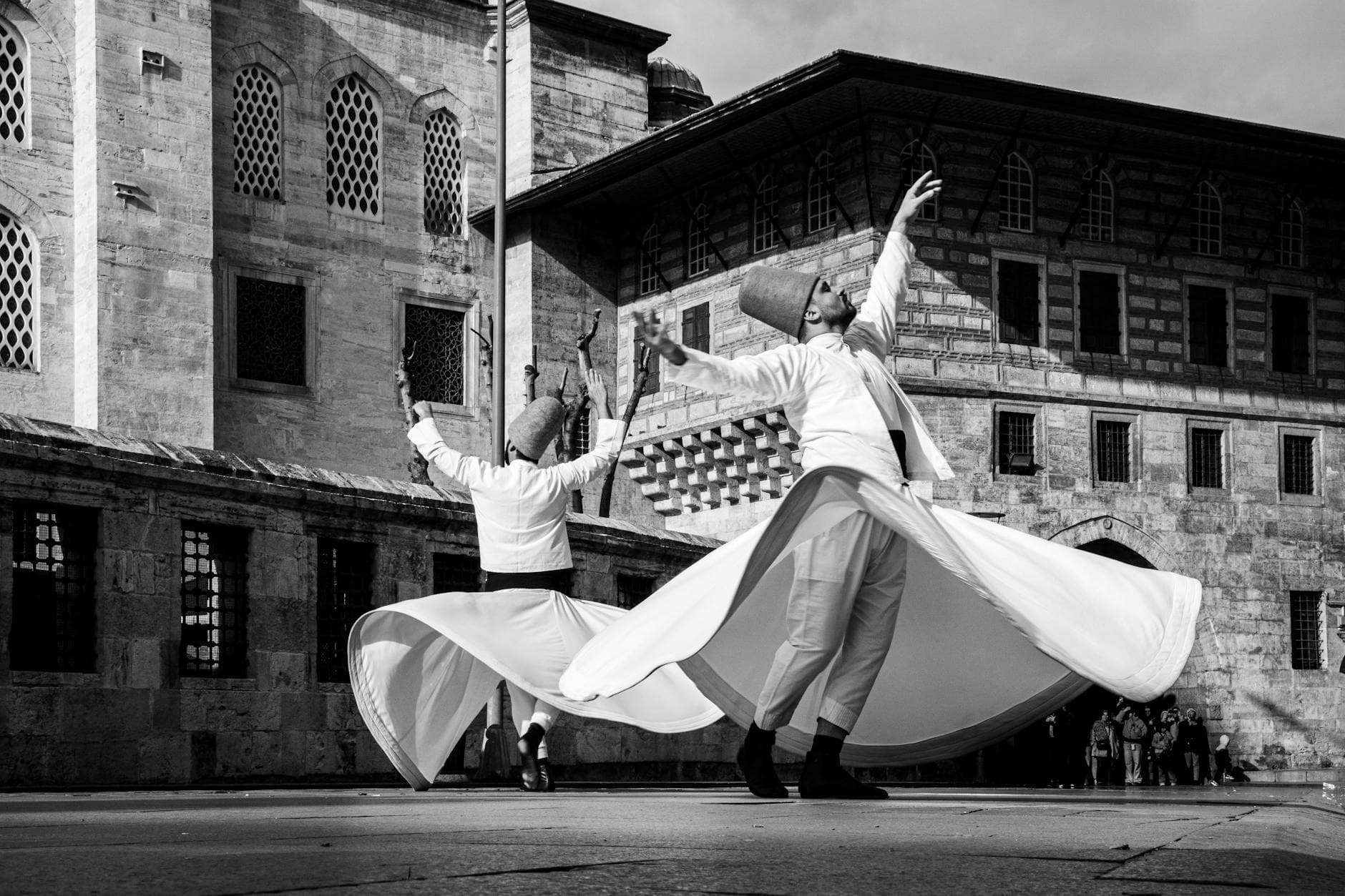
Black and white photo of whirling dervishes spinning at a historic mosque in Istanbul, Türkiye.
Abrahamic

Sufism

13 / 13

Sub-questions covered

85

Claims extracted

12

Distinct positions

33

Explicitly denied

Chapter 1

Where Did We Come From?

Q1.1 · Pre-Existence

Created Pre-Existence
See all traditions holding this position →
100%

weight

Emanation· 2 claims
145 We see, thus, that all things revert to their source. Parts ever must go shares in whole’s intercou
lines 145-146

How this tradition expresses it

The text suggests that all things, including the soul and its attributes, originate from a divine source and return to it, implying a cyclical nature of existence.

Why this supports “Emanation

The assertion that 'all things revert to their source' and that 'parts ever must go shares in whole's intercourse' articulates an emanationist cosmology where individual souls are ontological participations in the divine whole. This reflects the wahdat al-wujud tradition's understanding of pre-existence as intrinsic connection to the divine source rather than discrete temporal creation.

The auditor flagged this claim as ambiguous or weakly matching. See the scholarly note below for context.

Scholarly note

LLM council synthesis (round 2)

Direct Implicationhigh confidenceAudit: Contested· 95%
Data provenance
Auditor
llm_council_v2
Audit confidence
95%
Audited
4/11/2026

+1 more claim for this position

Created Pre-Existence· 1 claim
. Who’s from his home snatched far away, Longs to return some future day.
The Reed-Flute, lines 4-5

How this tradition expresses it

The soul experiences a sense of separation from its original home, longing to return to a prior state of union.

Why this supports “Created Pre-Existence

The image of the soul 'snatched far away' from its original home and longing to return directly evokes the Day of Alast covenant, affirming that the soul existed in a prior state before embodiment. The language of displacement from a 'home' implies a created soul placed in a primordial setting, consistent with the mainstream Sufi reading of Quran 7:172. This quote clearly addresses pre-existence and cannot be labeled Not Addressed.

The auditor flagged this claim as ambiguous or weakly matching. See the scholarly note below for context.

Scholarly note

LLM council synthesis (round 2)

Direct Implicationhigh confidenceAudit: Contested· 95%
Data provenance
Auditor
llm_council_v2
Audit confidence
95%
Audited
4/11/2026

What this tradition denies

The concept of a permanent, unchanging identity that remains tied to the physical form after death.

Q1.2 · Soul Nature

Universal Consciousness
See all traditions holding this position →
80%

weight

Universal Consciousness· 7 claims
The first of them is not He; the second of them is not other than He. Those, apparently, two things are in truth one and the same.
Section 21

How this tradition expresses it

The text suggests that God is the ultimate reality encompassing all existence, where the distinction between the creator and the created is a matter of perspective rather than ontological separation.

Why this supports “Universal Consciousness

The statement that 'two things are in truth one and the same' is a direct expression of wahdat al-wujud non-dualism: apparent duality between self and God is illusory, and our essential nature is identical with the one divine reality.

Nuance

The text notes that while the universe of qualities and the universe of essence are distinct in time/perception, they are essentially one.

The auditor flagged this claim as ambiguous or weakly matching. See the scholarly note below for context.

Scholarly note

LLM council synthesis (round 2)

Explicit Teachinghigh confidenceAudit: Contested· 95%
Data provenance
Auditor
llm_council_v2
Audit confidence
95%
Audited
4/11/2026

+6 more claims for this position

Not Addressed· 1 claim
These are the Occult Existences. They come to present themselves before you, to offer unto you gifts and presents from the invisible world.
Chapter III, Section 1

How this tradition expresses it

The text suggests that certain individuals possess an inherent, exalted spiritual nature or 'occult existence' that is recognized through divine intuition and lineage.

Why this supports “Not Addressed

This quote describes 'Occult Existences' offering gifts from the invisible world, which pertains to cosmological intermediaries or spiritual beings rather than directly addressing the essential nature of the human soul. The original Divine Spark label was an over-interpretation; the passage does not clearly establish that human souls are sparks or emanations of the divine.

The auditor flagged this claim as ambiguous or weakly matching. See the scholarly note below for context.

Scholarly note

LLM council synthesis (round 2)

Explicit Teachinghigh confidenceAudit: Contested· 95%
Data provenance
Auditor
llm_council_v2
Audit confidence
95%
Audited
4/11/2026

What this tradition denies

The idea that God is a 'living soul' in the same sense as a created being.

The idea that the physical body/flesh is the complete or ultimate reality of a person.

The existence of multiplicity or dualism in reality.

A permanent, unchanging individual identity independent of God.

The idea that the physical body is the true or permanent self.

The idea of a permanent, independent individual self.

The idea that the body and soul are of equal or unified importance in the spiritual journey.

The idea that the soul and flesh are a unified, harmonious entity.

The idea that material existence is the primary reality rather than an outward expression of the spirit.

Q1.3 · Why Embodied

Spiritual Growth
See all traditions holding this position →
100%

weight

Spiritual Growth· 2 claims
For idle spirits come into the world of material forms to contemplate the marvels of the horizons, and the wonders of men’s minds,--to acquire knowledge, and attain to certainty.
sufism_528, first paragraph

How this tradition expresses it

Human existence involves the pursuit of knowledge and the attainment of certainty through contemplation of the world.

Why this supports “Spiritual Growth

This passage explicitly states that spirits enter the material world 'to contemplate the marvels' and 'to acquire knowledge, and attain to certainty,' directly framing incarnation as an opportunity for epistemic and spiritual development—the core Sufi teaching of descent for the sake of ma'rifah.

The auditor flagged this claim as ambiguous or weakly matching. See the scholarly note below for context.

Scholarly note

LLM council synthesis (round 2)

Explicit Teachinghigh confidenceAudit: Contested· 95%
Data provenance
Auditor
llm_council_v2
Audit confidence
95%
Audited
4/11/2026
ks. This rising and descending alternates for aye. The Lord forbid that I should fail therein one da
lines 154-155

How this tradition expresses it

Life is characterized by a cycle of rising and descending, where the physical existence serves as a means or a vessel for spiritual development and expression of gratitude.

Why this supports “Spiritual Growth

The perpetual alternation of 'rising and descending' maps onto the Sufi understanding of oscillation between contraction (qabd) and expansion (bast), or between separation and union. The speaker's prayer never to cease this movement frames the cycle itself as the vehicle of ongoing spiritual refinement, supporting Spiritual Growth as the purpose of embodied engagement.

Nuance

The text suggests this rising and descending is an alternating process.

The auditor flagged this claim as ambiguous or weakly matching. See the scholarly note below for context.

Scholarly note

LLM council synthesis (round 2)

Explicit Teachinghigh confidenceAudit: Contested· 95%
Data provenance
Auditor
llm_council_v2
Audit confidence
95%
Audited
4/11/2026

What this tradition denies

The idea that human actions are purely the result of external compulsion or fate without personal responsibility.

Chapter 2

Why Are We Here?

Q2.1 · Purpose of Life

Spiritual Development
See all traditions holding this position →
100%

weight

Spiritual Development· 6 claims
Unless you will consent to cast out from your hearts the ‘_hiatus_’ of indecision and of self-love, you can never hope to escape from the noisome pit of self-worship
Section 19

How this tradition expresses it

Human purpose involves moving away from self-worship and worldly lusts toward a state of love for God and spiritual elderhood.

Why this supports “Spiritual Development

The injunction to cast out self-love and self-worship describes the purification of the ego-self (nafs), a core component of Sufi spiritual development (tazkiyat al-nafs) and a prerequisite for advancing toward divine proximity.

Nuance

The text warns that failing to cultivate a 'doxology' (spiritual purpose) renders one's existence hollow.

The auditor flagged this claim as ambiguous or weakly matching. See the scholarly note below for context.

Scholarly note

LLM council synthesis (round 2)

Explicit Teachinghigh confidenceAudit: Contested· 95%
Data provenance
Auditor
llm_council_v2
Audit confidence
95%
Audited
4/11/2026

+5 more claims for this position

Knowledge· 1 claim
my desire is that thou shouldest also acquire that knowledge,--the knowledge possessed by the prophets and the saints, which is entitled _The Science of Divine Intuition_
Section 3

How this tradition expresses it

The purpose of life involves the acquisition of 'The Science of Divine Intuition' and the fulfillment of spiritual duties to serve the Lord.

Why this supports “Knowledge

The quote explicitly identifies 'the Science of Divine Intuition' as the supreme acquisition, reflecting the Sufi emphasis on maʿrifa (gnosis). While this legitimately supports KNOWLEDGE as an alternative position, in orthodox Sufi context such gnosis is understood as the fruit of spiritual development rather than an independent purpose—hence it functions as a genuine alternative within the overarching developmental framework.

Nuance

The text emphasizes that this knowledge is a specific type of science spoken of by God.

The auditor flagged this claim as ambiguous or weakly matching. See the scholarly note below for context.

Scholarly note

LLM council synthesis (round 2)

Explicit Teachinghigh confidenceAudit: Contested· 95%
Data provenance
Auditor
llm_council_v2
Audit confidence
95%
Audited
4/11/2026

What this tradition denies

The idea that human station is merely physical or worldly.

The pursuit of purely material or worldly interests as a valid end for human life.

The validity of self-worship and ego-driven existence.

The idea that outward piety or religious ritual alone constitutes true righteousness.

The idea that outward beauty or physical charms constitute true love or lasting value.

The notion that earthly life is the only reality or that it is purely material.

The idea that earthly life has a purpose derived from material success or lust.

The sufficiency of outward/external conquest or worldly success.

The idea that outward prosperity or social status equates to spiritual success.

That outward religious rituals (fasting, prayer) are the end goal of existence.

Q2.2 · Body Relationship

Prisoner
See all traditions holding this position →
73%

weight

Prisoner· 6 claims
While in the body, I have two attachments; one, to you; the other, to the flesh.
Section 86

How this tradition expresses it

The body is viewed as a temporary vessel or 'attachment' that the spirit inhabits, which will eventually be shed to allow for union with the Divine.

Why this supports “Prisoner

The soul's 'two attachments'—to the divine and to 'the flesh'—frame the body as a competing constraint that impedes the soul's singular devotion to God, consistent with the PRISONER framework where embodiment is an obstacle to spiritual union.

Nuance

The text distinguishes between the 'attachment to the flesh' and the 'attachment to you' (the beloved/divine).

The auditor flagged this claim as ambiguous or weakly matching. See the scholarly note below for context.

Scholarly note

LLM council synthesis (round 2)

Explicit Teachinghigh confidenceAudit: Contested· 95%
Data provenance
Auditor
llm_council_v2
Audit confidence
95%
Audited
4/11/2026

+5 more claims for this position

Integrated Unity· 1 claim
He comprises all, and in Him all things have their being. He is, then, the receptacle also, comprising all existences
Section 21

How this tradition expresses it

The relationship between the divine and the manifest is one of total inclusion, where God is both the interior and the exterior.

Why this supports “Integrated Unity

Reflects the Wahdat al-wujud doctrine in which God 'comprises all' and is 'the receptacle comprising all existences,' dissolving the soul-body duality into a unified divine reality. This represents the Integrated Unity alternative within Sufi metaphysics.

Nuance

The text clarifies that God is the receptacle of all existences.

The auditor flagged this claim as ambiguous or weakly matching. See the scholarly note below for context.

Scholarly note

LLM council synthesis (round 2)

Explicit Teachinghigh confidenceAudit: Contested· 95%
Data provenance
Auditor
llm_council_v2
Audit confidence
95%
Audited
4/11/2026

What this tradition denies

The idea that the body and soul are an integrated, seamless unity in the material world.

The idea that the body and soul are a single, unified entity.

Q2.3 · Moral Accountability

Divine Judgment
See all traditions holding this position →
15%

weight

Divine Judgment· 5 claims
This I communicate to thee, that thou mayest set thy affairs in order, and repent thee of thy sins.
Section 4

How this tradition expresses it

Accountability is framed through the lens of divine decree and the necessity of repentance before death.

Why this supports “Divine Judgment

The exhortation to 'set thy affairs in order' and 'repent thee of thy sins' presupposes a personal God who judges sins—a classic expression of divine judgment and accountability in Sufi-Islamic literature.

Nuance

The text notes that while events are in God's hands, repentance is still necessary for the soul's state.

The auditor flagged this claim as ambiguous or weakly matching. See the scholarly note below for context.

Scholarly note

LLM council synthesis (round 2)

Explicit Teachinghigh confidenceAudit: Contested· 95%
Data provenance
Auditor
llm_council_v2
Audit confidence
95%
Audited
4/11/2026

+4 more claims for this position

Natural Law· 4 claims
se: “The cause and reason of thy bygone losses and misfortunes was, that, on a certain day thou wast in the west of Firengistān (Europe), where thou wentest into a c
Section 17

How this tradition expresses it

Misfortunes and losses in life are presented as the result of specific past actions or spiritual offenses that require atonement or forgiveness.

Why this supports “Natural Law

While the passage links a prior wrongful act directly to later misfortune, suggesting moral cause-and-effect, the Sufi-Islamic framework does not teach impersonal karma or transmigration. The best fit among canonical codes is Natural Law, reflecting consequences embedded in the moral structure of creation under God's providential decree, rather than Karmic Law which implies reincarnation alien to Islamic thought.

Nuance

The text implies that divine intervention or specific corrective actions can avert these trials.

The auditor flagged this claim as ambiguous or weakly matching. See the scholarly note below for context.

Scholarly note

LLM council synthesis (round 2)

Explicit Teachinghigh confidenceAudit: Contested· 95%
Data provenance
Auditor
llm_council_v2
Audit confidence
95%
Audited
4/11/2026

+3 more claims for this position

What this tradition denies

The validity of mere outward religious labels or hypocritical worship.

The concept of divine compulsion (predestination) as an excuse for human behavior.

The notion that wealth or outward abundance provides a shield against moral failure or spiritual emptiness.

The idea that one can be perfect or exempt from accountability through mere outward righteousness.

Chapter 3

Where Do We Go After Death?

Q3.1 · Surviving Death

Full Survival
See all traditions holding this position →
80%

weight

Transformation· 3 claims
When, by the grace of the unique Spirit, I become disembodied,--when the world of unbodied spirits, unity, and singleness, shall appear,
Section 86

How this tradition expresses it

Consciousness survives death through a transition from the physical to the spiritual realm, where the soul becomes 'disembodied'.

Why this supports “Transformation

The passage describes becoming 'disembodied' while entering a 'world of unbodied spirits, unity, and singleness'—consciousness persists but is radically transformed. The continued reference to 'spirits' (plural) and a 'world' suggests transformed existence rather than complete reabsorption into undifferentiated oneness, though the language of 'unity and singleness' gestures toward divine proximity.

Nuance

The transition involves moving from the 'attachment to the flesh' to a state of 'unity and singleness'.

The auditor flagged this claim as ambiguous or weakly matching. See the scholarly note below for context.

Scholarly note

LLM council synthesis

Explicit Teachinghigh confidenceAudit: Contested· 95%
Data provenance
Auditor
llm_council_v1
Audit confidence
95%
Audited
4/11/2026
In the other world there is union without disrupture, and junction without a parting.
sufism_528, first paragraph

How this tradition expresses it

Death is viewed as a transition from a state of separation to a state of union with the Divine or the beloved.

Why this supports “Transformation

The description of the afterlife as 'union without disrupture, and junction without a parting' describes permanent transformed union with the Divine. Crucially, 'union' and 'junction' are relational terms presupposing two parties—the soul and God—in intimate closeness, suggesting transformed consciousness in perpetual divine communion rather than complete ontological dissolution.

Nuance

The text distinguishes between the outward appearance of absence and the inward reality of presence.

The auditor flagged this claim as ambiguous or weakly matching. See the scholarly note below for context.

Scholarly note

LLM council synthesis

Explicit Teachinghigh confidenceAudit: Contested· 95%
Data provenance
Auditor
llm_council_v1
Audit confidence
95%
Audited
4/11/2026

+1 more claim for this position

What this tradition denies

The idea that death is the end of consciousness or existence.

Permanent separation after death.

The idea that the soul decays or ceases to exist upon the death of the body.

Q3.2 · Death Moment

Soul Departure
See all traditions holding this position →
100%

weight

Believers die not; they merely depart from one habitation to another abode!
Section 90

How this tradition expresses it

Death is characterized as a departure from one habitation to another, rather than an end of existence.

Why this supports “Soul Departure

The Sufi formulation reframes death as a change of dwelling rather than annihilation. The spirit departs the worldly habitation (body) for the spiritual abode. This is Soul Departure expressed as inter-habitation transit.

Nuance

The text presents death as a transitionary event for the believer.

Scholarly note

'Believers die not; they merely depart from one habitation to another' - a Sufi saying that uses 'depart' explicitly and frames death as relocation rather than ending. Direct Soul Departure.

Explicit Teachinghigh confidenceAudit: Strong· 92%
Data provenance
Auditor
claude-opus-4-6-1m
Audit confidence
92%
Audited
4/10/2026

Q3.4 · Long-Term Destiny

Resurrection
See all traditions holding this position →
100%

weight

At the first, all living will die; at the second, all the dead will rise to be judged.
Note 245

How this tradition expresses it

The text describes a process where the dead are raised to face judgment.

Why this supports “Resurrection

Sufi statement of universal resurrection-judgment - fits Islamic resurrection doctrine in mystical formulation.

Scholarly note

All dead will rise to be judged

Explicit Teachinghigh confidenceAudit: Strong· 88%
Data provenance
Auditor
claude-opus-4-6-1m
Audit confidence
88%
Audited
4/10/2026

What this tradition denies

The text rejects the notion that the soul is an independent, permanent entity separate from the divine source.

Q3.5 · Ultimate Destination

Ultimate Transcendence
See all traditions holding this position →
10%

weight

Ultimate Transcendence· 4 claims
In Thee alone my heart finds peace; it fire with love divine; Take it unto Thyself; to it both worlds are naught.
Section 6

How this tradition expresses it

The ultimate desire of the soul is to be taken unto God, finding peace only in the divine presence.

Why this supports “Ultimate Transcendence

Sufi mystical union.

Nuance

The text describes this as a release from the distractions of both worlds.

Scholarly note

Heart finds peace in Thee

Explicit Teachinghigh confidenceAudit: Strong· 88%
Data provenance
Auditor
claude-opus-4-6-1m
Audit confidence
88%
Audited
4/10/2026

+3 more claims for this position

Eternal Paradise· 3 claims
g God; while, in the world to come, they have left to us the everlasting abodes of paradise, the large-eyed damsels, and the pavilions, as well as the sight of God, of which they will enjoy no s
Section 33

How this tradition expresses it

The ultimate destination involves the sight of God and the attainment of paradise, which is denied to those who remain in misbelief.

Why this supports “Eternal Paradise

Islamic paradise imagery invoked in Sufi poetry, representing one strand of Sufi afterlife teaching that emphasizes reward rather than philosophical union.

The auditor flagged this claim as ambiguous or weakly matching. See the scholarly note below for context.

Scholarly note

Quote explicitly describes paradise, damsels, pavilions, and sight of God as rewards—this is paradise imagery, not mystical union/transcendence

Explicit Teachinghigh confidenceAudit: Contested· 80%
Data provenance
Auditor
comprehensive_cell_audit_v1
Audit confidence
80%
Audited
4/11/2026

+2 more claims for this position

What this tradition denies

The attainment of paradise and the sight of God for those in misbelief.

The idea that the Creator is a 'thing' that perishes with created things.

Hero image: Photo by Esra Erdoğdu on Pexels

NoeticMap Guide

Research Dashboard

How can I help?

Ask about NDEs, research, or this page

Responses may not always be accurate